In 2021, the State of California initiated the California County Resentencing Pilot Program, which allowed prosecutors to ask judges to release defendants before they had completed their sentences. It was an effort to incorporate prosecutorial discretion into resentencing decisions for individuals serving lengthy prison terms. Funded with an $18 million appropriation from the state budget, the program operated in nine counties, including Los Angeles, San Francisco, Riverside, and Santa Clara.
The program’s stated purpose was to create a mechanism through which district attorneys, in collaboration with public defenders and community-based organizations, could proactively review sentences and recommend early release where appropriate. It reflected a growing belief among reform advocates that achieving a more equitable criminal justice system requires revisiting past sentencing decisions, particularly for individuals who had demonstrated rehabilitation, had aged significantly while incarcerated, or whose “sentences might no longer align with current standards of justice.”
In other words, California tried an early release program in 2021, at the height of the movement to reform the system, and spend a big chunk of money on it.
The implementation of the program, however, proved costly. An independent evaluation conducted by the RAND Corporation revealed that the six counties most actively participating spent nearly $28 million over the three-year pilot period, more than twice the $12.5 million they were originally allocated. The majority of these expenditures were devoted to staffing, including prosecutors, public defenders, investigators, and non-profit personnel, all of whom were necessary to carry out the labor-intensive process of case review, petition preparation, and court advocacy.
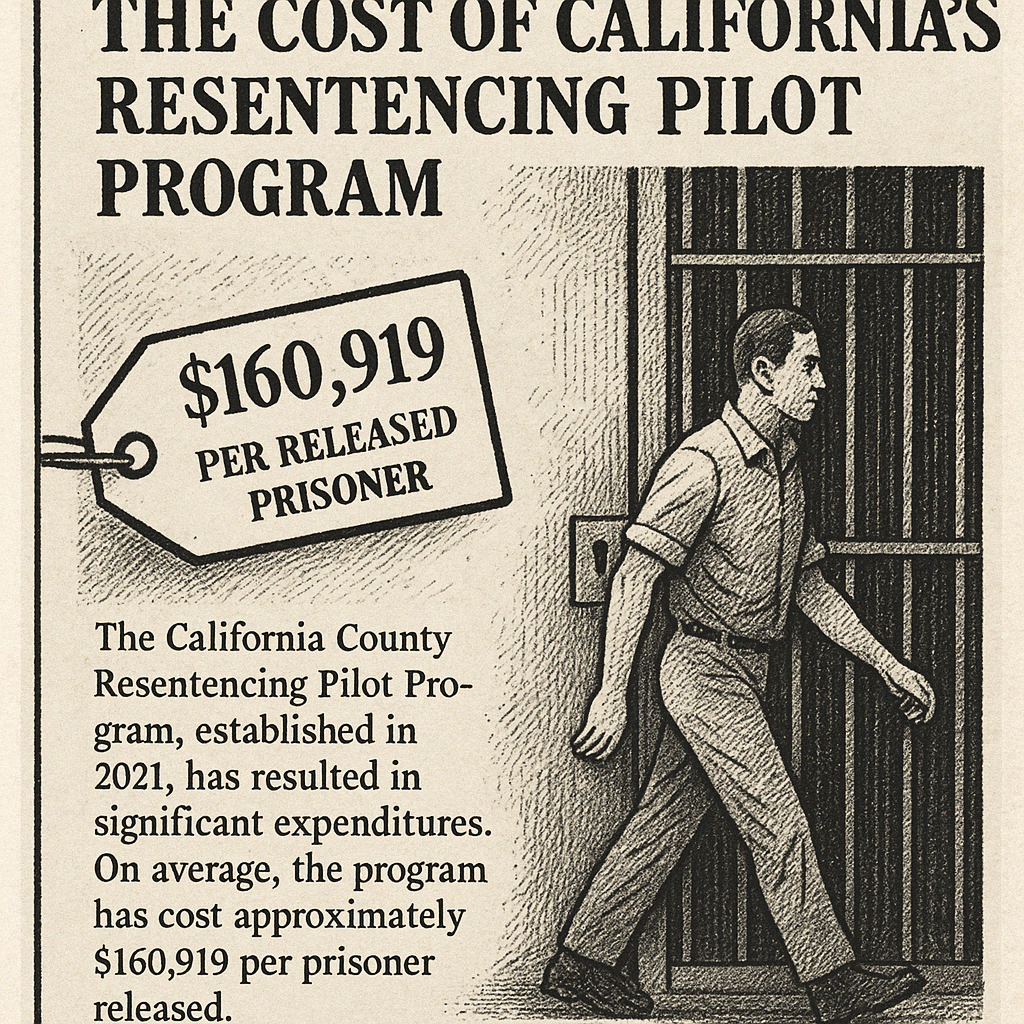
The program had a tiny impact on the 100,000 or so felons in state prison. Across the counties, 1,146 cases were reviewed, resulting in 227 resentencings and ultimately 174 individuals being released from custody: about 1/10 of one percent of state prisoners. This number is miniscule despite the stated purpose of the law: to reduce prison overcrowding. By comparison, the Board of Parole Hearings released about 3,600 individuals during the same time period. The 174 CCRPP releases equate to a public expenditure of approximately $160,919 per released individual. And these statistics do not account for the multiple other ways that prisoners may obtain early release. These include five different types of credit award programs from CDCR. Nor do they include the parole board, which has a budget of about $75m and employs over 300 people. And there is no mention of why the governor’s clemency office could not have done this work without any new program at all.
The huge cost and tiny impact of this program invites reflection on the broader question of whether it was money well-spent. Public spending in this arena necessarily involves trade-offs. Funds allocated to resentencing programs are funds not available for crime prevention, victim services, rehabilitation programs, or other public priorities. Advocates for the program may argue that the cost is justified by the moral imperative to correct overly punitive sentences and to recognize rehabilitation. Critics, however, may question whether a cost of $160,919 per release reflects an efficient use of scarce public resources.
As California continues to pursue sentencing reform, the experience of the County Resentencing Pilot Program suggests the importance of carefully evaluating not only the goals but also the implementation costs of such initiatives. California’s trial courts are facing a $97m deficit. Whether this program represented a sound investment in justice or an inefficient allocation of funds remains a question worthy of serious discussion.
 DA in CA