
On June6, federal Immigration and Customs Enforcement agents raided multiple locations across Los Angeles. They obtained judicial approval for the raids by obtaining search warrants. They detained 44-45 people who had immigrated to the United States illegally. ICE agents raided the Fashion District, Home Depot parking lots, a doughnut shop, and other sites. At the Home Depot in Westlake, protesters gathered and blocked exits. The protesters even threw concrete blocks. Authorities declared an unlawful assembly and used less-lethal munitions to clear the area.
There has been follow-on enforcement after June 6. DHS has signaled that ICE operations will continue for at least 30 days. These raids are part of an effort by federal immigration authorities to ramp up arrests of illegal migrants.
On June 7-8, President Trump activated the California National Guard under federal control and ordered troops to Los Angeles. Defense secretary Pete Hegseth has warned that active-duty Marines may be mobilized if unrest continues.
Reaction from Local Government
Los Angeles mayor Karen Bass issued a statement on June 6:
Bass said that neither she nor LAPD had been informed ahead of time of the ICE actions. On June 7, she said,
[M]any in our community are feeling fear following recent federal immigration enforcement actions across Los Angeles County. Reports of unrest outside the city, including in Paramount, are deeply concerning. […] Everyone has the right to peacefully protest, but let me be clear: violence and destruction are unacceptable, and those responsible will be held accountable.
She told a local news station that she was “outraged” that ICE “sows a sense of terror throughout the community… ICE was literally chasing people down the street.” She continued, “it’s just unacceptable.” She told the reporter that this was one of her “worst nightmares.” She said, “we will not stand for this.”
Gavin Newsom described the coordinated federal sweeps across California—labeled “chaotic” and driven by an “arbitrary arrest quota”—as both “reckless” and “cruel,” warning they were undermining public trust, tearing families apart, and hurting the state’s economy. He also sent a fundraising email accusing the federal government of wanting a spectacle and violence. He said the president was “deranged.”
11 Los Angeles City Councilmembers released a joint statement saying “we will not abide by fear tactics to support extreme political agendas…” County supervisors called the raids “chilling” and “acts of cruelty and bigotry.” California senator Alex Padilla said: “The Ice raids across Los Angeles today are a continuation of a disturbing pattern of extreme and cruel immigration enforcement operations across the country.
Protests and Riots
Angelenos responded to the raids with protests and riots. The initial raids—carried out at sites including a Home Depot, a garment warehouse in the Fashion District, and other locations—prompted spontaneous demonstrations in which protesters blocked agents, hurled concrete chunks, rocks, and Molotov cocktails, and set vehicles aflame. Federal agents responded with tear gas, flash‑bang grenades, pepper spray, rubber bullets, and less‑lethal munitions, with local law enforcement later declaring multiple unlawful assemblies, and arresting dozens of individuals.
A masked individual on a dirt bike circled a burning car while waving the Mexican flag.
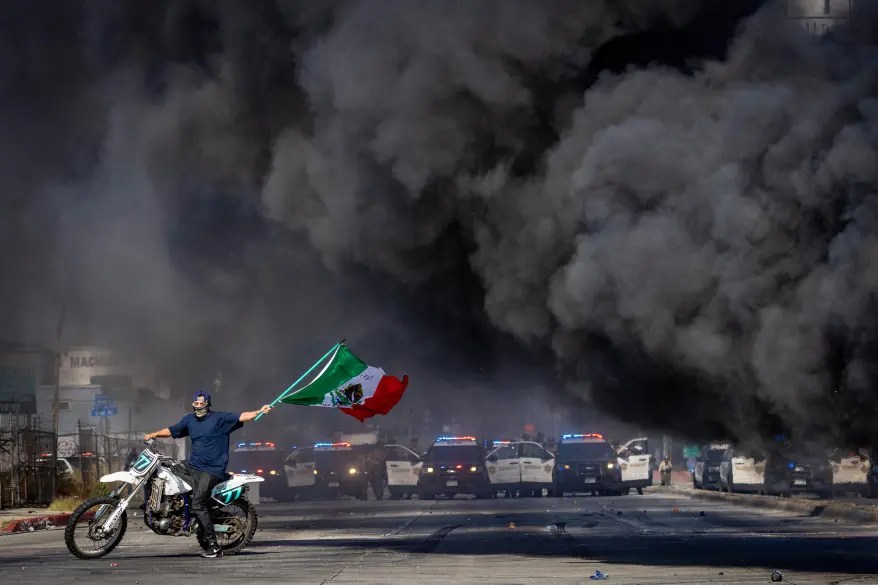
In Paramount, protesters erected barricades from shopping carts and bins, set fire to a vehicle, and threw Molotov cocktails at law enforcement. Protesters also threw rocks at ICE agents and vehicles. Crowds reportedly hurled concrete chunks, bricks, rocks, and bottles at ICE agents and police, and in one high-tension clash a rock shattered an ICE vehicle windshield, injuring an agent.
In downtown Los Angeles, rioters defaced a federal courthouse with graffiti and obstructed traffic by blocking entrances to a detention facility, prompting law enforcement to declare an unlawful assembly and make numerous arrests. Finally, aerial footage and NBC News confirm that at least two individuals were arrested for throwing a Molotov cocktail and assaulting deputies, causing injuries to three officers.
Authorities described up to 1,000 individuals as “rioters” involved in violent activity such as vandalism, assaults on ICE personnel, and property destruction.
The Orwellian Response by Local Media
Clearly, people are rioting in Los Angeles. But just in case, someone wants to quibble, a riot is “a violent disturbance of the peace by a crowd.” When used as a verb, it means to “take part in a violent public disturbance.” Legal definition agree with common usage. California Penal Code 404, defines rioting as “any use of force or violence, disturbing the public peace, or any threat to use force or violence, if accompanied by immediate power of execution, by two or more persons acting together, and without authority of law.” Applying these definitions to the facts is easy to do. It would be inaccurate to say that the protests in Los Angeles are nonviolent.
Unfortunately, describing reality with such a politically loaded word is itself a politically difficult for the press, particularly the liberal local press in Los Angeles. Various media outlets have employed euphemistic terminology to describe the events in Los Angeles following the ICE raids, often softening or reframing the severity of the unrest.
The Los Angeles Times, for example, primarily refers to the events as “clashes” and “[p]rotests against ICE raids” and notes that “National Guard troops arrived in L.A. on Sunday morning … after confrontations between protesters and immigration agents” NPR chose to describe recent events as “clashes with police.” Reuters ran the headline “Riot police, anti-ICE protesters square off in Los Angeles after raids.” The first photograph shows police detaining a “protester,” instead of one of the many photographs of rioting. The Los Angeles Daily News said that the National Guard arrived not to stop the riots but to “quell immigration protests.” There were there “on orders from President Donald Trump to stamp out protests.” Wikipeda’s article on the subject is called, “June 2025 Los Angeles Protests.”
The local CBS station’s headline is “National Guard troops arrive in Los Angeles as immigration enforcement tension escalate.” It’s hard to imagine how throwing a burning bottle of gasoline at law enforcement is just “tensions” and not “rioting.” The ABC affiliate describes “protests” and “clashes” but does not use the word “riots.” The NBC affiliate did not use the word “riot” either, but printed a quote where an HSI official uses the word, which appears to be the most courageous press description of actual reality in this entire list.
Perhaps the most egregious example is LAist, a local NPR station, whose headline is “ICE raids grow tense nationwide as protesters confront immigration agents.” After a request for donations, the article continues this deceptive tone. ICE has “contended with angry crowds protesting their actions.” “This most recent spate of encounters has become heated.” The first quote is from a politician blaming ICE agents. “It got out of control because of the way they showed up.” The article continues by blaming ICE agents for wearing masks and then quotes civil rights organization who defend doxing the agents. The article ends with a mention of George Floyd. The article makes no mention of any violent acts by protesters, injuries suffered by law enforcement, the fact that the raids were completely legal and done pursuant to democratically adopted laws, and does not use the word “riot” at all.
There are several plausible reasons why local media outlets might avoid using the word “riot,” even when it clearly applies to recent events in Los Angeles.
First, sympathy for the protesters or their cause likely plays a significant role. Many local journalists and media organizations operate in urban environments where there is broad political and cultural support for immigrant communities and sanctuary policies. Labeling actions as a “protest” rather than a “riot” implicitly preserves the moral legitimacy of the protesters and underscores their grievances rather than their tactics.
Second, this coverage reveals an underlying antipathy toward immigration enforcement itself. Characterizing these events as “protests” or “confrontations” allows media outlets to keep the focus on the federal government’s actions—which are seen by many in Los Angeles as heavy-handed or unjust—rather than on the disorderly response to those actions. In this framework, softer language shifts the blame narrative toward enforcement agencies and away from the demonstrators.
Third, in Los Angeles, the term “riot” evokes powerful historical memories, particularly of the 1992 unrest following the Rodney King verdict. Media outlets may be cautious about using the word because of its racial and political connotations, preferring less incendiary descriptions unless violence becomes extreme and sustained.
Why This Matters
In moments of crisis, the first duty of a journalist is to tell the truth. When violence erupts in our streets, calling it anything less than what it is—a riot—is not only a failure of candor but a disservice to the community that journalism is meant to serve.
Recent events in Los Angeles have made this clear. In the aftermath of federal immigration raids, we have witnessed acts of violence: vehicles set ablaze, projectiles hurled at law enforcement, Molotov cocktails thrown, businesses vandalized, and public order disrupted. These are not mere “protests” or “confrontations”; they meet the longstanding, well-understood definition of rioting. To describe them otherwise—whether from misplaced sympathy for a cause or from fear of political backlash—is to willfully obscure reality.
This failure is not harmless. By minimizing or playing down violent acts, journalists blur the line between lawful protest—a vital expression of democracy—and criminal conduct that endangers lives and property. In doing so, they erode public trust not just in the press but in civic institutions that depend on accurate information to function. Law-abiding citizens who depend on the media for an honest accounting are left misinformed. Public officials who must make decisions based on facts are given a distorted picture of the situation. Worst of all, victims of violence are effectively erased from the narrative, their injuries and losses rendered invisible under euphemism and understatement.
Moreover, obscuring the nature of the unrest fuels polarization. Those who see the reality of the violence firsthand—and who find the press unwilling to acknowledge it—conclude, not unreasonably, that the media are partisan actors rather than neutral conveyors of truth. They grow cynical and distrustful, believing that journalists are more concerned with protecting political narratives than with reporting facts.
There is no shame in acknowledging that a cause one may sympathize with has been marred by violence. In fact, doing so strengthens the moral authority of peaceful protesters who abide by the law and seek change through legitimate means. Honest reporting distinguishes between the peaceful and the violent, protecting the former from being tarred with the sins of the latter.
Words matter. Precision matters. Honesty matters most of all. In times of social tension, a community does not need comforting half-truths or selective reporting; it needs a clear-eyed account of what is happening. Journalists who shirk this responsibility not only betray their vocation but endanger the very public they are sworn to inform.
Notes
The best headline on this subject goes to the Times of India for A Song of ICE and Fire: How Donald Trump’s immigration raids sparked the LA riots.
Man on motorcycle photo credit: NY Post.
 DA in CA