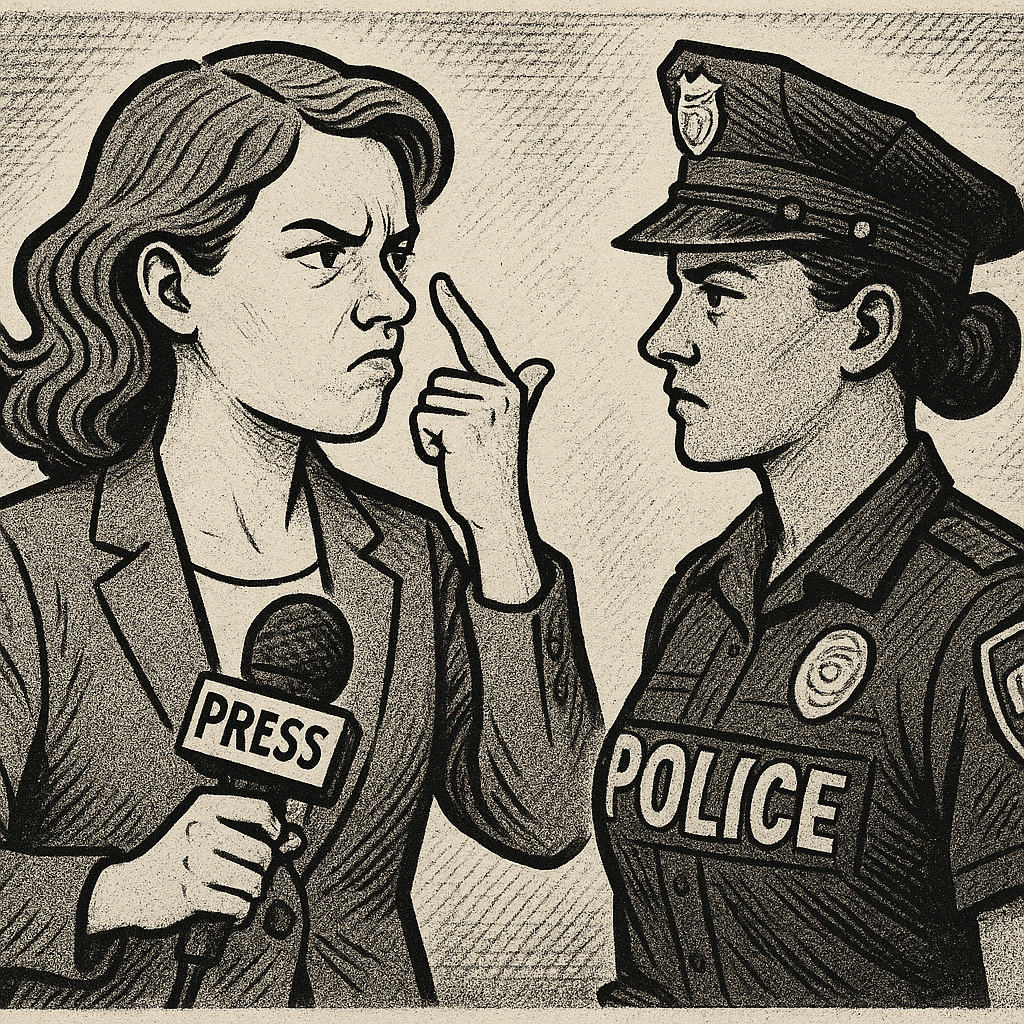
The sight of a journalist struck by a rubber bullet is disturbing, and it should give us pause, but in the case of Australian reporter Lauren Tomasi, who was hit while covering a protest in Los Angeles, it is important to separate the emotional impact of the footage from the legal and practical reality of what occurred. Tomasi’s injury, while unfortunate, was not the result of an outrageous act by law enforcement. It was the predictable outcome of a decision to remain in front of a police line after a lawful dispersal order had been issued.
When police declare an assembly unlawful under California Penal Code sections 407 and 409, they are empowered to order all persons present to disperse. There is no statutory exemption for members of the press. The law makes no distinction between a protester with a sign and a journalist with a microphone. Both are required to comply. If they refuse, they may be subject to removal, citation, or use of force consistent with department policy and constitutional standards.
Some argue that journalists should be allowed to remain in order to observe and report. And to be clear, courts have recognized the public value of newsgathering, even in moments of civil unrest. The Ninth Circuit, in the Index Newspapers case, held that law enforcement must not target journalists for removal simply because of their status as members of the press. However, this ruling did not give reporters the right to ignore police commands indefinitely. It emphasized that any accommodation must be reasonable and subject to the overriding concerns of safety and operational necessity.
Reasonableness is the key. Reporters do not possess a special legal status that entitles them to disregard lawful police orders. Their presence at the front lines of an escalating protest may complicate law enforcement efforts, draw the attention of agitators, and place themselves and others at greater risk. Once police have issued a dispersal order, the prudent (and the only lawful) course is to comply. The time to challenge the order is in court, not by remaining in a position that law enforcement has designated as dangerous or illegal.
The fact that Ms. Tomasi was struck with a non-lethal round in a non-vital area during a crowd dispersal operation is not evidence of malice or misconduct. It is, rather, an unfortunate but foreseeable consequence of ignoring a lawful directive in a tense and chaotic environment. Law enforcement officers are trained to distinguish between press and protesters when possible, but they are not required to hold fire on individuals who voluntarily remain in harm’s way after repeated warnings.
This is not an argument against press freedom. It is an argument for press responsibility. Journalists have a vital role in holding government accountable. That role is not diminished when they follow the same laws as everyone else. The First Amendment guarantees freedom of the press, not immunity from lawful orders. It is possible to report the news without obstructing police operations or creating additional safety risks.
The presence of reporters at a protest should never be used as a shield to defy law enforcement. Journalists are not above the law. Their work is essential, but their judgment must be sound. Remaining after a dispersal order has been given is a choice. When that choice results in injury, we should look not only at the actions of the police, but also at the decisions that preceded the incident.
Press freedom and public safety are not mutually exclusive. Both can be upheld—when all participants, including the press, recognize that their rights come with responsibilities.
Notes
On June 10th, police declared another unlawful assembly and gave the crowd orders to disperse. This time they explicitly warned the press to stay out.
Journalists sued the LAPD on June 16th, alleging that the police used excessive force. Ms. Tomasi’s case is listed as the first example of police misconduct in the complaint. The complaint does not mention that she had ignored a lawful order to disperse.
The complaint does mention sections 407 and 409, the statutes that allow police to disperse a protest, but says that they are trumped by Penal Code section 13652. It’s a puzzling argument. Section 13652 explicitly permits the use of less than lethal weapons to bring an “objectively dangerous and unlawful situation under control.” Which puts the press in the uncomfortable situation of having to claim that the protests were either lawful or not dangerous. Otherwise, the police were specifically and explicitly authorized to use less than lethal weapons.
On July 10, 2025, federal district judge Hernan D. Vera issued a temporary restraining order to the LAPD. He ordered them to stop using foam projectiles, tear gas and flash bang devices against journalists covering protests. The order became a preliminary injunction on September 10, 2025, which was appealed by LAPD on October 7. As of December 27, 2025, the appeal remains pending in the Ninth Circuit while the district court has a scheduling conference set for May 19, 2026.
 DA in CA