Roman Continuances

My family got me a Penguin Edition of the Selected Works of Cicero. My attention was drawn to a speech he published from his prosecution of Gaius Verres, a Roman governor of Sicily. The book provides a scholarly introduction, which provides the “tactics of the opposition,” as they are described.

First, the opposition tried to put up a false prosecutor, Quintus Caecilius Niger – probably an ex-slave of the Caecilii Metelli – who was really on their own side. Then they attempted to occupy the court with another case altogether, in the hope that Verres’ trial would be postponed until the following year, when more complaisant judges would be available.

Cicero’s prosecution was successful. Verres fled the city during the trial and was later killed by Mark Antony, who also killed Cicero.

The first prong of the strategy was to delay proceedings by litigating who could prosecute Verres in the first place: the Roman equivalent of trying to disqualify the prosecutor’s office. These motions are often used tactically to waste time and force the prsoecution to reveal theory and witnesses.

The second tactic was crowding the docket and exploiting the court calendar so that the case would be postponed. Roman courts had a finite number of days that they were in session. Moreover, the composition of the courts changed meaningfully from yea rot year. Modern courts also operate under severe docket restraints and judicial-assignment systems that can make timing affect the outcome.

Modern equivalents include aggressively seeking continuances (often framed as “need time to investigate,” “new discovery,” “late disclosure,” “expert unavailability,” “substitution of counsel”), filing motion packages that require hearings and written findings (suppression, severance, change of venue, Pitchess/Brady litigation, admissibility of experts, complex discovery), and pursuing interlocutory review when available (writs, appeals from disqualification orders, etc.). The strategic objective is often the same as the Roman one: get to a procedural inflection point where the decision-maker changes. Specifically, the defense can get a different judge after reassignment, a different jury pool due to fading publicity, a different set of trial-ready witnesses, or simply a weaker prosecution as memories decay.

There’s a flip side to this little anecdote. Four years after the prosecution of Verres, in 66 B.C.E., Cicero himself caused a public outcry when prosecuting C. Manilius, who demanded several days to prepare a defense. Cicero granted only one day, which was widely viewed as inadequate. Indeed, in California law a defendant must have at least 2 days to prepare for a preliminary hearing.

Win First and Then Go To Trial

Victorious warriors win first and then go to war, while defeated warriors go to war first and then seek to win.

Sun Tzu, Art of War, Ch. IV

I know that Sun Tzu’s Art of War is beloved by a certain type of businessman, the type that you might not want to be on a long car ride with. The type that takes Glengarry Glen Ross too seriously. Although I’m suspicious of its application to business, The Art of War does have some ideas that are useful to criminal prosecution, especially as it relates to case preparation.

Although I will quote Sun Tzu several times, this first quote rang true more than any other. I will translate it slightly. “Victorious prosecutors seek to win first and then go to trial, while defeated prosecutors go to trial first and then seek to win.”

Most Prosecutors Focus Only on the Strength of the Evidence

if one force is hurled against another ten times its size, the result will be the flight of the former.

Sun Tzu, The Art of War, Ch. X

Sun Tzu intuitively understands that the bigger force usually wins. So it goes in court: the side with the strongest evidence usually wins. This basic fact is the beginning of an understanding of trial strategy, but not the end. Unfortunately, prosecutors don’t take strategy as seriously as they might. The prevailing view seems to be that size matters. Just generate as much inculpatory evidence as you can using your law enforcement resources. Then load it into your trial train and run over the defense. Most of this work is done by others; specifically the police. You are discouraged from doing investigative work by the rules on prosecutorial immunity. Your law clerk may help you with jail calls, if you’re lucky enough to have a clerk. You may have to subpoena medical records or send evidence out for testing.

Surprise plays no role in trial tactics. The discovery rules prevent surprise, as do prosecutorial ethics. Preliminary hearings allow both sides to test the evidence before trial. Motions in limine allow us to resolve many of the contested issues at trial before the jury even arrives. Indeed, some judges will punish you for not explaining your strategy in advance and ensuring it is judicially approved.

The Filing Decision is the First and Most Important Tactical Decision of the Case

He will win who knows when to fight and when not to fight.

Sun Tzu, The Art of War, Ch. III

What happens in the DA’s office is much more important to trial success than what happens in the courtroom. Trial success starts with filing. Specifically, it starts with filing discipline. Prosecutors should not file every case that they are referred. They should judiciously choose which case to file, and carefully control themselves to avoid common pitfalls. Specifically, there are several major errors made by filers. First, many filers lose the ability to evaluate cases because they don’t try cases anymore. Most filers haven’t prosecuted cases for many years. They don’t remember, or have inaccurate memories, about how to try cases. This leaves them unable to evaluate the strengths or weaknesses of a case. Filers should be careful to talk about “close calls” with the attorneys that will actually try the cases.

Second, many filers are unwilling to have tough discussions with law enforcement. They have relationships with the filing detectives in their local area. They know that the detectives want their cases to be picked up. Detectives view their work as a failure if a filer says they don’t believe the case can be proved. Detectives may view their work as a waste of time if it does not result in a case. Some detectives even take declinations personally. They view a declination as a referendum of their job performance. They read in to the declination and view as a message that the detective “doesn’t know the value of a case.”

Third, filers may look at the criminal record of the defendant and decide to file a difficult case so that a dangerous person can be taken off the street. This is not entirely a bad practice. Prosecutors should consider a person’s record and public safety when making a filing decision. But a person’s record should only be considered after an initial determination is made as to whether the case is provable. If, and only if, a case is provable should a filer consider the record.

Fourth, filers may file a weak case in order to obtain a plea bargain. Again, the first consideration for a filer should be whether the case is provable. Filers, who do not negotiate plea bargains, should be careful about making these types of decisions for the attorneys who do negotiate.

Fifth, filers often do not consider that each additional filed case leaves less time to work existing cases. There are only so many criminal trials that a prosecutors office can put on. Each trial requires work. More cases means more total work and less work per case. This is especially true when new hiring does not keep pace with a growing workload. Disciplined filing requires an overall view of the resources of the office and the court.

Prosecutors Who Want to Convict Should Work Hard in the Office

Whoever is first in the field and awaits the coming of the enemy, will be fresh for the fight; whoever is second in the field and has to hasten to battle will arrive exhausted.

Sun Tzu, The Art of War, Ch. VI.

This is the most important lesson from Sun Tzu. You must arrive in the courtroom having already won the case by preparation. The trial should feel like the execution of a plan, not like an ad-libbing improv exercise. Indeed, a well-prepared case is much more likely to lead to a dispositive. Defendants can tell when they are cornered.

Here are some practical suggestions:

  • Prepare a case workbook
  • Use a to do list
  • Write down things that must be done
  • Talk to your coworkers in detail about the case
  • Organize your material
  • Read everything you have
  • Visit the scene
  • Prepare jury instructions
  • Subpoena and prepare your witnesses
  • Prepare your exhibits
  • Prepare your opening statement and closing argument
  • Get the law together

There are Lessons Here for Management

Soldiers must be treated in the first instance with humanity, but kept under control by means of iron discipline. This is a certain road to victory.

Sun Tzu, The Art of War, Ch. IX

In large trial units, cases are often handed off before trial. Up until trial, the case was handled by many different lawyers for various amounts of time, none of whom had to present the case. Invariably, no one takes ownership of the case and work is left undone before trial. Trial deputies are left holding the bag and scrambling to complete the investigation and delay the trial. This is “going to war first and then seeking to win.” It’s a recipe for disaster. Sun Tzu would hate it.

Management must prevent filers from making filing mistakes. Management should carefully control the quality of the filings. They must also prevent cases from languishing without attention because they bounce from prosecutor to prosecutor. Vertical prosecution should be the rule, not the exception. The trial handoff system does not produce good results.

Instead, prosecutors should be treated humanely. They should be given time to prepare their cases and present them effectively. If this is done, trials will take care of themselves.

Chris Darden on Race and Prosecution

Race is a controversial topic, especially today, but those of us in criminal prosecution cannot ignore it. I began reading Christopher Darden’s In Contempt, to get a look at how he conducted the OJ Simpson trial. Although I haven’t finished it yet, or even got to the portion of the book discussing the trial, I was struck by Darden’s thoughts about race and prosecution.

Darden’s Early Radicalism

As a young man, Darden admired Malcolm X and the Black Panthers. He described himself as a “baby panther,” a “young militant.”

Sadly, by the time Dr. King was killed, I – like many other young blacks – had already given up on nonviolence as a solution to the problems of race and poverty. If we needed another indication that nonviolence wasn’t working, Martin’s murder was it. I’d watched the news coverage of protests that quickly dissolved into fire hoses, dogs, and cracker police officers with nightsticks. Nonviolence was an admirable, right-minded idea, but it didn’t work fast enough for young people like me, people excited by the word “revolution.”

He says, “my stands then were simple. The white man was a racist oppressor. The government conspired to jail and kill the brothers who stood up to it.”

Darden Joins the DA’s Office

As Darden grew up, he fell in love, had a child, and went to law school. Given his youthful views, his next step is jarring. He was working as a lawyer at the National Labor Relations Board. “I didn’t enjoy the work and still wasn’t making enough money to help Pathenia very much with our daughter. So I applied for a job with the Los Angeles County District Attorney’s Office and got it.”

Several things jump out at me about this statement. First, Darden does not explain why he applied to the DA. Indeed, he previously described prosecutors as conspiring to jail and kill black people. After becoming a DA, he writes, “It was my job to add to the list of prison inmates.” At some point, his views must have changed radically. But he does not describe how his views changed, even though it must have been an interesting transitional period. He would even go so far as to write, “I believed I had a calling and that here, there was work I could do that would actually help people.”

Second, Darden could have just as easily applied to the public defender’s office, which is the sister office to the district attorney. Or the County Counsel, the Attorney General, the US Attorney, or any one of a dozen other government jobs that involve trial work. Did he apply to these places and not get offers? Or did he pick the DA for a reason? All of this is glossed over in one lonely sentence.

Third, Darden couches the decision as a financial one. The DA does not pay that well. And all the other jobs mentioned above have similar pay. It makes the reader wonder whether it was really about money. And if it was about something else, what was it?

Maybe his description of Los Angeles gives us a clue about how his views changed:

But the young brothers who were terrorizing Los Angeles in the 1980s and their younger brothers who are terrorizing the country today felt no kinship, no solidarity with anyone. They saw a young black man, they pulled a Glock 9-mm pistol from their sagging waistband and they shot him for the unforgivable offense of standing on the wrong corner. If they had eve heard of a time when black people stood together and tried to raise not just themselves, but everyone around them, these gangsters had long since forgotten it. More likely, no one had ever taught them.

An abandoned building in Los Angeles at the intersection of La Brea and Romaine

Darden as Prosecutor

Once Darden settled into his role as a deputy district attorney, his views seemed to mirror those of many prosecutors. “I was determined to stop as much of the violence as I could, one asshole at a time if necessary.” But race still hung over him.

Even then, people sometimes asked me how I could work so hard to put other brothers in jail. I was always amazed and sometimes angered by that question. This wasn’t an issue of solidarity or brotherhood! This was the murder of the weakest in our society by bullies, the terrorizing of entire neighborhoods and communities. The victims in these cases were usually black, and they were often old people or children. How could I put other brothers in jail? How could I not? As long as they were victimizing old people and making orphans of black children, how could I not?

Even though these views are typical of many prosecutors, Darden still had an insight into the effect of criminal justice on people of color.

You can’t just toss out the kind of anti-crime rhetoric that was fashionable in the 1980s (“This is a war on crime!”) without expecting some casualties. In this case, the casualty was Africa Americans’ trust in the police and the judicial system, which was frail enough anyway. […] In some small way, the police were to blame for that irrationality. There were simply too few black people in L.A. who didn’t have a story about being hassled, or a story about their son or husband or nephew being hassled. There were few African Americans who didn’t know someone arrested in Operation Hammer or pulled over for a phantom blinker. In some parts of L.A., people smiled and were relieved to see a police car. In others, they tensed up and were afraid.

Darden was deeply frustrated by the riots.

Korean businesses were looted and black-owned businesses were torched. For days after the riots, black people couldn’t buy a bag of groceries because they’d burned down the ten supermarkets that would do business in the ‘hood.

Darden and OJ

Darden spoke to his father after getting assigned to the prosecution of OJ Simpson. Sitting on the porch of his house, his father told him, “Black folks want to kinds of justice, like everyone else […] one for them and one for the other guy.”

I disagreed, silently. This was a strong case and black people are fair. We are repulsed at injustice. Historically, what segment of the American population is more fair than blacks? Fairness is a fundamental part of our nature. A black jury would convict if the evidence was there. I was on the outside, and just the evidence I’d heard about appeared to be more than in any of the murder cases I’d ever prosecuted. It was more than in any case I’d ever seen.

We all know how the story ends. Even though I haven’t finished the book, I’m fascinated to find out how Darden sees the outcome.

A Most Beautiful Argument for Purity

I’m reading The Warrior Ethos by Steven Pressfield, a short work that seems to be mostly a collection of aphorisms for soldiers. Each brief chapter seems like it could be a starting point for a much more detailed examination of how to be ethical while fighting for a cause. I’m reading it with a group of prosecutors with an eye to how it applies to our work. Pressfield discusses the Israeli Defense Force’s doctrine of “purity of arms,” which he translates as “purity of weapons.” He says the doctrine derives from two verses in the Old Testament. I went looking, and found the two that I think he might be referring to:

When the host goeth forth against thine enemies, then keep thee from every wicked thing. 10 If there be among you any man, that is not clean by reason of uncleanness that chanceth him by night, then shall he go abroad out of the camp, he shall not come within the camp: 11 But it shall be, when evening cometh on, he shall wash himself with water: and when the sun is down, he shall come into the camp again. 12 Thou shalt have a place also without the camp, whither thou shalt go forth abroad: 13 And thou shalt have a paddle upon thy weapon; and it shall be, when thou wilt ease thyself abroad, thou shalt dig therewith, and shalt turn back and cover that which cometh from thee: 14 For the Lord thy God walketh in the midst of thy camp, to deliver thee, and to give up thine enemies before thee; therefore shall thy camp be holy: that he see no unclean thing in thee, and turn away from thee.

Deutoronomy 23:9-14

Deutoronomy is sometimes exalted and sometimes quotidian and specific. For example, this chapter starts out with what to do if you are wounded in the testicles, and this quote discusses “nocturnal emissions” in some translations. For exalted language, it’s hard to find a passage better than verse 14. Ellicott’s Commentary for English Readers calls it “[a] most beautiful argument for purity in every sense.”

It is harder to find the second Bible verse that Pressfield is referring to, but I think this may be it:

And ye, in any wise keep yourselves from the accursed thing, lest ye make yourselves accursed, when ye take of the accursed thing, and make the camp of Israel a curse, and trouble it.

Joshua 6:18

If The Warrior Ethos is mostly a collection of aphorisms for soldier, what can the prosecutor do with it? What is purity of arms for the prosecutor? The most obvious interpretation is this: don’t break any rules when you prosecutor rule-breakers. This is a cliche, and like most cliches, it is both obvious and true. But there is deeper truth here that we should dwell on. The same tools that we use against others can be used against us. Many of our ethical lapses are crimes themselves. For example, in California, it is a crime to withhold evidence. This is a recent change to the law. But before it was a crime, it was unethical. It has always been unethical. You may be prosecuted for withholding evidence. Keep yourself from this accursed thing, lest ye make yourself accursed. And if you do, all of us will be shamed by it. You won’t just be incriminating yourself, you are making every prosecutor look bad, cursing our camp and troubling it. Instead, we should follow both the letter of the law and its ethical spirit. Many of us believe that we are the good guys in the room. They point to our higher ethical standards and our responsibility to do justice, rather than win. This only remains true while we remain true to our principles. While we keep our work pure, so that there is no unclean thing there, and God does not turn away from us.

Notes

Pressfield also draws valuable lessons from the Hindu Bhagavad Gita, which help me understand why I’ve been obsessed with a billboard.

Deuteronomy, the source of the first quote above, has criminal law in it. It includes laws concerning the appointment of judges, rules for witnesses, and proscriptions against kidnapping and rape.

Prosecute Yourself

There’s a billboard on the way to work. It’s a recruitment billboard for the Marines. A young man in fatigues with a rifle is wading through water. In the background, other soldiers appear to be running with him. He looks tired. His arms are not in the position of the typically military runner, they are almost listless at his sides. And his expression is less grim determination than hollow stare. Framing him, in big block letters, the sign reads, “Battles Are Won Within.”

The billboard was part of an advertising campaign, created by the same ad agency that came up with “The Few, the Proud, the Marines.” Despite this unsavory origin, the “Battles Won” campaign has some great values. “Battles Won” is designed to drive home the message that mental, moral and emotional strength are as important as physical toughness. The campaign was created around three concepts, fighting self-doubt, fighting the nation’s battles and fighting for what’s right, officials said. They put out a commercial as well:

The billboard fascinated me, less as a recruiting device, but more as an unintentionally profound reflection of life. It has long since been replaced by a “turn to Jesus” billboard. But it returned to my mind as I’ve been reading The Warrior Ethos by Steven Pressfield. In a chapter entitled, “The War Inside Ourselves,” Pressfield discusses the Bhagavad Gita.

In the well known framing story, Krishna instructs Arjuna to kill his adversaries, even though they are his friends and comrades. I’ve always wanted to like the Bhagavad Gita, although it bored me at places, even though it’s very short. In the past, I was drawn to Krishna’s exhortations to work without attachment to results. I was familiar with descriptions of Arjuna’s conflict at this moment. Pressfield had something new for me; something I wasn’t expecting.

The names of these enemy warriors, in Sanskrit, can be read two ways. They can be simply names. Or they can represent inner crimes or personal vices, such as greed, jealousy, selfishness, the capacity to play our friends false or to act without compassion toward those to love us. In other words, our warrior Arjuna is being instructed to slay the enemies inside himself.

Pressfield, The Warrior Ethos, at Ch. 26 [emphasis in the original].

Pressfield devotes two chapters to the Gita, pointing out that the higher struggle for a warrior is to battle his own baser nature, to battle his own vices, to battle the demon within, so to speak. He might as easily have said that this is the role of the veteran, to use the toughness and fighting spirit that he has learned to overcome himself. After all, when you can no longer fight the war, that doesn’t mean you have nothing left to fight, or nothing left to fight for.

There is a lesson for the prosecutor here as well. The tools that we use for justice and truth can be used to make us just and true. Epicurus says, “The knowledge of sin is the beginning of salvation.” (Frag. 522 Usener.) Seneca, after quoting this approvingly, continues.

He who does not know that he has sinned does not desire correction; you must discover yourself in the wrong before you can reform yourself […] Therefore, as far as possible, prove yourself guilty, hunt up charges against yourself; play the part, first of accuser, then of judge, last of intercessor. At times be harsh with yourself.

(Lucius Seneca, Letters From a Stoic (Collins 2020) at p. 48.)

Treat your life as if it were a case. Take a cold, dispassionate look at the facts. What reasonable inferences can you draw? What possible defenses are there. And then make your charging decision. Consider what you have done. What crimes have you committed against your better self? What crimes have you committed against your loved one, against strangers? Are they infractions, misdemeanors, or felonies? And maybe the hardest question: what do you deserve? Or maybe break the question into two questions, as we do during case evaluation. What is the maximum allowed by law? Then, what is the just amount?

Once you have taken a hard look at yourself, apply yourself to correction and rehabilitation. That’s what the system prescribes for the criminal. But we are all guilty of something. So ask yourself what you ask of others, every day. What have I done? What can do to correct it, in myself and in the world? So you will be fighting the battle within, and applying the wisdom of the Bhagavad Gita, and of course, the wisdom of the advertising agency.

Notes

I also enjoyed Pressfield’s references to the Bible, especially the Old Testament concept of “Purity of Arms.”

Marcia Clark is a Frustrated Project Manager

The tactics…no, amateurs discuss tactics,…. Professional soldiers study logistics.

Tom Clancy

Consider this anecdote from World War I. The Germans had written a detailed plan for the invasion of France. It was so detailed that when mobilization day came, there was nothing for the lead general to do. He sat on his couch and read a novel. (See Quintin Barry, Moltke and His Generals at p. 136.) In a perfect world, this should be our situation when a defense lawyer announces ready. Everything should be done. I know that’s not reality. I’ve often heard the prosecutor’s motto: “Always ready and never prepared.” The late nights and scrambling that we associate with trial work is really associated with inadequate time to prepare. If we want to be more specific, we might say inadequate logistics, “the detailed coordination of a complex operation involving many people, facilities, or supplies.”

I enjoy reading about trial tactics, but I now understand that logistics are the most important part of a successful trial. You get your first hint of this when you can’t get your witnesses on the stand at preliminary hearing. Later, as you begin to try misdemeanors, you will need to preserve the chain of custody for the blood draw on a DUI, for example. As you get to violent crime, the challenges only increase with the importance of the case. Where is the murder weapon? Has it been tested by ballistics? Was enough blood kept for defense testing? Who lifted the prints? Who analyzed them?

These tasks are much more difficult than, say, closing argument, or questioning a witness. Nevertheless, there isn’t much written about trial logistics. This thought struck me as I read about a famous prosecutor complaining about being buried in defense discovery motions.

As primary litigator, I shouldn’t have been saddled with these day-to-day distractions. I should have been concentrating on building what is called the case-in-chief – the essence of a presentation that proves the defendant committed the crime. But there was absolutely no time for overall planning or, indeed, any creative though abut this case.

Marcia Clark, Without a Doubt (1997)

As I read this, I had two thoughts. First, this was the biggest case at the LA DA’s office at the time. They were reeling from a hung jury in the prosecution of the Menendez brothers, another high profile murder. They didn’t want to be embarrassed again. Is it possible that the office had so few resources that Clark had to respond to discovery motions herself, and had no time for “overall planning?” It’s possible, but unlikely. Several other lawyers have appeared already in the book, helping on other parts of the case, that could certainly handle discovery motions for Clark. It’s more likely that she did not delegate this work properly and the case suffered for it. I sympathize with her, the vast majority of cases are prosecuted by deputy district attorneys working alone. Much of case preparation is unstructured, and prosecutors can develop their own idiosyncratic ways of doing this, which come with a general distrust of the work of others. Although I understand these things, they don’t excuse the failure to delegate. This failure, at its heart, is a failure of logistics. Clark either failed to get adequate staff, or failed to use them.

My second thought was about a podcast called You’re Wrong About, which has an extended series of episodes on the O.J. Simpson trial. The hosts pick a subject and challenge the conventional wisdom. In this case, they were challenging the convential wisdom that Marcia Clark lost the “Trial of the Century.” They point out, correctly, that she was not in charge of the sloppy criminalist, the detectives who failed to adequately interview the defendant, the judge and his incorrect rulings, and the hidden prejudices of the first detective to enter Simpson’s property, Mark Fuhrman. She did not supervise them. Indeed, since they all worked for different agencies in the criminal justice system, none of which were the DA’s office, she had no ability to even reprimand them. When she discusses the investigation of the crime in Without a Doubt, she must constantly swallow her pride and put on a happy face if she wants to keep a working relationship with these people. This is a familiar scenario for many prosecutors. For that reason, the hosts of You’re Wrong About argue that she did not lose the Simpson trial. She was more like a frustrated project manager. He project failed because of people she couldn’t adequately manage or control.

This struck a chord with me. I kept thinking that it was related to an important big picture concept. Sure enough, on page 1 of my 1L criminal law book, the authors address this head-on.

To speak of the criminal justice “system” is something of a misnomer… the agencies of criminal justice are not part of a single, coherent organization. Their relationships with one another often are haphazard and uncoordinated. […] Each of the steps in the process is managed by an official who is, to a considerable degree, independent of the others, and the officials are responsible to different groups of constituents. […] The criminal justice system, in short, is extremely decentralized.

Kadish, Schulhofer, and Steiker, Criminal Law and Its Processes (8th Ed.)

This is the most important logistical lesson from the Simpson investigation. Indeed, I think it’s the most important lesson for any prosecutor seeking to improve her trial logistics. No one works for you. Not the sheriff investigating the crime, not the police making the arrest, not the coroner conduct the autopsy, not the jailer holding the defendant, not the judge conducting the trial and sentencing the defendant, not the correctional officers or parole officers responsible for the defendant after conviction. All of these groups are responsible to different organizations. None of the organizations are the DA’s Office.

I would point out these hard facts on page one of my book on trial logistics. We are managing a project where we have no control over those underneath us. We will be held responsible in a public courtroom for people who are not responsible to us. We have to find a way to get things done in this powerless situation. Maybe it’s personal charm. Maybe it’s yelling. Maybe it’s working tirelessly to do everything yourself. That definitely seems to be Marcia Clark’s method. Whatever it is, the stakes are high. So high that this message should be given on the first day of training, explicitly, instead of discovered in the true crime section or a battered textbook. Or worse, discovered through hard experience, like Clark did.

Notes

Prosecutors may have access to DA investigators. Since you are in their chain of command, DA investigators are a ray of hope in a dark situation. Use them if you can get them. But if you aren’t prosecuting a celebrity athlete/actor, you probably can’t get them.

There is a different way. In the federal system, the FBI, the US Attorneys, the federal bench, and the federal Bureau of Prisons all work for the Attorney General at the Department of Justice. Is this better? I’m not a federal prosecutor, I’m a real prosecutor, so I don’t know. The professors mentioned above think our “chaotic arrangement” is a “valuable mechanism for preventing the accumulation and centralization of power, with its accompanying dangers of abuse.” For what it’s worth.

Both logic and logistics ultimately derive from the Greek logos, meaning “reason.” But while logic derives directly from Greek, logistics took a longer route, first passing into French as logistique, meaning “art of calculating,” and then into English from there.

I realize that Tom Clancy, who is not a veteran, is a weird person to quote about logistics. I did it anyway, because Clancy is an English major, just like one of the hosts of You’re Wrong About, which had a nice symmetry to me. Since that’s not obvious to you, dear reader, I feel compelled to point it out here. Marcia Clark was a political science major, but she has written a lot of books, so I think she fits the type as well.

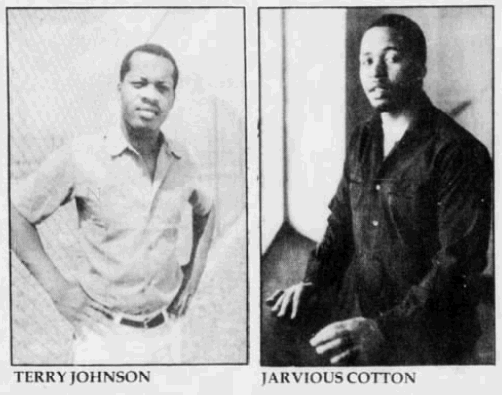
What Happened to Jarvious Cotton After He Was Convicted of Murder

After his conviction, Cotton became a jail house lawyer. He sued Mississippi prison officials asking for money to compensate him for having to prove his legal mail did not contain drugs. (Cotton v. Taylor (5th Cir. 1994) 37 F.3d 632.) This request was denied. (Ibid.) A few years later, he brought suit complaining that he wasn’t allowed to request a change in his prison job assignment. (Cotton v. Hargett (5th Cir. 1995) 68 F.3d 465.) The court described this claim as “frivolous” and warned Cotton not to file more appeals like it. (Id. at p. *1) Cotton continued to sue, and actually won $2,000 after complaining about a leaky prison roof. (Cotton v. Taylor (N.D. Miss. 1997) 1997 WL 560875.) Prison officials, however, appealed,

Cotton brought another case, but the grounds for his complaint are not clear. The new case went to the Fifth Circuit in 1998. They decided they had enough of Cotton’s lawsuits, which they described again as frivolous. (Cotton v. Fordice (5th Cir. 1998) 136 F.3d 1329, *1 [“Cotton has had three dismissals as frivolous by the district court and/or this court.”] They barred him from filing further appeals except in rare circumstances. (Ibid.) Cotton asked the Supreme Court of the United States to take his case. They declined. (Cotton v. Fordice (1998) 119 S.Ct. 214.)

The Voting Rights Case

Cotton’s next lawsuit was a big one. He filed a civil rights action asserting that Mississippi unconstitutionally disenfranchised him. He brought the suit with another man, Keith Brown, who was in prison for an armed robbery. Michelle Alexander is a civil rights attorney; this may be how Cotton came to Alexander’s attention.

The case was not argued by a lawyer. Brown argued it himself. The trial court ruled that the complaint was so lacking in merit that it would be a waste of a jury’s time to hear. In other words, no reasonable jury could find for Cotton and Brown. The court dismissed the case. Cotton and Brown appealed. (Cotton v. Fordice (1998) 157 F.3d 388.) Cotton’s appeal was dismissed as frivolous, since the court had already warned him not to file further lawsuits like this. (Id. at fn. 1.)

Brown made an interesting claim, one that’s relevant to Alexander’s arguments. Her core claim, after all, is that felon disenfranchisement was done to create a “new Jim Crow”; an underclass of convicted black men without voting rights. Brown makes the same argument in his appeal. He says that Mississippi’s felon disenfranchisement law “was originally drafted with the intent to disenfranchise blacks.” (Cotton v. Fordice (1998) 157 F.3d at 392.) Mississippi conceded that the law “was enacted in an area when southern states discriminated against blacks by disenfranchising convicts for crimes that, it was thought, were committed primarily by blacks. (Id.) Interestingly, the Mississippi Supreme Court itself held that the disenfranchisement law discriminated against blacks. (Ratliff v. Beale (1896) 74 Miss. 247 [the law “swept the circle of expedients to obstruct the exercise of the franchise by the negro race.”].) It took the Mississippi courts six years to recognize the law’s “odious origin.” (Fordice, supra, 157 F.3d. at p. 391.)

If the 1890 law were applied to disenfranchise Brown, I think we can all agree that the law should be struck down. Indeed, it was a shameful blot on Mississippi when it was passed, and it is still a shameful memory. But the Fifth Circuit considered the fact that the law was overhauled in 1950.

Section 241, as enacted in 1890, was amended in 1950, removing “burglary” from the list of disenfranchising crimes. Then, in 1968, the state broadened the provision by adding “murder” and “rape”—crimes historically excluded from the list because they were not considered “black” crimes. Amending § 241 was a deliberative process. Both houses of the state legislature had to approve the amendment by a two-thirds vote. The Mississippi Secretary of State was then required to publish a full-text version of § 241, as revised, at least two weeks before the popular election.  Finally, a majority of the voters had to approve the entire provision, including the revision. Because Mississippi’s procedure resulted both in 1950 and in 1968 in a re-enactment of § 241, each amendment superseded the previous provision and removed the discriminatory taint associated with the original version.

(Fordice, supra, 157 F.3d at p. 391 [internal citations omitted].)

Although Brown had proved that the 1890 law discriminated in an unconstitutional way, he did not prove that the current law was unconstitutional. (Id. at p. 392.) Moreover, he did not even offer evidence that the current law discriminates against blacks. (Id. at fn. 9.) The Fifth Circuit then affirmed the dismissal of the case.

Cotton Keeps Suing

The same year that the Fifth Circuit decided against him, Cotton sued again. He claimed that he was denied parole based on his race. The trial court rejected this claim without even discussing it. (Cotton v. Booker (5th Cir. 1998) 166F.3d 341, *1.) The Fifth Circuit remanded the case to them to provide a justification. (Ibid.) It is unclear what happened on the second go-round in the trial court.

Cotton Gets Out

Jarvious Cotton served his time for murder and was released on parole to Adams County Mississippi.  

Orange Juice and Trial Tactics

Vincent Bugliosi likes orange juice but hates OJ. When “the sun is shining brightly in the morning and the orange juice is good” he’s “in a very generous and magnanimous mood.” He was not in such a mood when he wrote Outrage: The Five Reasons Why O.J. Simpson Got Away with Murder. If you are a lawyer, particularly a lawyer in criminal law, this book is an interesting treatise on tactics, as much as a history of a famous case.

Bugliosi packs the book with entertaining observations and aphorisms. “As a trial lawyer, intelligence is important only in the sense that it allows you to play the game, if you will… Beyond that, it doesn’t get you very far at all.” He emphasized that a successful prosecutor “takes charge” of the case. “The typical incompetence that one sees in the great run of prosecutors and trial lawyers in general – inadequate preparation.” “Whenever I prosecuted a murder case, I always at least aspired to a masterpiece.”

His philosophy is to introduce all the evidence. “[T]he prosecution should always convey to the jury that as representatives of the people they want to present all relevant evidence on the issue of guilt.” “I mean, that’s what the prosecutor does in a criminal case – present incriminating evidence.” He continues, “when you have exceedingly powerful evidence of guilt, you automatically offer it. You don’t stumble on your way to the courtroom over the smallest thread in your path.” “When you know the defense is going to present evidence damaging or unfavorable to your side, you present that evidence yourself.”

“What I try to do on direct examination, basically, is conduct my opponent’s cross-examination for him, but bringing out the information the way I want it to be brought out.”

His attitude towards juries: “with almost any jury, you have to spoon-feed them.” “I never take a chance on assuming a jury is going to see something important without my help.”

I loved his advice on how to deal with a disrespectful judge:

Back in chambers he should have been told, first in a very civil way, but if this was unavailing, much more assertively, that although he had the right to speak, if he chose, in a condescending way to the prosecutors outside the presence of the jury, he did not have a right to hurt the prosecutor’s clients, the people of the State of California, in any way whatsoever in front of the jury, and they therefore not only wouldn’t permit him to do so, but had an obligation to ensure that he did not. Therefore, if he had anything negative to say to them, it had to be outside the presence of the jury. In front of the jury he had to show them the same, identical respect they showed him, nothing more, nothing less.

“I’ve always considered final summation the most important part of the trial for the lawyer.” He hates lawyers who address “the jury after scandalously little preparation.” Far too often this results in their delivering arguments which are disjointed and sterile in articulation, and which, most injurious of all to their clients, omit a number of salient facts and inferences.”

I could go on and on. There are worse ways to learn tactics than by discussing this fascinating and controversial case. But if you aren’t a lawyer, you might try another OJ book instead.

Notes

I also read Chris Darden’s book, which contains this advice from a judge to Darden:

“Calm down, he said “and make sure never to appear angry or confrontational. Don’t take these cases personally. Treat the witnesses in a dignified manner and treat opposing counsel in the same way, no matter how much you may dislike them.

Darden followed this advice and turned around a losing streak early in his career.

The Valley of the Shadow of Death

I love inside baseball, so I picked up The Valley of the Shadow of Death by Kermit Alexander to hear about how the LA DA’s office handled this high profile case in the late 1980s. I didn’t know who Kermit Alexander was or what happened to his family.  Here’s a video of the story:


Alexander’s family was killed by members of the Rollin’ 60s set of the Crips.  The killers apparently intended to murder a woman who was suing a local business owner.  The woman lived two houses away from Alexander’s family.  Tragically, the near-illiterate killers misread the address and four people paid the price.  The case was unsolved for several weeks, but was broken open when another person in the community was arrested on another minor charge but began talking while in custody.  Like Jarvious Cotton, this anecdote shows that enforcing less important laws can lead to arrests for violating the most serious kind of laws.

The book succeeds on two grounds. First, the inside baseball is there: tons of names that still bounce around the halls of courtrooms and law offices. It’s a weird pleasure to read about someone you work with. A hardback book confers a certain officiality, a kind of credibility that’s hard to describe, especially when that person may be standing next to you in the men’s room tomorrow. Second, the book is full of interesting esoterica about Los Angeles gangs and crime. The two professors who co-wrote the book used Alexander’s story as a hook to hang all sorts of tidbits and trivia that will delight and inform you. You may not expect to learn the history of the Crips, but you will, and you’ll be glad you did. When I put the book down, my expectations were exceeded, and I found myself wondering what happened to the characters, especially the killers, since publication.

Annotations

Here’s Alexander advocating for the death penalty.  He supported Proposition 66, along with Los Angeles County District Attorney Jackie Lacey.  This Proposition, which was approved by the voters, speeds up the implementation of the death penalty.  The shooter, Tiequon Cox, was sentenced to death but has not been executed.  Alexander says, “justice is not easy, and it is certainly not gentle.”

It’s an interesting contradiction that he also talks about forgiveness.  There has been no apology from the killers.  But Alexander says he has forgiven him.

The gunman, Tiequon Cox, later stabbed Tookie Williams, another Crip, before Williams was executed.  Williams was one of the original founders of the Crips.  He ordered Cox to kill Darren Williams, who was also involved in the Alexander shooting.  Cox refused to do it, and stabbed Williams instead.  At the time, there were 20-30 Crips on death row in San Quentin.

Some think that Cox should not be executed.  Here’s an essay arguing Cox “needs more than jail they need mental help and should be sent to an asylum or some type of counseling that can try and help them. “

The Anatomy of Violence

I read The Anatomy of Violence by Adrian Raine, all 373 pages, for the trivia.  The book was interesting enough by itself, but the most engaging part of the book, and the reason I kept reading, was the little criminological factoids sprinkled throughout.  You are more likely to be killed on they day you are born than any other day.  Stepfathers are much more likely to murder their children than biological fathers.  Men are better able to detect infidelity than women.  Men who murder are more likely to be single.  You are more likely to be killed in your home by someone you know than by a stranger.  On and on.  The longer your ring finger relative to your index finger, the more testosterone in your body.  Yes, the crime-stopping effects of Omega-3 fish oil are interesting, but just not enough without the trivia.

I picked up an electronic sample of the first few chapters to read while waiting around in court.  I followed Raines’ argument (a recitation of Dawkins’ selfish gene theory) but I was most interested the little facts and statistics he flavored it with.  I kept telling other lawyers about them.  By the time I was carpooling home, I had noted ten of the best and was going through them.

Raines clearly set out to write a book that was accessible to general readers.  His book is peppered with examples of killers, serial or otherwise.  His prose is lofty and often hyperbolic, which is totally necessary when you are talking about the left ventral prefontal cortex.  Otherwise your eyes would dry up.  And Raine even talks directly to the reader at times, speculating about why they bought the book and whether their purchase was predetermined by their biology.

Raine’s work on early childhood development is another area where the book really shines.  He identifies things that can happen in the womb and in the first years of a child’s life that will increase the chances of criminality later on down the line.  Head injury has to be at the top of the list.  Maternal rejection, or just bad parenting during the first months, is another huge factor.  Birth complications like hypoxia, preeclampsia, and maternal infection can all lead to neurological problems and then on to violence.  Shaking your baby, failing to feed your baby, the list goes on and on.

It would be pretty uncontroversial to say that we should focus public policy on avoiding these problems.  Parenting classes, better obstetrics, and safer playgrounds are all areas of improvement that would probably get wide agreement.  But what about the implications or Raines’ work on the biological factors predisposing someone towards crime?

If the government finds out that someone is biologically predisposed to crime, should it label them and treat them differently?  Maybe we should surveil them constantly.  Maybe we should forbid them from having children, or force them to get a license.  Maybe we should lock them up for our protection?  Raines, originally from the UK, may not know that we have “Equal Justice Under Law” written above our Supreme Court.  He does seem to know that many of these ideas are an anathema to the politically liberal.  So he flirts with these ideas rather than marrying them.  Even though his whole book is built around the idea that there are biological markers for violence, Raine is not willing to recommend that we do anything about it.  Reading this book is kind of like reading about boat design by an author who doesn’t recommend sailing.

At the end of his book, Raine recommend that we treat violence as a public health problem.  In my view, this approach ignores the moral aspects of crime, which would have a real, measurable effect on the crime rates.  Crimes are crimes, not symptoms.  Crimes are voluntary acts, not involuntary results of an unwanted disorder.  We may learn a lot from Raines’ book, and take many of his suggestions, without medicalising crime.

Annotations

The Nazis were in favor of sterilization to prevent “unsound progeny”.

This farrago of pseudoscience written by a criminologist is everything that’s wrong with “evolutionary” theories about human behavior wrapped up and deposited between two covers. Jam-packed with dubious speculation based on misperceptions of how evolution works, “Anatomy of Violence” is all the more alarming because Raine seems to think the ideas in it ought to have a role in public policy. Not just a bad book, but a potentially dangerous one.

-Laura Miller in Salon.