Gascon: Opposition Has a “Financial Interest” in Mass Incarceration

There’s another article this morning about the problems created by newly elected LA DA George Gascon. In it, Gascon says criticism is “not surprising to me” because “people have benefited from a system that has been impacting communities in so many negative ways without necessarily producing good results because they had a monetary interest. I know there are people in the criminal justice system across the board both in the private and public sectors that have greatly benefited from mass incarceration…”

It’s not clear to me who he’s talking about. But the resistance to Gascon’s orders is being led by line prosecutors. They are the regular people that try cases in Los Angeles County. Deputy District Attorneys have no financial interest in mass incarceration. They do not get a bonus for every conviction they obtain. They are not evaluated for promotion on the number of convictions they obtain. Nor do they benefit from trial convictions. They don’t get money or promotions from long sentences over short sentences. They are promoted (or not) because of their knowledge of the law and their skill at trial presentation. If there were zero state prisoners, they would get the exact same paycheck.

Maybe Gascon’s not to blame. Maybe he just doesn’t know these facts. In that case, he’s off the hook for his appalling remarks. But he’s not off the hook for his appalling ignorance of the office he’s supposed to lead. After all, he should know how his employees are paid.

On the other hand, maybe Gascon does know that his prosecutors have no “financial interest” in mass incarceration. In that case, saying something you know is not true is called lying. Obviously, it’s wrong to lie, particularly when you’re an elected official and you’re lying to the public about your own employees to persuade people that your employees are acting in bad faith. There are layers and layers of bad conduct there. If Gascon knows that his prosecutors have no “financial interest” in mass incarceration, why tell people that they do? To undermine their argument? To silence them? Or, as I said, the most obvious conclusion, to persuade the public that his own employees are arguing in bad faith?

Gascon to Judges: Go Along or Get Out

Los Angeles judges just got dragged in to the conflict between George Gascon’s policies and the Penal Code. Gascon already has his hands full compelling his own prosecutors to follow orders to dismiss all enhancements. These orders are unwise at best and illegal at worst. Meanwhile, independently elected judges are refusing to go along. Their permission is required and they are not giving it. Today, Gascon began threatening them too.

Gascon is Forcing Prosecutors to Move to Dismiss Enhancements

In a dramatic move, Gascon banned the use of enhancements on his first day in office. Enhancements lengthen prison terms for particularly bad conduct. They also lengthen the terms of people with bad records. Gascon claims that these laws are racist and drive mass incarceration. The legislature claims these laws make the punishment fit the crime and take dangerous criminals off the street.

Crime victims and prosecutors are generally in favor of the use of enhancements. Prosecutors are also aware that the California Constitution and the Penal Code require the use of enhancements in certain circumstances. There were rumors of widespread opposition to Gascon’s ban on the filing of enhancements. The opposition correctly pointed out that Gascon was ordered prosecutors to violate the law. Instead of backing down, Gascon doubled down, and began threatening to fire those prosecutors who continued following the law. As their supervisor, Gascon has a lot of leverage of prosecutors. Threatening to fire someone is an effective way to compel them to do things. Gascon can intimidate his employees in other ways. He can give them “freeway therapy,” by assigning them to a courthouse across the county from their home. He can prevent them from obtaining plum assignments. He can move them to difficult or boring assignments.

Gascon seems to be using each one of these tools to force compliance with his orders. And it seems to be working. Most prosecutors are going along. But there has been resistance from the bench.

Gascon Needs the Judges’ Permission to Dismiss Enhancements

The law clearly provides that a prosecutor may not dismiss an enhancement herself. She must move the judge to do it. The judge, in turn, must make a finding that it is in the interests of justice. The findings required may be even more complicated for a “strike” offense. Prosecutors have been reluctantly moving to dismiss enhancements pursuant to Gascon’s instructions. They are doing this to avoid being fired, even though many believe that such dismissals are both unjust and illegal.

But judges haven’t been going along. They have been denying the motion. Many believe the judges are on solid legal ground. Today, Gascon’s administration responded to the judges.

Gascon Threatens the Judges

Each party in a criminal matter may refuse to have their case appear in front of a judge. (Pen. Code section 170.6.) This is called “papering” a judge. The email above is an order to paper Judge Shellie Samuels for refusing to dismiss enhancements. At first blush, this doesn’t appear to be that big of a deal. After all, Judge Samuels probably has hundreds of cases on her docket. But consider this: the District Attorney’s Office is a party to every criminal case. That means they are a party to every single case on Judge Samuels’ docket. If the District Attorney papers Judge Samuels on every case, Judge Samuels will have no criminal cases at all. That is what Joseph Iniguez is ordering. He specifically says that no other cases should be assigned to her. He is ordering his prosecutors to use Penal Code section 170.6 to take Samuels entire criminal docket away.

Once these orders are carried out, and Judge Samuels’ docket is gone, she is useless as a criminal judge. She can’t be fired, because she is herself an elected official. The only place she is useful is Civil Court and Traffic Court. That’s where she will be moved.

Gascon and Iniguez clearly want to make an example of Samuels. No judge wants to lose their case load, be moved out of their courthouse, and forced to preside over civil or traffic cases. Some judges have never even practiced in these areas of law. In fact, most criminal judges are either former public defenders or former district attorneys. Most of them have no idea what goes on in civil court and shouldn’t be there. That’s the threat that Gascon is using.

The tactic worked. On December 17, Bill Melugin from FOX LA reported that Gascon will no longer be papering Judge Samuels because “she has subsequently started dismissing enhancements in accordance with his new policies.”

Why Is This a Big Deal?

Issuing an order to your employees to violate the law is a big deal. That’s what Gascon did when he ordered prosecutors not to file strike enhancements. Then threatening to fire them if they did not comply was an even bigger deal. Break the law or lose your job is a choice that no one should have to make. Still, the judiciary is an independent branch of government that is supposed to check the executive branch in these situations. So threatening the judicial branch is not only immoral but threatens our separation of powers. Those who think Gascon is a reformer should stop and ask themselves why he has to break the law threaten virtually every other person in the criminal justice system in order to accomplish his goals. Has he gone to far? Just ask Judge Shellie Samuels.

Gascon Walks Back the First of His Day One Orders

George Gascon began his term as DA last week and issued several controversial orders on his first day. Many of these orders appear to be at worst illegal and at best unwise. The most controversial was his order not to use the Three Strikes Law, even though the California Constitution and Penal Code require us to do so. That order remains in place.

But cracks are beginning to appear in the barrage of day one orders. Specifically, Gascon’s Special Directive 20-06 has just been walked back and qualified. This order directed prosecutors from requesting bail for any misdemeanor or felony, with the limited exception that we make seek bail on strikes offenses. In other words, bail is pretty much dead in LA.

This order didn’t last long, mostly because the people that wrote it don’t understand how criminal justice works. They forgot about arrest warrants. An arrest warrant is a complaint that is approved by a judge, and allows someone to be arrested for a crime. When they are arrested, they are held on bail and brought to court to face their charges.

The problem is, if you are not using bail, you can’t use arrest warrants. The courts will not issue arrest warrants without a bail amount. That’s because the arresting officer would have to immediately release the arrestee. This defeats the purpose of the warrant. “I’m arresting you!” would be followed immediately by “I’m releasing you!” and nobody would go to court.

Once this problem was brought to the new administration, the Interim Chief Deputy Joseph Iniguez sprang into action. You may have heard of Iniguez. He supported Gascon and contributed to his campaign. In return, he was made #2 at the office, even though he has virtually no experience. He has only prosecuted four felony trials, compared to hundreds by other deputies.

Iniguez partially reversed the earlier special directive. He reinstated bail for arrest warrants at $1. This will almost certainly not be enough for officers to retain custody of the arrestee. Many are predicting that bail will be back in full for arrest warrants. This may be the first of many corrections to day one policies opposed by prosecutors.

Can George Gascon Just Not File Strikes?

One of the most controversial policies implemented by newly-elected district attorney George Gascon is a directive to not file enhancements under the Three Strikes Law. You might remember this law: it provides that when a person is convicted of a third serious or violent felony they are “out,” meaning sentenced to 25 years to life.

Three Strikes has other provisions you may not have heard of as well. If you have been convicted of one strike, any subsequent felony conviction’s punishment is doubled. Strikes also keep people in prison for more of their term. With a strike the good behavior credit you get in prison is limited to 20% of your sentence. Without a strike, you could get much more, up to 75% credit. In other words, if you are sentenced to 10 years, you could get out in 2.5 years if you don’t have a strike. But you serve 8 years if you do.

The Directive: Don’t Plead and Prove Strikes

Three Strikes is an “enhancement.” It must be plead in the complaint. In other words, you must write down in the complaint that a defendant was previously convicted of these strikes on these dates and is thus in even more trouble. Then, before conviction, you have to actually prove this happened. You can use RAP sheets and prison documents and other things. Gascon has ordered his deputies to stop pleading these enhancements. In other words, if you find out that someone has a previous strike, you should just ignore it.

The Constitution: Plead and Prove Strikes

Here’s the problem. Article I of the California Constitution, at section 28(f)(4), says this:

 Use of Prior Convictions. Any prior felony conviction of any person in any criminal proceeding, whether adult or juvenile, shall subsequently be used without limitation for purposes of impeachment or enhancement of sentence in any criminal proceeding.

Cal. Const. Art. I, Section 28(f)(4).

You shall use strikes without limitation. “Shall” in the legal context means “must,” as in “no option.” There is no exception to this provision in the California constitution. It tells prosecutors: you must do this.

The Penal Code: Plead and Prove Strikes

The Penal Code has similar provisions.

Notwithstanding any other law, [Three Strikes] shall be applied in every case in which a defendant has one or more prior serious or violent felony convictions as defined in subdivision (d). The prosecuting attorney shall plead and prove each prior serious or violent felony conviction…

(Pen. Code section 667(f)(1).)

Because it’s the Penal Code, they put the exact same thing in another place, just for good measure.

Notwithstanding any other provision of law, this section shall be applied in every case in which a defendant has one or more prior serious and/or violent felony convictions as defined in this section.  The prosecuting attorney shall plead and prove each prior serious and/or violent felony conviction…

(Pen. Code section 1170.12.)

Notice that “shall” pops back up in here. There’s one important difference between these laws and the California constitution. Prosecutors may ask the court to dismiss the strikes once they are plead, if it is “in the furtherance of justice.” But it’s up to the court, meaning the judge, to decide whether to do this. It’s not up to the prosecutor. It doesn’t just happen automatically. The judge has to agree that it is “in the furtherance of justice.”

Follow Orders and Be Disbarred or Follow the Law and Get Fired

This is a big deal because the new DA is ordering his deputies to violate the California Constitution. That puts them in a tough spot. They could choose to follow orders and not file strikes. But that has consequences. First and foremost, prosecutors don’t want to break the law. In fact, that’s the exact opposite of thing they signed up for. Even if you leave out the important principles at issue here, there are still pitfalls. Following orders puts them at risk of a bar complaint. This has happened already to the Head Deputy in Antelope Valley. Just imagine that your family member was shot but lived. Imagine the shooter had two strikes. The shooter was facing 25-life, or more, under the previous administration. Now, without the strikes, they are facing five years served at 50% – just 30 months prison. You can’t even get a law degree in 30 months. Victims are – and should be – upset about this. Deputies who follow orders have to face these victims on virtually every case.

Now imagine that you don’t follow orders. The constitution trumps an office directive, after all. You’ve read up on things, and you’re trying to do the right thing. Well, you are going to get put on a list. The defense bar is keeping a list of prosecutors that don’t go along. They are providing that list to the new DA. If you find yourself on that list, you can be disciplined or even fired for insubordination. Rumor is that your boss will be fired to for failing to control you.

Gascon has put prosecutors between a rock and a hard place. Follow his orders and be disbarred, or follow the law and be fired.

CDAA Letter

On January 12, 2021, the California District Attorney’s Association published an open letter discussing this issue. You can read it here:

The letter focuses more on the wisdom of the “no enhancements” policy, rather than its legality, but it is still worth reading.

Update

A Superior Court Judge ruled that Gascon must file strikes. He issued a new policy to that effect.

Public Defenders Blacklist LA Prosecutors

George Gascon recently replaced Jackie Lacey and brought dramatic policy changes with him. One of the most controversial is that Gascon ordered his prosecutors not to file any sentence enhancements for any reason.

The most famous sentence enhancement is the Three Strikes Law. Gascon has been clear from the beginning of his term that this law will not be used. His orders are to dismiss the enhancement from any pending case in which it applies.

Many prosecutors are reluctant to follow this order because they believe it is illegal. Whether they are justified is an important question. But the more salacious issue is how the defense bar has inserted itself into this dispute.

The public defender, alternate public defender and other criminal defense lawyers are keeping lists of prosecutors who refuse to dismiss strikes. The rumor goes on. The defense bar will provide these lists to Gascon and his administration so that these prosecutors, and their supervisors, can be fired. The prosecutors will be fired for insubordination. The supervisors will be fired for failing to control their employees. The rumored purpose of these firings is to create job openings that can be filled with prosecutors who believe in Gascon’s changes.

Shame on the defense bar for acting this way. They should not be creating blacklists. They should not inject themselves into disputes in someone else’s office over internal policies. One lawyer should not try to get another lawyer fired over a legal disagreement.

Criminal court has been different than civil court, an environment that is notoriously uncivil. Every little transaction between civil litigators is fraught with aggression, lack of mutual trust, an unprofessionalism. As a result, civil litigators waste their clients time and money with pointless bickering and posturing. By contrast, criminal lawyers, especially public defenders and prosecutors, often work together day after day in the courtroom. They know each other. Importantly, they have a chance to build trust with each other. That can lead to real communication, not the pointless bickering we find in the civil system. It helps the system work in a just way.

What the public defenders are doing now will break the trust and civility that used to exist in Los Angeles. An entire office is engaged in a coordinated campaign to get portions of the other office fired.

Systemic Racism and the Guilty Defendant

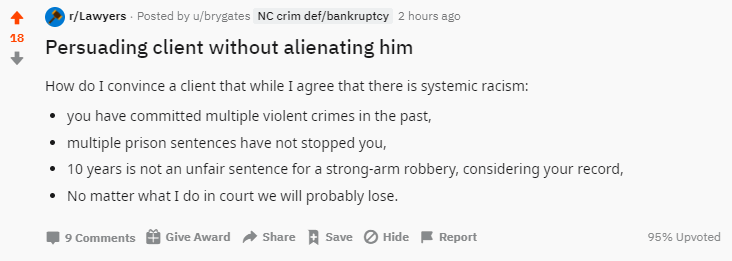
I stumbled across this question on Reddit. There were a bunch of interesting answers. Most of them are very practical. But something different occurred to me. Why is this lawyer helping this defendant at all?

Maybe this person is a public defender who has to represent the client whether they like it or not; they have no choice in the matter. That’s the most likely answer. But I’d like to make two assumptions. First, assume the client is guilty. Otherwise, why would the lawyer mention that no matter what she does in court they will lose? Second, assume that the lawyer has a choice. She can represent this defendant or dump him. Does she have an ethical duty not to help a guilty client get away with something?

I think that regular people intuitively understand that we should not do bad things ourselves nor should we help others do bad things. People also understand that the job of criminal defense attorney involves helping people get away with bad things.

Criminal defense lawyers often respond that their job is to make sure the system treats their client fairly. Or they will say that their job is to protect the constitutional rights of their clients against the government. And those are fine slogans, but this Reddit post illustrates an uncomfortable truth about the job. Most of the time, in fact, virtually all of the time, the client is guilty and is receiving fair treatment. In those situations, what is the role of the criminal defense lawyer?

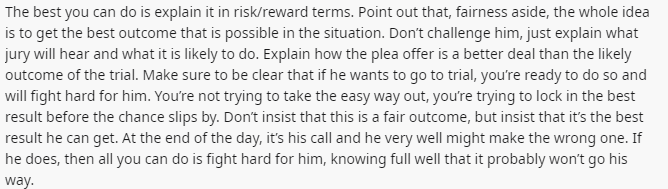
If you ask the criminal defendant, the role of the lawyer is to get the defendant off, or at least get him the lightest possible punishment. When plea bargaining fails, and a case goes to trial, the role of the defense lawyer is to win the trial. And that means secure a verdict of not guilty, or at least a hung jury. Here’s an example from the Reddit comments:

There are a lot of interesting lines to parse in this candid post. Two lines really struck me. First, the “whole idea is to get the best outcome that is possible in the situation.” This is different than “defend the constitution” or “act as a check on the government.” And although it’s not as noble, I think it is a more accurate description of the “whole idea” of criminal defense. Second, the commenter says, “if he wants to go to trial, you’re ready to do so and will fight hard for him.” Here again we have straight talk about how the system works. The lawyer will try hard to get the client off if that’s what the client wants him to do. Notice that he didn’t say, “I will withdraw if you insist on a trial because I cannot represent a guilty defendant.” He didn’t say, “you should admit what you did and take responsibility for it, including whatever punishment the legislature has prescribed.” I know this will sound naive to some readers. But it’s the tension between the client and the lawyer’s ethics that I find interesting.

There may be a rare defense attorney who never represents a guilty client. But that person is one in a million. I have never, in my entire career, charged someone with a crime when I’m not sure that they did it, and that I can prove it. Neither has anyone I know. The court system today is full of guilty people either trying to get a low offer or trying to trick a jury. Here’s another candid comment from the same post:

Maybe it’s naive, but I don’t think it’s right to go to trial, launch a hail mary, and play for a mistrial. This dynamic is well illustrated by the Reddit post. It seems like the person posting is a defense lawyer. It seems like the defendant is guilty. I’m guessing the defendant is asking the lawyer if he can get the charges dropped or reduced because of systemic racism, or something. It seems like the lawyer is saying no. The lawyer is recommending that the defendant take a 10 year offer. This makes sense because of the defendant’s record and because of the People’s ability to prove the case. Nevertheless, the defendant won’t go for it. He wants to have a trial. And to put a fine point on it, in that trial, he wants his lawyer to get him off. Even though he is guilty.

What about systemic racism?

No one can really agree what system racism is. Nevertheless, many loud voices have recently claimed that there is system racism in our justice system.

If we keep telling people that systemic racism exists, they will continue to blame it, rather than themselves, for their criminal conduct. This undermines the whole point of the system, which is to educate criminal defendants. Specifically, it is to teach them that criminal conduct will not benefit them. How can they learn this lesson if they believe that systemic racism, rather than their own choices, are responsible for crime? Here’s another comment from the same post:

That’s the sinister undertone to the Reddit post. Whether systemic racism exists or not – I think it doesn’t – it works as an excuse. It undermines the fundamental role of the justice system: holding someone accountable. Because everyone understands what this Reddit defendant understands. If systemic racism is to blame, you aren’t to blame.

Frances Choy Was Not Exonerated

Frances Choy confessed at least three times to murdering her parents. An accomplice also told the police that she was guilty. Forensic evidence tied her to the crime. Yet the New York Times published a story painting her as a victim of a wrongful conviction. Buzzfeed News wrote that Frances Choy was “exonerated.” So does Boston.com. The Boston College Chronicle described her as “cleared.” The Milford Daily news headline is “The Truth Has Been Revealed.” What happened?

The Facts

In April of 2003, the Frances Choy was a high school senior living with her parents and her nephew, Kenneth Choy. (Choy v. Com. (2010) 456 Mass. 146.) Early one morning she called 911 to report a fire in her home. Firefighters arrived and rescued Frances and Kenneth Choy. Frances did not appear upset and displayed no visible signs of injury. Firefighters went back in the house to rescue Frances Choy’s parents. They were hospitalized and each died that day as a result of smoke inhalation and burns. Expert testimony from Sergeant Jeanne Stewart, a State police fire investigator, indicated that the fire was set intentionally and appeared to be designed to spread toward the parent’s bedroom. Additionally, fire investigators found gasoline throughout the house and on the defendant’s sweatpants.

Frances Choy confessed to the crime to several different people. A State police sergeant testified that Choy told him that she resented her parents because they prevented her from spending time with her boy friend, assigned her extensive chores, and planned to force her to live at home when she entered college. Additionally, she told the officer that she believed she was the beneficiary of a life insurance policy purchased by her parents. Another police officer testified that on two occasions the defendant admitted that she planned the fire and placed containers of gasoline throughout the house, but on both occasions she immediately retracted her statement.

Kenneth Choy also admitted that Frances was guilty. Police found handwritten notes by Kenneth Choy in his bedroom after the fire. They contained a step-by-step checklist on how to set the house of fire. He spoke to the police as well. He told police that he made the notes at the defendant’s request as part of a joint plan to set fire to their home.

The Conviction and Appeals

Frances Choy was tried twice; both trials ended in hung juries. She was tried a third time an convicted of murder and arson charges in 2011. Kenneth Choi was tried in 2008 and found not guilty. At trial, he claimed that the fire was Frances Choy’s idea.

Ms. Choy continued to appeal her conviction. She hired new lawyers. They hired an expert to testify that there was actually no gasoline on Ms. Choy’s sweatpants, in contrast to a police expert who testified that there was. They found a friend of Kenneth Choy’s who they claimed would testify that Kenneth Choy was more involved than he claimed. In September 2020, a judge vacated the 2011 convictions.

The appeal was vacated on two grounds. First, Frances Choy’s lawyers “uncovered” evidence that Kenneth Choy had worked alone and then blamed Frances Choy. Second, the lawyers uncovered evidence of emails by prosecutors that were racially offensive. They contained pictures of Asian people accompanied by pejorative comments. They also contained jokes about Asian stereotypes. For example, one of the emails compared Kenneth Choy to a character from the movie “Sixteen Candles.”

During her appeal, the prosecutor’s office filed a motion saying he would not prosecute the case further. The New York Times described that decision in this way: “With that motion, Ms. Choy was officially exonerated and freed after 17 years in detention, according to her lawyers” from the Boston College Innocence Program. Incredibly, Ms. Choy, 34, thanked her lawyers, her family and her friends “for always believing in my innocence.”

Police have no other suspects. No was has explained who set the fire, if Frances and Kenneth did not.

Having Your Case Dropped is Not “Exoneration”

When a jury acquits you, they are not finding that you are innocent. The jury simply finds that the evidence did not prove you guilty beyond a reasonable doubt. That’s why the verdict is called a “not guilty” verdict, not an “innocent” verdict. You may still be guilty by clear and convincing evidence even if you are not guilty beyond a reasonable doubt. Acquitted defendants are not innocent.

In this case, the prosecutor’s office declined to try Ms. Choy a fourth time. This is also not a court finding that Ms. Choy is innocent. Prosecutor’s decline to prosecute for many reasons, such as a lack of evidence, the fact that the defendant is serving a long term on another case, or even the fact that staff are not available to prosecute the case. None of these are an innocence finding.

This is Criminal Law 101, but many news outlets consistently make this mistake. It’s much worse when lawyers do this. Ms. Choy’s lawyers, who are law professors, know the difference between “not guilty” and “innocent.” Yet they still went around the national media puffing themselves up by claiming that this was an exoneration. It wasn’t.

Misconduct Unrelated to a Case Should Not Be Grounds For Overturning the Case

Prosecutors should not send racist emails about their cases. There’s no excuse for that. The prosecutors who did that in Frances Choy’s case were out of line and should have faced consequences. Those consequences can and should include reprimands at work and even from the Massachusetts State Bar. We should stand by our principles that the fair administration of justice means that people in the justice system should be accountable for their misconduct.

But we need to remember an important fact. None of the misconduct by prosecutors in this case had any bearing on whether or not Frances Choy was guilty. A racist email is not the same thing as framing someone for murder. A racist joke is not right, but it does not change the strength of the evidence in court. In this case, a judge took what should be a personnel issue, got herself involved, and used it to overturn a jury’s decision. The judge did this even though there was no showing that the emails in this case affected the trial at all. As far as I can tell, no one explained how the emails translated into an unfair trial for Frances Choy. Why would you overturn a jury conviction because of misconduct that didn’t affect the fairness of the trial?

Imagine that you were a relative of Frances Choy’s parents. Imagine that you were someone that loved Frances Choy’s parents. Their names were Anne and Jimmy. They burned to death. You would want justice. You would want the person that burned them to be held accountable. You learn that the two teenagers are the only suspects, that one has confessed several times, and that the other had notes with arson instructions written on them. You watch as the prosecutors work hard, over the course of three trials, and eventually secure a conviction.

Then, a judge comes along, 17 years after the crimes, and decides to punish the prosecutor’s office for their racist emails, by robbing you of the justice you waited for. How is that fair to you? How is that fair to any one of us that want Anne and Jimmy’s death to mean something?

No-Knock Warrants in California

Officers from the Minneapolis Police Department obtained a “no-knock” warrant to search Breonna Taylor’s apartment. It resulted in her death. An officer was shot and another officer shot at an apartment with small children. Some have reported that the officers were not wearing police identifiers on their clothing. They imply that Taylor’s boyfriend, who shot at officers, believed he was legally fighting off a home invader.

This had led to criticism of the practice of using no-knock warrants.

Why do no-knock warrants even exist? The purpose of no-knock warrants is to prevent the destruction of evidence. They are also used to protect officers in situations where they reasonably believe that suspects will arm themselves. Finally, they are also used in situations where officers believe that that suspects will flee from arrest. (People v. Neer (1986) 177 Cal.App.3d 991, 995.) Under the Fourth Amendment, no-knock entries are justified when police officers have a reasonable suspicion that knocking and announcing their presence before entering would be dangerous or futile, or destructive to the purposes of the investigation. (U.S. v. Banks (2003) 540 U.S. 31, 36-37.) The Fourth Amendment even allows no-knock warrants when there is no existing exigency, but the officer expects that there will be exigency when a knock is made. With this many exceptions, you may wonder whether the Fourth Amendment even exists at all anymore.

But just because the Constitution allows no-knock warrants doesn’t mean that the states have to allow them. After all, in theory, the Constitution provides the floor for protection of constitutional rights, and states are free to be more protective if they want. That’s what California decided to do.

No-knock warrants are illegal in California.

Here, a magistrate may not issue a no-knock warrant. (Pen. Code, § 1531.) Although that wasn’t always the case. In 1872, 12% of all search warrants in Los Angeles County were no-knock warrants. (Parsley v. Superior Court (1973) 9 Cal.3d 934, 939-40). In Parsley, officers believed that there were drugs in a house, and obtained a no-knock warrant. (Id. at 938.) They had been told that the resident was known to answer the door armed with a weapon. (Id. at p. 941.) They crawled through a bedroom window without giving notice of their authority or purpose. They found narcotics and two men, who were both arrested. (Id.) The men complained that the officer shouldn’t have been allowed to crawl in, and they asked that the court throw out the drugs they found. The California Supreme Court agreed, relying on Penal Code section 1531. (Id. at p. 939.)

But there are still ways police can enter your house without knocking.

Don’t forget that officers can still enter your house without knocking if there is exigency existing when they arrive. (Parsley, supra, at p. 939.) It’s just that a judge can’t make that determination in advance: it has to be made by police on the scene. Police can also enter if the search is of a public place. This usually happens when police are searching stores or restaurants. Finally, if the occupant of the home agrees to allow the search, by letting police in before they can knock, or by waiving his rights before the search starts, police don’t have to knock.

What Qualified Immunity Is, and Isn’t

Qualified Immunity

Qualified immunity is a defense against civil lawsuits over money. It gives police officers partial immunity in civil court, not in criminal court, which has a different set of rules. It also cannot protect police officers from administrative discipline, including termination.

Qualified immunity was first invented by the Supreme Court in Pierson v. Ray (1967) 386 U.S. 547. It’s only about 50 years old. It gave officers immunity from money damages when they were acting with “good faith and probable cause” in making arrests. The Court has tinkered with the definition over the years, after all, they made it up in the first place, but the point has remained the same: police shouldn’t have to pay damages for violating rights when they were acting in good faith. Acting in good faith means that an officer must not intend to violate the constitution. But the constitution is interpreted in different ways over the years. What is constitutional today may be unconstitutional tomorrow. For example, it used to be constitutional to question a suspect without a Miranda warning. Then one day it wasn’t. Should a criminal be able to sue for failure to give the Miranda warning before the Miranda case was decided by the Court? Of course not, how could the officer know he was violating the constitution? The Supreme Court has argued with itself over what it means to act in “good faith” when constitutional law is unclear.

Today, qualified immunity is available if a reasonably well-trained officer would not know that her precise conduct would run afoul of that principle and violate the plaintiff’s rights. (Anderson v. Creighton (1987) 483 U.S. 635.) That’s what good faith means now. Reasonably trained officers don’t have to be constitutional scholars, as long as they are not deliberately violating the constitution.

Examples of Qualified Immunity

One example is the Miranda example above. Here’s another example of how this works. In 1983, an FBI agent conducted a warrantless search of a home. They wrongly believed that a bank robbery suspect on the run might be in the house. In this circumstance, a search is allowed under the exigent circumstances exception to the Fourth Amendment. The family that lived in the house sued, claiming that their Fourth Amendment Rights were violated. The officer responded, even if they were, I didn’t intend to violate your rights, and a reasonable officer would have believed this was a perfectly fine “exigent circumstances” search. The Court held that the officer was right, he could not be sued. (Anderson v. Creighton, supra.)

Here’s another example. Today, it is legal for a police officer to use force to overcome a suspect’s resistance or to gain compliance with a lawful order. Imagine that an officer at a protest lawfully orders protesters to go home. One protester doesn’t go home, and an officer uses force to get him to comply with the dispersion order. The protester sues the officer. At the time of the protest, what the officer did was legal. But while the protesters case was pending, the Supreme Court rules that force cannot be used to enforce a dispersion order: a new rule of law. Since it’s new, the officer could not have known about this rule and thus couldn’t comply with it. The officer should get qualified immunity because he was acting in good faith.

What Qualified Immunity Isn’t

If an officer uses force against you, and you are prosected for battering the officer, you can always claim excessive force as a defense. Qualified immunity doesn’t enter into the picture. In fact, it is not relevant in criminal proceedings at all.

Qualified immunity doesn’t protect an officer from internal discipline. It can’t prevent an officer from being fired. It can’t prevent a citizen complaint.

Finally, qualified immunity doesn’t protect officers who violate the constitution in bad faith. In the excessive force example above, the officer would not get qualified immunity because the case law is clear that excessive force violates the Fourth Amendment. Virtually all of the rights that you think of, like the Miranda right or the Massiah right. Qualified immunity is a narrow form of immunity that protects officers when the law is changing or unclear.

Are Prosecutors To Blame For The Growth In Incarceration?

The prosecutor has more control over life, liberty, and reputation than any other person in America.

– Robert Jackson, United States Attorney General, Justice of the United States Supreme Court, and Chief United States Prosecutor at the Nuremberg Trials.

The public prosecutor was a uniquely America invention.  Although we borrowed much of our law from England, criminal prosecutions there were generally conducted by the victims, in tandem with tort suits against hte perpetrator of the harm.  A public prosecutor prevents blackmail by the victim, who in early England could, and often did, threaten criminal prosecution unless the defendant paid a settlement in the tort suit.  A public prosecutor prevents the criminal courts from being used as conduits for unreasonable, vengeance-seeking victims (or their survivors) who are incapable of neutrally assessing the defendant’s criminal responsibility.  It also means that poor victims will have their rights protected even if they could not afford the costs of prosecution.  And it ensures that public money is only spent on crimes that the public feels are important, and not on private disputes.

John Pfaff thinks that prosecutors, because of their power, are the primary driver of mass incarceration in America. He argues that prosecutors are responsible for rising prison populations during a period of falling crime.

What appears to happen during this time—the years I look at are 1994 to 2008, just based on the data that’s available—is that the probability that a district attorney files a felony charge against an arrestee goes from about 1 in 3, to 2 in 3. So over the course of the ’90s and 2000s, district attorneys just got much more aggressive in how they filed charges. Defendants who they would not have filed felony charges against before, they now are charging with felonies. I can’t tell you why they’re doing that. No one’s really got an answer to that yet. But it does seem that the number of felony cases filed shoots up very strongly, even as the number of arrests goes down.

Pfaff advocates reform by electing new district attorneys.

What makes it very hard is that the person we really need to target now—whose behavior we need to regulate—is the district attorney, and the district attorney is a very politically independent figure. He’s directly elected, and he’s directly elected at the county level. […] So you have to figure out how to go county by county and either elect DAs who have less punitive attitudes, or you can try to sort of change the incentives DAs face at the state level. But it’s very tricky.

Pfaff’s work was a response to a National Research Council report. The report was conceived by James Q. Wilson, an extremely influential thinker in criminology. It lists the underlying causes of incarceration as “crime, politics, and social change.” It found that “[t]he policies and practices that gave rise to unprecedented high rates of incarceration were the result of a variety of converging historical, social, economic, and political forces.” The system was made punitive by “powerful institutional, cultural, political, economic, and racial forces.”  “[T]he United States responded to escalating crime rates by enacting highly punitive policies and laws and turning away from rehabilitation and reintegration.”

Pfaff had a strong reaction to this report. He began writing about what he believed were flaws in the report. His writing started to pile up. And it eventually led to his book, Locked In.

Pfaff is making a diagnosis of exclusion. He isn’t sure why prison populations have risen, but he noticed that more arrests are resulting in prosecution. So he identifies the rise in prosecution as the cause of mass incarceration. This is not proof by a long shot; it’s more like an educated guess. When more research is needed, academics shouldn’t publish books acting as if the question is settled.

The second problem that I have with Pfaff’s thesis is that he doesn’t know why prosecutors are filing more. Personal experience leads me to believe that prosecutors offices are chronically short-staffed, and that the filing decisions of the past were driven by the very real limitations of staffing. In the old days, prosecutors had to decline cases because they did not have the resources to prosecute them. As time has gone on, prosecutors have obtained more staff and resources, and can prosecute more. And they should, after all, one of our guiding principles is “equal justice under law.” Imagine how a victim feels when a prosecutor tells them that they do not have time to prosecute their victimizer. As we move away from a history of unequal enforcement to a period of equal enforcement against all criminals, Pfaff should not complain that prosecutor’s filing decisions are causing mass incarceration. After all, prosecutors are simply living up to our ethical ideals, and doing more of the work that we are entrusted with.