The Intent Problem in the Renee Good Video

I got on the elevator at work the other day and saw a man watching Renee Good get killed on his phone. Like many people, he was parsing the video to see whether this was the police murder of an innocent woman or a protester attempting to run down a federal agent. After the killing, opinions have covered that range, with few in between. The two camps seem to mirror the two camps in our national politics, but careful attention to the facts can moderate opinions on both sides, and sometimes even lead to agreement.

Because Ms. Good is dead, we will never have conclusive evidence of what she intended in the moment. And based on the video alone, a reasonable person could conclude that she was attempting to escape a chaotic scene or comply with shouted orders to move the car, rather than intending to injure or even frighten the agent. That matters, because in both Minnesota law and the most likely federal statute, intent is not a technical footnote. It is an element the government must prove beyond a reasonable doubt.

Another related question is whether Agent Jonathan Ross acted in self-defense. Based on the timing of his shots, he may not have.

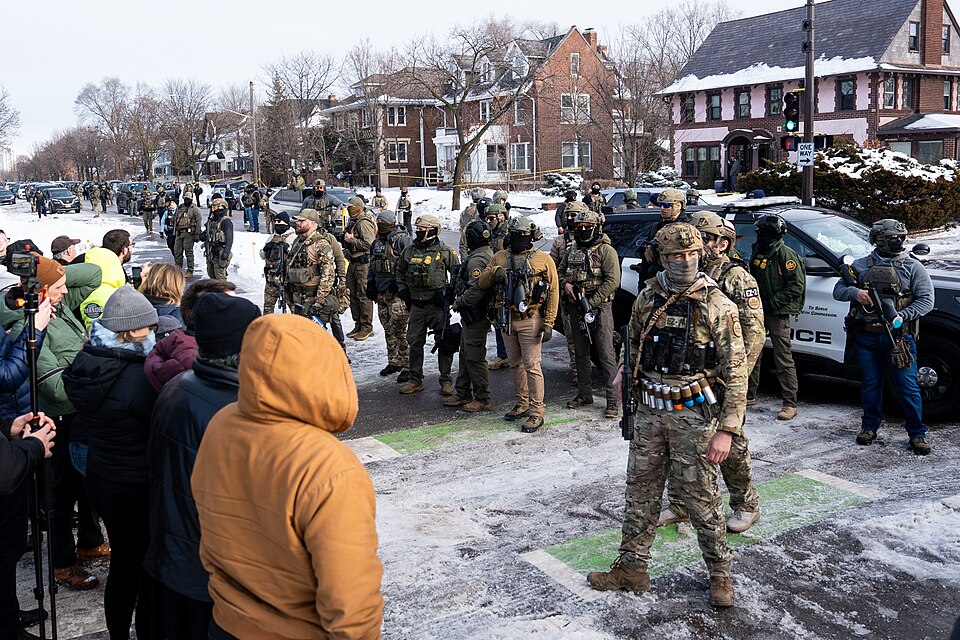
Ice agents at the scene of the shooting.

Minnesota Assault Requires Intent

Minnesota does not use a separate “battery” statute. Instead, Minnesota defines “assault” in two ways: (1) an act done with intent to cause fear in another of immediate bodily harm or death, or (2) the intentional infliction of, or attempt to inflict, bodily harm.

It is not enough, under Minnesota law, to show that Renee Good drove her car in a way that put Agent Ross in fear of being hit. Nor is it enough that her conduct scared him or created a dangerous situation. The prosecution must prove that Ms. Good intended to cause Agent Ross to fear immediate harm (the “assault-fear” theory) or intent to inflict or attempt harm (the “assault-harm” theory). This is a reasonable inference given that Ms. Good drove her car directly at the agent and would have hit him if he had not jumped out of the way.

Intent is often a disputed element, mostly because people do not usually say what they intent to do as they are doing it. Intent is usually proved by circumstantial evidence. Supporter of Ms. Good can plausibly say that she intended to leave, or to comply with shouted instructions to leave. If that’s right then Ms. Ross did not commit a crime under Minnesota law, which requires intent to scare Agent Ross or intent to harm him. Near-misses can happen for a lot of reasons. Since the video plausibly supports the interpretation that Ms. Good intended to escape or comply, it would be hard to prove assault. Moreover, Ms. Good is dead, so there is no way to obtain an admission from her that she did intend to scare or hurt the agent. This is a very common way for law enforcement to prove these cases. In other words, Ms. Good cannot settle the intent issue by implicating herself.

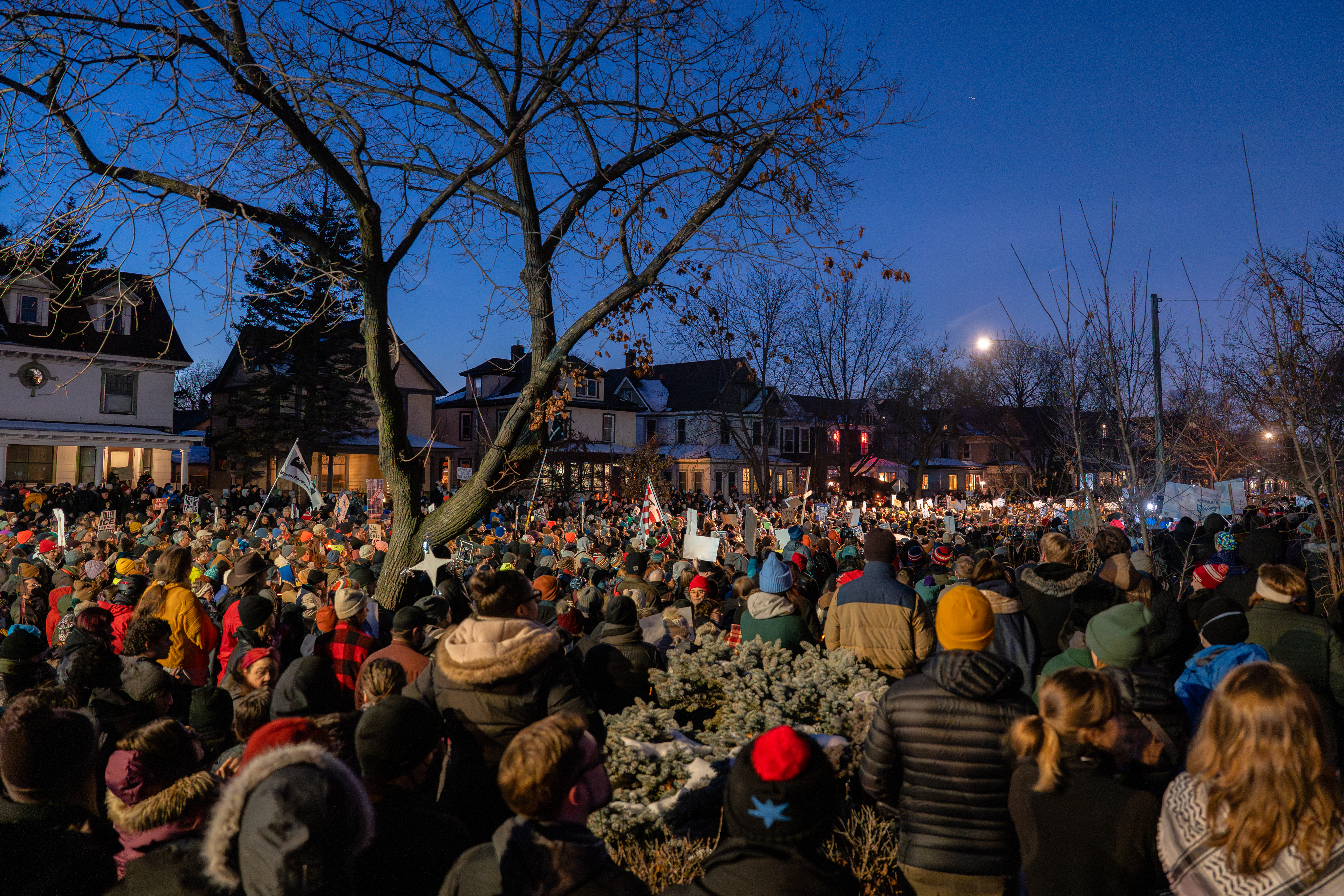
Large vigil for Renee Good in South Minneapolis. Good, who was observing ICE actions, was killed by an ICE agent earlier in the day.

Federal Law Also Requires an Intentional Assaultive Act

It is a crime to assault a federal officer. (See 18 U.S. Code § 111.) In order to prove this crime, a prosecutor must prove that Ms. Good “forcibly assaulted” Agent Ross. This phrase is defined as follows:

There is a forcible assault when one person intentionally strikes another, or willfully attempts to inflict injury on another, or intentionally threatens another coupled with an apparent ability to inflict injury on another which causes a reasonable apprehension of immediate bodily harm. 

Again, notice the intent requirements. The videos, standing alone, support the inference that Ms. Good intended to hit Agent Ross when she stepped on the gas pedal with him standing in front of the car. But it is also reasonable to infer that she intended to escape or to comply with orders to leave. When there are two reasonable inferences, and one of them means a criminal defendant is not guilty, the jury must accept the inference that leads to acquittal.

Why Death Matters Here

Intent is almost always proved circumstantially. Prosecutors infer it from the defendant’s acts, timing, and context. But in hard cases, a defendant’s own statements (before, during, or after) often supply the decisive evidence. That is what Ms. Good’s death takes off the table. We will never have her direct explanation. We will never have her post-incident admissions, denials, or inconsistent statements. We will never have her testifying (truthfully or not) about what she perceived and what she was trying to do.

None of that means intent is impossible to prove. It means the case is likely to remain a video-only inference fight, and video-only inference fights are precisely where reasonable doubt often lives, especially when the same footage can be plausibly read as panic and escape rather than deliberate intimidation or attempted harm.

Agent Ross Was Not Entitled to Shoot Ms. Good After He Was Out of Danger

In order to use deadly force in self-defense, Agent Ross must have reasonably believed that he was in imminent danger of death or bodily harm. Ross may also use force to prevent death or great bodily harm to others. Deadly force, like firing a gun, can be used to defend against deadly force, like an oncoming car. The reasonableness of the force is judged from the perspective of an objectively reasonable person in the shoes of Agent Ross, not from Agent’s Ross’s subjective perspective. The fact that Agent Ross was previously hit and dragged by a car would not factor into this analysis.

Moreover, Agent’s Ross’s right to use deadly force in self-defense only lasts as long as he is in imminent danger. If someone tries to kill you, then passes out, you can no longer use force in self-defense. Similarly, if someone is fleeing from you it is (generally) not legal to use force on them in self-defense.

Applying these principles to Agent Ross, he was not entitled to shoot Ms. Good once he was out of the way of her car. At that point he would no longer be in imminent danger of death or great bodily injury. He could chase her and arrest her for assault with a deadly weapon. But he could not use force on her.

The video is unclear as to whether the shots were fired after Ross was out of the way of the car. Most people seem to think the first shot was fired when Ross was in the vehicle’s path, but that the second and third shot were fired after he had already jumped out of the way. Others think all the shots were fired after he was to the side of the car. This matters for a self-defense analysis.

A Narrow Conclusion

This is not a claim that Ms. Good’s driving was safe, wise, or morally defensible. It is not a claim about civil liability or constitutional “reasonableness.” It is a narrower claim about proof. Under Minnesota law, assault requires proof of intent . Under the most likely federal statute, § 111, the government must also prove bad intent, not merely that an officer was frightened.

Moreover, it does seem like some of Agent Ross’s shots, although understandable for a man who had been dragged by a car before, do not meet the legal definition of self-defense.

Notes

Since the possible crime occurred in Minnesota, not California, I did not discuss California law. However, California law would treat Ms. Good’s conduct differently. If this incident had occurred in California, it is more likely that she committed the crime of assault with a deadly weapon.

Minnesota uses the term “dangerous weapon” rather than “deadly weapon”. But this is a distinction without a difference, since the Minnesota term includes “any […] instrumentality that, in the manner it is used or intended to be used, is calculated or likely to produce death or great bodily harm.”

What Eric Neff Did

Eric Neff was run out of his job as a prosecutor in Los Angeles County after uncovering evidence that pollworker data was leaked to China. His investigation, once touted by liberal DA George Gascon, was dismissed after President Trump indicated his support for it. Neff was put on leave and given a less-prestigious assignment. He was later cleared of any wrongdoing by an outside investigator. Now, Neff has been hired by the federal government, and media are insinuating that he’s an unqualified political hack, not a legitimate prosecutor. What’s the real story?

Neff Uncovered a Crime After Being Tipped Off by a Conservative Advocate

Eric Neff was a deputy district attorney at the Los Angeles County District Attorney’s Office in 2022. He was assigned to the Public Integrity Division, which investigates corruption, and had been there for two years, when he heard claims that a pollworker data in Los Angeles had been leaked to China.

Neff heard the claims from True the Vote, a conservative vote-monitoring organization whose stated objective is stopping voter fraud. The group has repeatedly falsely claimed that Donald Trump won the 2020 election. Gregg Phillips, a board member of True the Vote, claimed on social media in 2022 that his associates had discovered misconduct by Konnech, a poll worker management software company. Konnech’s software is designed to recruit and train election workers, handle their payroll, and assign them to jobs. This software was used in Los Angeles County in the 2020 elections, including the presidential election. Konnech agreed to securely maintain pollworker data and ensure that access to the data was limited to Americans. Despite this, Phillips alleged that Konnech had stored data on a Chinese server and allowed the Chinese government to access it. Konnech denied the claims and sued True the Vote. Phillips said the discovery had been made by two associates who hacked Konnech’s servers. He was unwilling to identify the “associates” and was jailed for contempt of court. He spent nine days in federal jail until he was ordered released by the Fifth Circuit in November 2022.

Meanwhile Neff, acting on the tip from True the Vote, assigned investigators to determine whether pollworker data had been stolen. Investigators learned that Konnech’s “PollChief” application has its data sources “resolve” to a Chinese IP address. “District Attorney investigators found that in contradiction to the contract, information was stored on servers in the People’s Republic of China,” according to George Gascon, LA County’s liberal district attorney. Investigators executed a search warrant at Konnech’s headquarters, seized evidence, and developed an employee as a cooperating witness. They did not find that the crime had any impact on the tabulation of votes and did not alter election results.

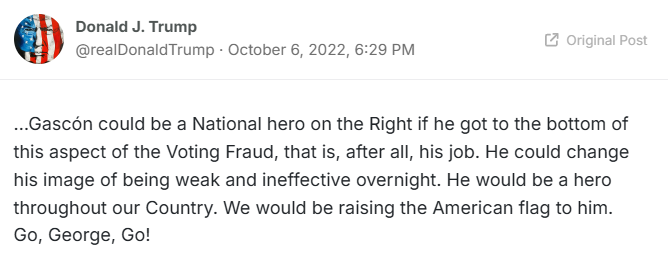
District Attorney George Gascon’s enthusiasm for the case would be short-lived. President Trump retweeted a post from the Washington Examiner about the affair, falsely connecting it to voting fraud, and lauding Gascon, a political liberal and Trump opponent. Trump said, “Go, George, Go!” and that he would become a “National hero on the Right if he got to the bottom of this aspect of the Voting Fraud.”

Meanwhile, Konnech sued True the Vote for defamation, among other things, on September 12, 2022. They denied the claims, saying “[a]ll of Konnech’s U.S. customer data is secured and stored exclusively on protected computers located within the United States.” The complaint provides a detailed recitation of the True the Vote’s claims about Konnech.

But the criminal investigation continued. After the suit, and the President’s posts, Eugene Yu, the CEO of Konnech, was charged on October 13, 2022. Yu immigrated to the U.S. from China in the 1980s and became an American citizen in 1997. The complaint was reviewed and approved by Neff’s “entire chain of command.” Other sources say Gregg Phillips, who had made the controversial claims, testified before the grand jury that indicted Yu.

Criminal Charges Must Be Supported by Evidence

Regardless of whether the case began with a criminal complaint or an indictment, it’s important to provide readers with some basic context. The most important thing to understand here is that criminal charges cannot be filed on the basis of a hunch or suspicion. There must be evidence. Specifically, enough evidence to provide “probable cause” to believe that a crime had occurred and that Eugene Yu was the one who did the crime. Bringing charges without evidence is itself a crime: malicious prosecution. It’s illegal. In fact, the LADA’s own guidelines require more than just probable cause to bring a case: they require that the case can be proved beyond a reasonable doubt: a higher standard. When a prosecutor, like Eric Neff, signs a complaint, they are certifying that evidence exists. High profile cases, like this one, are often reviewed by the filer’s entire chain of command. In other words, filing a criminal case is a more reliable indicator that a crime has been committed than just writing something online or posting on social media.

More context. A prosecutor cannot just “go rogue,” and file charges on whoever he likes for whatever reason he likes and have them arrested. A judge has to review the complaint to ensure that there is probable cause within 48 hours of arrest. This is a second pair of eyes on the complaint to ensure that it is based on evidence. The judge’s review provides an important safeguard for criminal defendants and it is another reason why readers can be sure that if there is a criminal case, there is evidence to support the defendant’s guilt.

The evidence is also given to a defense lawyer, who can also review it. If they believe there is not enough evidence, the defense has several mechanisms to challenge the complaint. The most significant is a preliminary hearing, which takes place within 10 court days of arraignment and during which the prosecution must show the judge the evidence in support of the complaint.

When a defendant is indicted, they have even more procedural safeguards. Indictments are issued not by prosecutors, but by grand juries, made up of random citizens. The grand jury, not the prosecutor, is the one who decides if there is enough evidence for charges.

All this is to say, Neff’s case is based on evidence. It’s more substantial than rumors on the internet.

Gascon Dismisses the Case

Neff was supervised by a more senior DDA during pretrial litigation, which included a demurrer. This DDA, by the way, also believed in the case and wanted to prosecute it. The demurrer was calendared for hearing on November 10, 2022. Prior to the hearing Neff was told by his supervisors that the DA’s office would dismiss the case. A manager, not Neff, made the actual motion for dismissal.

Tiffiny Blacknell, the notoriously political ex-public defender working as George Gascon’s advisor, said that LADA hasn’t ruled out refiling the charges after reviewing the evidence. She said LADA would “assemble a new team, with significant cyber security experience to determine whether any criminal activity occurred.”

On November 14, a few days after the dismissal, Neff made a written complaint alleging that the dismissal was politically motivated. He claimed that LADA George Gascon wanted to avoid the perception that he was supporting President Trump’s claims about the 2020 election. Two days later, Neff was placed on administrative leave. LADA conducted an internal investigation but found no evidence that Mr. Neff committed any misconduct. No disciplinary actions were taken and he was reinstated in April 2024, but moved by Gascon to a less prestigious unit. Going nowhere, Neff eventually left the office.

In September 2023, Yu sued LADA alleging civil rights violations and negligence. On January 27, 2024, Los Angeles County agreed to pay Yu and Konnech $5 million to settle a lawsuit arising out of the prosecution. Neff spoke during the Board of Supervisors meeting and questioned whether the timing of the settlement was intended to support Gascon’s re-election campaign, which ultimately failed. The Board approved the settlement without discussion.

On April 17, 2024, Neff began the process of suing the County of Los Angeles over the whole affair by filing a Governmental Tort Claim. The case is set for trial in early 2026.

Neff landed on his feet. In 2025 he was made acting head of the voting section of the U.S. Department of Justice’s Civil Rights Division.

Local Coverage Has Been Misleading

The Los Angeles Times recently ran an article with the headline, “Trump’s DOJ hires voting rights lawyer behind L.A. case cited by conspiracy theorists.” The author of the article was reporter James Queally, who also publishes fiction about social justice activists fighting racist cops. Queally heavily implies that Neff brought false charges against Konnech and Yu. This conclusion seems to be based on the idea that the case would have proceeded if there had been reliable evidence. Queally does not consider what might seem obvious to a regular person: that the case was dismissed when the liberal DA realized he was helping the conservative president. Queally’s implication that the charges were false is also made without anyone having seen the evidence that the prosecution was based on. And it ignores the fact that the D.A.’s office paid for an outside law firm to investigate the matter. The outside firm cleared Neff.

Queally frames Neff’s new job in the federal Department of Justice as a reward for the prosecution against Konnech, and characterizes Neff as unqualified, despite over a decade of experience and time spent in LADA’s public integrity division, where he handled prosecutions related to elections.

Finally, Queally repeats allegations that Neff “withheld information about potential biases in the case from a grand jury, according to the two officials” that he does not name, and that many speculate to be Gascon loyalists who are out of power. According to the Ethics & Journalism Initiative, “journalists should use anonymous sources only when essential.” It’s hard to understand how repeating a smear against Neff is essential. It’s also hard to square this allegation with the undisputed fact that Neff was cleared of any wrongdoing by an outside firm. At minimum, this use of anonymous sources was not essential. Withholding the source names deprives the reader of the ability to consider the motives of, say, allies of George Gascon vs. allies of Donald Trump.

A better reporter might have written that Neff stepped into a politically charged case and paid for it with his job. We don’t know what evidence Neff had to support his prosecution, only that it was reviewed by his chain of command and several judges who all agreed there was probable cause to believe the charges were true. If you want your prosecutors to be fearless in their pursuit of the truth, wherever it might lead, Neff’s story suggests that this is a myth. Dragging Neff’s name through the ringer because he is working for a president who is unpopular in Los Angeles teaches us that the LA Times has also failed to fearlessly pursue the truth, wherever it might lead.

When Journalists Ignore Dispersal Orders

The sight of a journalist struck by a rubber bullet is disturbing, and it should give us pause, but in the case of Australian reporter Lauren Tomasi, who was hit while covering a protest in Los Angeles, it is important to separate the emotional impact of the footage from the legal and practical reality of what occurred. Tomasi’s injury, while unfortunate, was not the result of an outrageous act by law enforcement. It was the predictable outcome of a decision to remain in front of a police line after a lawful dispersal order had been issued.

When police declare an assembly unlawful under California Penal Code sections 407 and 409, they are empowered to order all persons present to disperse. There is no statutory exemption for members of the press. The law makes no distinction between a protester with a sign and a journalist with a microphone. Both are required to comply. If they refuse, they may be subject to removal, citation, or use of force consistent with department policy and constitutional standards.

Some argue that journalists should be allowed to remain in order to observe and report. And to be clear, courts have recognized the public value of newsgathering, even in moments of civil unrest. The Ninth Circuit, in the Index Newspapers case, held that law enforcement must not target journalists for removal simply because of their status as members of the press. However, this ruling did not give reporters the right to ignore police commands indefinitely. It emphasized that any accommodation must be reasonable and subject to the overriding concerns of safety and operational necessity.

Reasonableness is the key. Reporters do not possess a special legal status that entitles them to disregard lawful police orders. Their presence at the front lines of an escalating protest may complicate law enforcement efforts, draw the attention of agitators, and place themselves and others at greater risk. Once police have issued a dispersal order, the prudent (and the only lawful) course is to comply. The time to challenge the order is in court, not by remaining in a position that law enforcement has designated as dangerous or illegal.

The fact that Ms. Tomasi was struck with a non-lethal round in a non-vital area during a crowd dispersal operation is not evidence of malice or misconduct. It is, rather, an unfortunate but foreseeable consequence of ignoring a lawful directive in a tense and chaotic environment. Law enforcement officers are trained to distinguish between press and protesters when possible, but they are not required to hold fire on individuals who voluntarily remain in harm’s way after repeated warnings.

This is not an argument against press freedom. It is an argument for press responsibility. Journalists have a vital role in holding government accountable. That role is not diminished when they follow the same laws as everyone else. The First Amendment guarantees freedom of the press, not immunity from lawful orders. It is possible to report the news without obstructing police operations or creating additional safety risks.

The presence of reporters at a protest should never be used as a shield to defy law enforcement. Journalists are not above the law. Their work is essential, but their judgment must be sound. Remaining after a dispersal order has been given is a choice. When that choice results in injury, we should look not only at the actions of the police, but also at the decisions that preceded the incident.

Press freedom and public safety are not mutually exclusive. Both can be upheld—when all participants, including the press, recognize that their rights come with responsibilities.

Notes

On June 10th, police declared another unlawful assembly and gave the crowd orders to disperse. This time they explicitly warned the press to stay out.

Journalists sued the LAPD on June 16th, alleging that the police used excessive force. Ms. Tomasi’s case is listed as the first example of police misconduct in the complaint. The complaint does not mention that she had ignored a lawful order to disperse.

The complaint does mention sections 407 and 409, the statutes that allow police to disperse a protest, but says that they are trumped by Penal Code section 13652. It’s a puzzling argument. Section 13652 explicitly permits the use of less than lethal weapons to bring an “objectively dangerous and unlawful situation under control.” Which puts the press in the uncomfortable situation of having to claim that the protests were either lawful or not dangerous. Otherwise, the police were specifically and explicitly authorized to use less than lethal weapons.

On July 10, 2025, federal district judge Hernan D. Vera issued a temporary restraining order to the LAPD. He ordered them to stop using foam projectiles, tear gas and flash bang devices against journalists covering protests. The order became a preliminary injunction on September 10, 2025, which was appealed by LAPD on October 7. As of December 27, 2025, the appeal remains pending in the Ninth Circuit while the district court has a scheduling conference set for May 19, 2026.

Yes, They Are Rioting in LA

On June6, federal Immigration and Customs Enforcement agents raided multiple locations across Los Angeles. They obtained judicial approval for the raids by obtaining search warrants. They detained 44-45 people who had immigrated to the United States illegally. ICE agents raided the Fashion District, Home Depot parking lots, a doughnut shop, and other sites. At the Home Depot in Westlake, protesters gathered and blocked exits. The protesters even threw concrete blocks. Authorities declared an unlawful assembly and used less-lethal munitions to clear the area.

There has been follow-on enforcement after June 6. DHS has signaled that ICE operations will continue for at least 30 days. These raids are part of an effort by federal immigration authorities to ramp up arrests of illegal migrants.

On June 7-8, President Trump activated the California National Guard under federal control and ordered troops to Los Angeles. Defense secretary Pete Hegseth has warned that active-duty Marines may be mobilized if unrest continues.

Reaction from Local Government

Los Angeles mayor Karen Bass issued a statement on June 6:

Bass said that neither she nor LAPD had been informed ahead of time of the ICE actions. On June 7, she said,

[M]any in our community are feeling fear following recent federal immigration enforcement actions across Los Angeles County.  Reports of unrest outside the city, including in Paramount, are deeply concerning. […] Everyone has the right to peacefully protest, but let me be clear: violence and destruction are unacceptable, and those responsible will be held accountable.

She told a local news station that she was “outraged” that ICE “sows a sense of terror throughout the community… ICE was literally chasing people down the street.” She continued, “it’s just unacceptable.” She told the reporter that this was one of her “worst nightmares.” She said, “we will not stand for this.”

Gavin Newsom described the coordinated federal sweeps across California—labeled “chaotic” and driven by an “arbitrary arrest quota”—as both “reckless” and “cruel,” warning they were undermining public trust, tearing families apart, and hurting the state’s economy. He also sent a fundraising email accusing the federal government of wanting a spectacle and violence. He said the president was “deranged.”

11 Los Angeles City Councilmembers released a joint statement saying “we will not abide by fear tactics to support extreme political agendas…” County supervisors called the raids “chilling” and “acts of cruelty and bigotry.” California senator Alex Padilla said: “The Ice raids across Los Angeles today are a continuation of a disturbing pattern of extreme and cruel immigration enforcement operations across the country.

Protests and Riots

Angelenos responded to the raids with protests and riots. The initial raids—carried out at sites including a Home Depot, a garment warehouse in the Fashion District, and other locations—prompted spontaneous demonstrations in which protesters blocked agents, hurled concrete chunks, rocks, and Molotov cocktails, and set vehicles aflame. Federal agents responded with tear gas, flash‑bang grenades, pepper spray, rubber bullets, and less‑lethal munitions, with local law enforcement later declaring multiple unlawful assemblies, and arresting dozens of individuals.

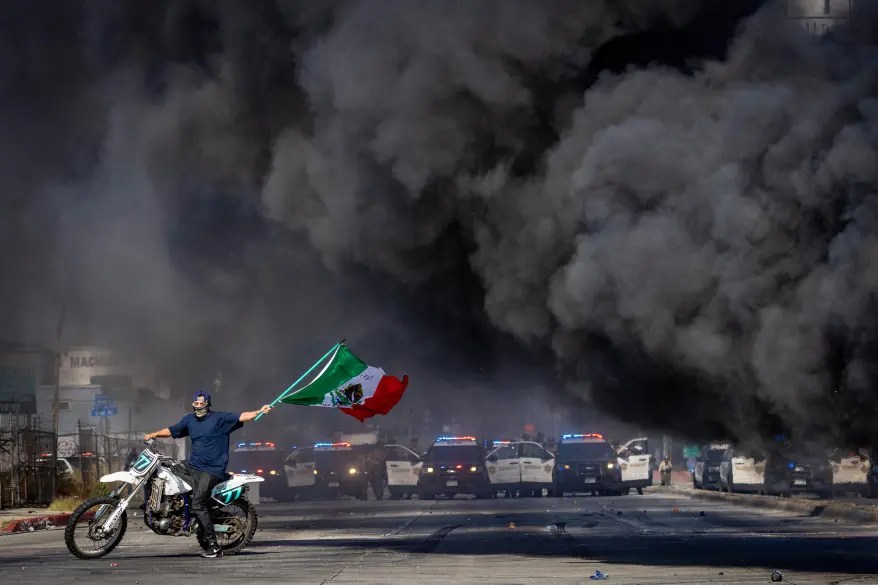
A masked individual on a dirt bike circled a burning car while waving the Mexican flag.

In Paramount, protesters erected barricades from shopping carts and bins, set fire to a vehicle, and threw Molotov cocktails at law enforcement. Protesters also threw rocks at ICE agents and vehicles. Crowds reportedly hurled concrete chunks, bricks, rocks, and bottles at ICE agents and police, and in one high-tension clash a rock shattered an ICE vehicle windshield, injuring an agent.

In downtown Los Angeles, rioters defaced a federal courthouse with graffiti and obstructed traffic by blocking entrances to a detention facility, prompting law enforcement to declare an unlawful assembly and make numerous arrests. Finally, aerial footage and NBC News confirm that at least two individuals were arrested for throwing a Molotov cocktail and assaulting deputies, causing injuries to three officers.

Authorities described up to 1,000 individuals as “rioters” involved in violent activity such as vandalism, assaults on ICE personnel, and property destruction.

The Orwellian Response by Local Media

Clearly, people are rioting in Los Angeles. But just in case, someone wants to quibble, a riot is “a violent disturbance of the peace by a crowd.” When used as a verb, it means to “take part in a violent public disturbance.” Legal definition agree with common usage. California Penal Code 404, defines rioting as “any use of force or violence, disturbing the public peace, or any threat to use force or violence, if accompanied by immediate power of execution, by two or more persons acting together, and without authority of law.” Applying these definitions to the facts is easy to do. It would be inaccurate to say that the protests in Los Angeles are nonviolent.

Unfortunately, describing reality with such a politically loaded word is itself a politically difficult for the press, particularly the liberal local press in Los Angeles. Various media outlets have employed euphemistic terminology to describe the events in Los Angeles following the ICE raids, often softening or reframing the severity of the unrest.

The Los Angeles Times, for example, primarily refers to the events as “clashes” and “[p]rotests against ICE raids” and notes that “National Guard troops arrived in L.A. on Sunday morning … after confrontations between protesters and immigration agents” NPR chose to describe recent events as “clashes with police.” Reuters ran the headline “Riot police, anti-ICE protesters square off in Los Angeles after raids.” The first photograph shows police detaining a “protester,” instead of one of the many photographs of rioting. The Los Angeles Daily News said that the National Guard arrived not to stop the riots but to “quell immigration protests.” There were there “on orders from President Donald Trump to stamp out protests.” Wikipeda’s article on the subject is called, “June 2025 Los Angeles Protests.”

The local CBS station’s headline is “National Guard troops arrive in Los Angeles as immigration enforcement tension escalate.” It’s hard to imagine how throwing a burning bottle of gasoline at law enforcement is just “tensions” and not “rioting.” The ABC affiliate describes “protests” and “clashes” but does not use the word “riots.” The NBC affiliate did not use the word “riot” either, but printed a quote where an HSI official uses the word, which appears to be the most courageous press description of actual reality in this entire list.

Perhaps the most egregious example is LAist, a local NPR station, whose headline is “ICE raids grow tense nationwide as protesters confront immigration agents.” After a request for donations, the article continues this deceptive tone. ICE has “contended with angry crowds protesting their actions.” “This most recent spate of encounters has become heated.” The first quote is from a politician blaming ICE agents. “It got out of control because of the way they showed up.” The article continues by blaming ICE agents for wearing masks and then quotes civil rights organization who defend doxing the agents. The article ends with a mention of George Floyd. The article makes no mention of any violent acts by protesters, injuries suffered by law enforcement, the fact that the raids were completely legal and done pursuant to democratically adopted laws, and does not use the word “riot” at all.

There are several plausible reasons why local media outlets might avoid using the word “riot,” even when it clearly applies to recent events in Los Angeles.

First, sympathy for the protesters or their cause likely plays a significant role. Many local journalists and media organizations operate in urban environments where there is broad political and cultural support for immigrant communities and sanctuary policies. Labeling actions as a “protest” rather than a “riot” implicitly preserves the moral legitimacy of the protesters and underscores their grievances rather than their tactics.

Second, this coverage reveals an underlying antipathy toward immigration enforcement itself. Characterizing these events as “protests” or “confrontations” allows media outlets to keep the focus on the federal government’s actions—which are seen by many in Los Angeles as heavy-handed or unjust—rather than on the disorderly response to those actions. In this framework, softer language shifts the blame narrative toward enforcement agencies and away from the demonstrators.

Third, in Los Angeles, the term “riot” evokes powerful historical memories, particularly of the 1992 unrest following the Rodney King verdict. Media outlets may be cautious about using the word because of its racial and political connotations, preferring less incendiary descriptions unless violence becomes extreme and sustained.

Why This Matters

In moments of crisis, the first duty of a journalist is to tell the truth. When violence erupts in our streets, calling it anything less than what it is—a riot—is not only a failure of candor but a disservice to the community that journalism is meant to serve.

Recent events in Los Angeles have made this clear. In the aftermath of federal immigration raids, we have witnessed acts of violence: vehicles set ablaze, projectiles hurled at law enforcement, Molotov cocktails thrown, businesses vandalized, and public order disrupted. These are not mere “protests” or “confrontations”; they meet the longstanding, well-understood definition of rioting. To describe them otherwise—whether from misplaced sympathy for a cause or from fear of political backlash—is to willfully obscure reality.

This failure is not harmless. By minimizing or playing down violent acts, journalists blur the line between lawful protest—a vital expression of democracy—and criminal conduct that endangers lives and property. In doing so, they erode public trust not just in the press but in civic institutions that depend on accurate information to function. Law-abiding citizens who depend on the media for an honest accounting are left misinformed. Public officials who must make decisions based on facts are given a distorted picture of the situation. Worst of all, victims of violence are effectively erased from the narrative, their injuries and losses rendered invisible under euphemism and understatement.

Moreover, obscuring the nature of the unrest fuels polarization. Those who see the reality of the violence firsthand—and who find the press unwilling to acknowledge it—conclude, not unreasonably, that the media are partisan actors rather than neutral conveyors of truth. They grow cynical and distrustful, believing that journalists are more concerned with protecting political narratives than with reporting facts.

There is no shame in acknowledging that a cause one may sympathize with has been marred by violence. In fact, doing so strengthens the moral authority of peaceful protesters who abide by the law and seek change through legitimate means. Honest reporting distinguishes between the peaceful and the violent, protecting the former from being tarred with the sins of the latter.

Words matter. Precision matters. Honesty matters most of all. In times of social tension, a community does not need comforting half-truths or selective reporting; it needs a clear-eyed account of what is happening. Journalists who shirk this responsibility not only betray their vocation but endanger the very public they are sworn to inform.

Notes

The best headline on this subject goes to the Times of India for A Song of ICE and Fire: How Donald Trump’s immigration raids sparked the LA riots.

Man on motorcycle photo credit: NY Post.

California’s Resentencing Pilot Program: Evaluating Costs and Purpose

In 2021, the State of California initiated the California County Resentencing Pilot Program, which allowed prosecutors to ask judges to release defendants before they had completed their sentences. It was an effort to incorporate prosecutorial discretion into resentencing decisions for individuals serving lengthy prison terms. Funded with an $18 million appropriation from the state budget, the program operated in nine counties, including Los Angeles, San Francisco, Riverside, and Santa Clara.

The program’s stated purpose was to create a mechanism through which district attorneys, in collaboration with public defenders and community-based organizations, could proactively review sentences and recommend early release where appropriate. It reflected a growing belief among reform advocates that achieving a more equitable criminal justice system requires revisiting past sentencing decisions, particularly for individuals who had demonstrated rehabilitation, had aged significantly while incarcerated, or whose “sentences might no longer align with current standards of justice.”

In other words, California tried an early release program in 2021, at the height of the movement to reform the system, and spend a big chunk of money on it.

The implementation of the program, however, proved costly. An independent evaluation conducted by the RAND Corporation revealed that the six counties most actively participating spent nearly $28 million over the three-year pilot period, more than twice the $12.5 million they were originally allocated. The majority of these expenditures were devoted to staffing, including prosecutors, public defenders, investigators, and non-profit personnel, all of whom were necessary to carry out the labor-intensive process of case review, petition preparation, and court advocacy.

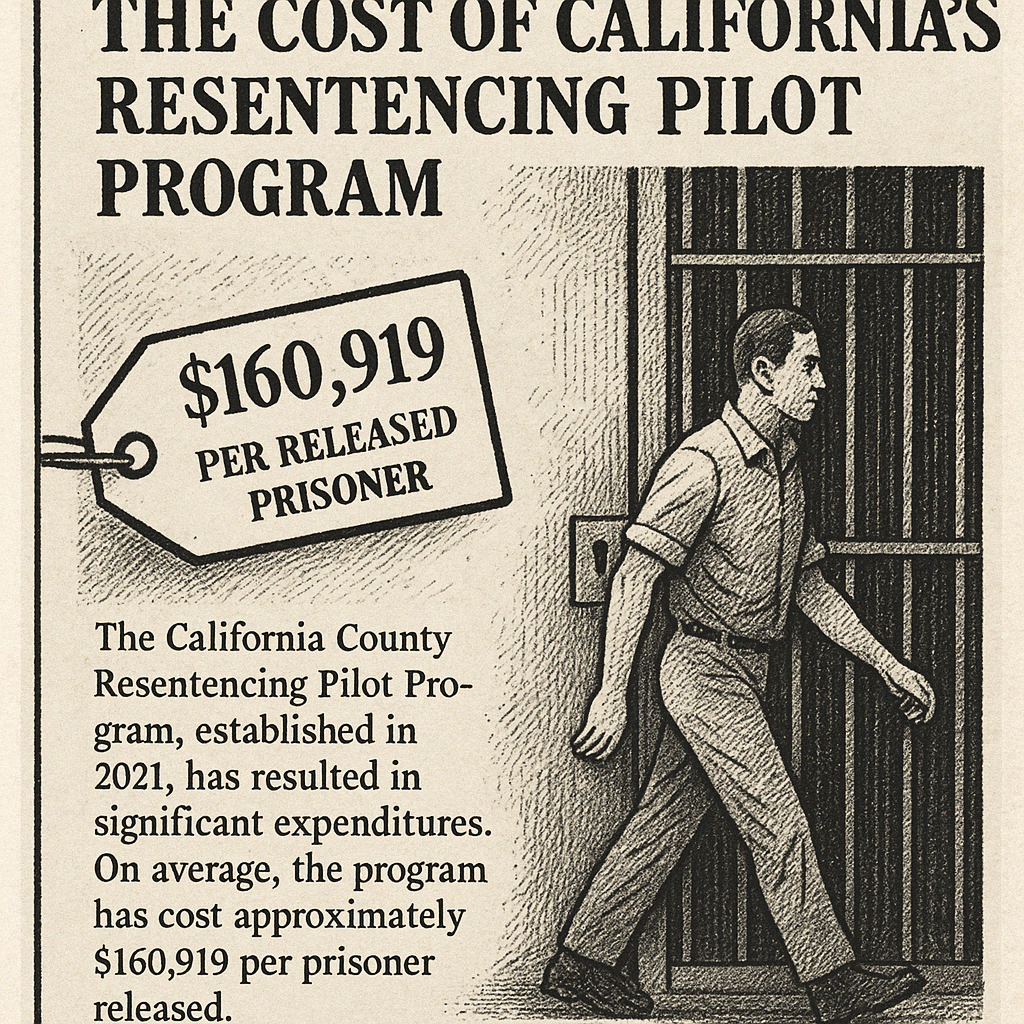
The program had a tiny impact on the 100,000 or so felons in state prison. Across the counties, 1,146 cases were reviewed, resulting in 227 resentencings and ultimately 174 individuals being released from custody: about 1/10 of one percent of state prisoners. This number is miniscule despite the stated purpose of the law: to reduce prison overcrowding. By comparison, the Board of Parole Hearings released about 3,600 individuals during the same time period. The 174 CCRPP releases equate to a public expenditure of approximately $160,919 per released individual. And these statistics do not account for the multiple other ways that prisoners may obtain early release. These include five different types of credit award programs from CDCR. Nor do they include the parole board, which has a budget of about $75m and employs over 300 people. And there is no mention of why the governor’s clemency office could not have done this work without any new program at all.

The huge cost and tiny impact of this program invites reflection on the broader question of whether it was money well-spent. Public spending in this arena necessarily involves trade-offs. Funds allocated to resentencing programs are funds not available for crime prevention, victim services, rehabilitation programs, or other public priorities. Advocates for the program may argue that the cost is justified by the moral imperative to correct overly punitive sentences and to recognize rehabilitation. Critics, however, may question whether a cost of $160,919 per release reflects an efficient use of scarce public resources.

As California continues to pursue sentencing reform, the experience of the County Resentencing Pilot Program suggests the importance of carefully evaluating not only the goals but also the implementation costs of such initiatives. California’s trial courts are facing a $97m deficit. Whether this program represented a sound investment in justice or an inefficient allocation of funds remains a question worthy of serious discussion.

Fire Departments Should Cut Excessive Pay, Not Charge Fees, to Fund Public Safety

I was surprised to read that San Jose approved a fee program allowing their Fire Department to charge people for medical treatment. Starting January 1, 2026, a new “first responder fee” of $427 will be charged for medical services provided by the fire department.

What are “First Responder Fees”?

The mayor said, “Our fire department is responding to more and more medical calls where they are performing health care services, medical services, out in the field. […] All we are saying is for the sustainability of our department we need to be able to bill insurance when it is available to collect or recover the cost of providing medical care out in the field.” Approximately two-thirds of the department’s calls involve medical care, or more than 68,000 requests in 2024. The fees are expected to raise $4 million dollars for the San Jose Fire Department.

San Jose’s Mayor told residents that the city would not attempt to collect the money from them, only from insurance companies. “We are not sending debt collectors, it is not going to ding your credit, we are not interested in collecting directly from residents.” Uninsured residents can pay a reduced fee or get the fee waived altogether if they qualify for the “compassionate billing” provision.

California’s legislature first allowed cities to charge “First Responder Fees” in the 1990s. More than 20 California cities are charging the fees, including Napa, Alameda, Vallejo, and San Francisco, which charges $567. In 2014, the Burbank Fire Department started charging $100 when fire personnel respond to emergency medical calls that don’t include transporting someone to the hospital. A trip to the hospital costs between $1,100 and $1,500. The fee “was derived by calculating personnel costs for a typical response, which generally lasts 20 minutes and includes a fire captain, engineer, two firefighters and two paramedics.” Burbank residents can avoid the fee by paying an extra $48 on top of the taxes they pay to fund the fire department.

“First Responder Fees” Are an Abdication of Government’s Responsibility to Provide Fundamental Services

Mariel Garza argued persuasively in the Los Angeles Times that these fees are “a backward response to changing duties of urban fire departments.” Using her common sense, Garza pointed out that charging a fee for calling 911 would lead to less people calling 911, even though this is a service that people are already paying for with their taxes.

Garza’s argument is supported by real-world examples. Linda Grow’s elderly father fell, cracked four ribs, and collapsed his lung. She called 911 to get help for him. Then she got a bill from the Vallejo Fire Department for $1,880. “I want to warn you all it is not a free call and they do not tell you — you just … get this great big bill in the mail at a real bad time … it was free before our city council voted it in. I thought the firemen came out to help if you fell.”

Hundreds of years ago, fire departments were mostly private. Homeowners would pay a fee to an insurance company, and in return, the company would send firefighters only if the house had a “fire mark” indicating it was insured by them. If you didn’t pay the fee, too bad, your house would burn down. This led to the absurd situation where rival fire companies would race to fires to get the insurance payout, sometimes even fighting each other for the money rather than putting out the fire. And poorer neighborhoods were left with no protection. This situation lead to public outrage, and led to advocacy for better fire services by many people, including Benjamin Franklin. Cities began organizing municipal fire departments at the end of the 19th Century. They recognized that fire protection benefited the whole community.

“First Responder” fees are a return to the “pay for protection” model that public departments were supposed to replace. They create a two-tier system: one for those who can afford to absorb the cost and another for those who hesitate to call for help out of fear of the bill. They revive, in modern form, the exact conditions that public fire departments were created to end — a world where lifesaving services are transactional, conditional, and selective.

The public already pays for fire and emergency services through taxes. Adding additional fees at the moment of crisis is a form of double billing that shifts public safety from a guaranteed public good to an optional, purchasable service. It undermines the very idea of emergency response as a shared social obligation and moves us backward to the days when help came only if you could pay.

These Fees Would Be Unnecessary if Firefighters Weren’t Massively Overpaid

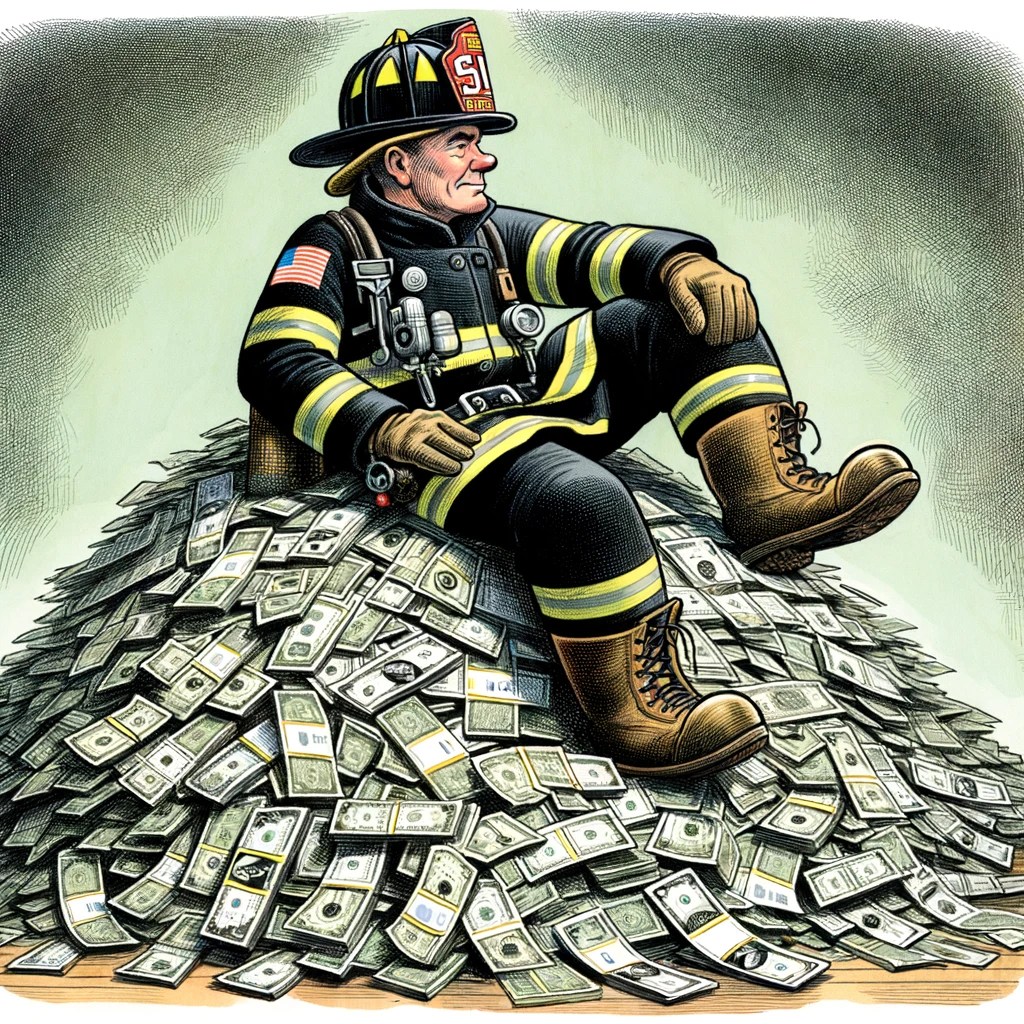
The first fire departments were staffed by volunteers. In many California cities, firefighter compensation has spiraled far beyond what most taxpayers earn. It’s common for rank-and-file firefighters to earn over $200,000 a year when you include base pay, overtime, and benefits. Many retire in their 50s with six-figure pensions, guaranteed for life and often adjusted upward for inflation. Excessive overtime is routine, not because of emergency need, but because of structural staffing policies and union contracts that incentivize costly scheduling.

For example, the average firefighter salary in San Jose, where the fees were just implemented, is $205,312 per year. Maximillian Duenas, a fire captain, made $703,815.29 in 2023. He was the highest-paid employee of the city of San Jose. The second highest paid was Galvin Charekian, also a fire captain, who made $588,301.93, including $309,358 in overtime, almost double his regular pay.

To put Captain Duenas’s mammoth paycheck in context, the average annual salary for an elementary school teacher in San Jose is approximately $83,416. Dividing Captain Duenas’s earnings by this average salary suggests that the city could employ about 8.4 elementary school teachers for the same amount. That is enough to teach 240 children for a year. $703,815 is also enough to buy 28,152 new books at $25 each, enough to fill an entire public school library. If the average annual maintenance cost per acre of a public park is $5,000, Captain Duenas’s salary could maintain approximately 140 acres of public parkland for a year. It’s also enough to repair 2,346 potholes assuming a range of $100 to $500 per pothole.

These costs aren’t the unavoidable price of public safety. They are the result of decades of political deals, union leverage, and a system that pays public employees more than the taxpayers who fund them. Now, when budgets strain under those inflated payrolls, departments propose slapping a fee on people at their most vulnerable moments — after an accident, injury, or medical emergency — to cover costs that are bloated by public employee compensation.

Notes

San Jose’s Fire Department recently protested their salaries, demanding more pay.

LAFD union chief made $540,000 in 2024 because of overtime.

More Details on the LASD Personnel File Heist

The Los Angeles Times has a long article on LASD’s investigation into stolen deputy personnel files and document leaks. The Times obtained LASD’s report into crimes by its oversight. Readers will quickly recognize that the paper wants to tell readers what the report says without letting readers believe any of it is true. Still, some fascinating details are hidden in the article if you read carefully.

New Details Into Potential Crimes by Oversight Agencies

The LA Times obtained an 80-page report of the LASD investigation into stolen deputy personnel files. The report is part of a larger, 300-page case file. The Times reviewed the report and discussed it but did not provide a copy of the report for readers to draw their own conclusions.

The article begins with LASD‘s investigation into the theft of confidential personnel documents.

The criminal investigation began soon after Villanueva took office, when his transition team noticed “abnormalities” while reviewing personnel records, according to the report. In early 2019, the sheriff’s chief of staff asked internal criminal investigators to look into it, and in 2021 the department sent the case file to state prosecutors.

The investigation has two prongs. The first prong of the investigation focused on Office of the Inspector General chief Max Huntsman, and his effort to obtain deputy personnel files, including the file of then-Sheriff Alex Villanueva. Peace office personnel files are protected by law and by LASD policy. But LASD has an informal agreement to share personnel files with OIG for limited purposes. OIG cannot use the files for any purpose they like: the files must be used only to further their oversight role. LASD suspected that OIG was abusing their access to personnel files.

In 2018, LASD cut off OIG access to the personnel files of 54 deputies who were being investigated by LASD’s Internal Affairs Bureau. Huntsman requested that LASD restore access to these files to OIG. Huntsman later emailed an LASD oversight official – distinct from OIG – and told her that the Sheriff had instructed her to release all files. This turned out not to be entirely true.

By apparent coincidence, the LASD oversight official was Diana Teran, who was recently charged with several felonies related to document theft by the attorney general. Teran corrected Huntsman and said she had not been authorized to release all the files, just a smaller group of them. Later, a different LASD official gave OIG all the files. The LASD investigation says that this official was “duped” by Huntsman’s OIG into giving OIG the documents.

Huntsman disputed the accusation that OIG obtained the files by fraud. He said that they obtained the files to track any changes made to them by incoming LA County Sheriff Alex Villanueva.

“Our reason for getting those files was, in part, to be sure the Sheriff’s Dept. complied with the law,” Huntsman told The Times this month. “We were concerned that there might be an attempt to alter government records, and we wanted to obtain a copy so that we would be able to provide proof to anybody later.”

It is not clear if OIG was permitted by law to do this. The article is silent on this point. A cursory look at OIG’s mission suggests it is outside the scope of their oversight and therefore illegal. What is clear is that Huntsman was “concerned” by Villanueva’s election. He was also against Villanueva’s decision to rehire a deputy that Villanueva believed had been fired unjustly. Huntsman, through OIG, had written a report opposing the rehiring.

The second prong of the investigation focused on suspicions “that oversight officials, as well as the former LASD constitutional policing advisor, Diana Teran, stole records of Villanueva and his top associates.”

Oversight officials were apparently unaware that LASD had been tracking their access to confidential personnel files.

In 2018, department officials created a secret audit tool that would allow them to track who accessed personnel files — including outside oversight officials.

Over the next 11 months, the sheriff’s report says, that auditing tool showed that Office of Inspector General officials downloaded an “extraordinary number” of items — 1,500 — from the department’s database of personnel files.

LASD officials were particularly concerned about the files being accessed by OIG Attorney Bita Shasty. She accessed personnel files of people Villanueva intended to promote, even though none of them were under investigation. This is a violation of OIG’s agreement with LASD and a violation of the California Government Code.

The LASD tracker also turned up evidence against Diana Teran. She “downloaded dozens of case files on at least three separate occasions, including on June 5, 2018, the day of the primary election, and Dec. 2, 2018, her last day working for the Sheriff’s Department,” according to the report. Teran was recently charged with stealing confidential deputy personnel files by the California attorney generals office.

LASD officials also believe that the contents of these files were leaked to the press by OIG in an effort to foil the deputies’ promotions and harm Villanueva politically. The Los Angeles Times is itself a long-time beneficiary of leaks believed to originate with LASD oversight agencies like OIG.

Villanueva described the investigation like this:

“People got caught with their hands in the cookie jar, […] It turns out I was one of 22 employees, where their files were illegally accessed and downloaded. When you illegally access them, that’s a misdemeanor crime. When you download them, and remove them, then it becomes a felony. This happened 2,400 times. […] These files, as they were downloaded, they started appearing in the media. Gee, I wonder how.”

Oversight officials concede that they downloaded confidential personnel files but say they were entitled to the files, did not misuse them, and did not leak them.

The Implications

The article ends with a provocative bit of information. OIG head Max Huntsman said “he has never officially been informed by the department or the attorney general’s office that he’s no longer a criminal suspect.” Many rumors suggest that the charges against Teran are a prelude to charges against Huntsman. Rumors are circulating that an indictment against more oversight officials (beyond Teran) is in the works.

At the very least, despite the LA Times’ obfuscation efforts, it appears that LASD has evidence that OIG officials were overstepping their access privileges and committing crimes in the process.

As of April 2, 2025, the Court of Appeal has taken up a pretrial writ and appears skeptical of the charging decision.

Update on the Charges

The charges against Diana Teran were dismissed by the Court of Appeal in June. In September, Chief Probation Officer Guillermo Viera Rosa named Diana Teran as his special counsel.

New Details on Gascon’s “Ethics” Czar Charged with Stealing Deputy Data

A Los Angeles judge released an arrest warrant affidavit shedding light on why the California Department of Justice filed a case against Diana Teran, a top deputy of LADA George Gascon. The affidavit revealed that the AG began looking into allegations that another Gascon appointee had drunkenly threatened to blacklist an officer who pulled him over. This investigation led to evidence that Teran had illegally stolen police personnel data to put it on the same blacklist.

It All Started With A Drunken Chief Deputy District Attorney

In February 2022, Joseph Iniguez was pulled over for a DUI traffic stop. He is the Chief Deputy to the Los Angeles County District Attorney, progressive prosecutor George Gascon. Iniguez, who was drunk, got out of the passenger seat of the car to argue with the police. When this did not result in him being let go, he began to threaten the officers, urging them to run his license plate, which would reveal his position as a high-ranking prosecutor.

He also threatened to put the officers on LADA’s Brady list. This is a list of officers that cannot be trusted to testify in court. In other words, Iniguez threatened to end the officer’s career by blacklisting him. Officers who cannot testify cannot be used to investigate cases. Placement on the Brady list can even result in termination. Iniguez’s threat was credible: he is the prosecutor that oversaw that list at the time he was pulled over. Iniguez was arrested, allowed to sober up, and released. He was never charged with a crime.

Iniguez’s threats apparently caught the attention of the California Department of Justice. They began to investigate, presumably to see if Iniguez was using his position to retaliate against the officer that pulled him over. But the investigation ended up in a very different place.

The AG’s investigation revealed that another Gascon political appointee named Diana Teran “accessed over 1,600 statutorily-protected peace officer personnel files as well as internal emails and documents concerning internal affairs investigations and confidential civil service proceedings” while overseeing LASD. There’s nothing wrong with doing that while in an oversight role. The problem is that Teran left LASD in 2018. What caught the AG’s eye was evidence that she illegally took those files to LADA in 2021.

After joining LADA in January 2021, TERAN repeatedly used data from those LASD personnel files and internal emails and documents in a surreptitious attempt to add peace officer names into LADA’s Brady and ORWITS databases.

(Affidavit at pp. 2:28-33.)

That is exactly what Iniguez was threatening to do during his drunken DUI stop. Adding those officers to the list would end their careers. And she was stealing their data to do it, which the AG says is a felony.

George Gascon’s Ethics and Integrity Chief is a Criminal Defendant

Attorney General Rob Bonta filed felony charges against Ethics and Integrity Assistant District Attorney Diana Teran on April 24, 2024. After what he called “an extensive investigation,” the California Department of Justice charged Teran with violating Penal Code section 502 subdivision (c)(2), alleging repeated and unauthorized use of data from police personnel files.

“No one is above the law,” he said. “Public officials are called to serve the people and the State of California with integrity and honesty. At the California Department of Justice, we will continue to fight for the people of California and hold those who break the law accountable.”

Even though Teran had accessed 1,600 records, Bonta focused on 11. He accused Diana Teran of downloading the records of 11 Los Angeles County Sheriff’s deputies while working as a Constitutional Policing Advisor at the Los Angeles County Sheriff’s Department. Bonta accused her of impermissibly using those records after joining the Los Angeles County District Attorney’s Office.

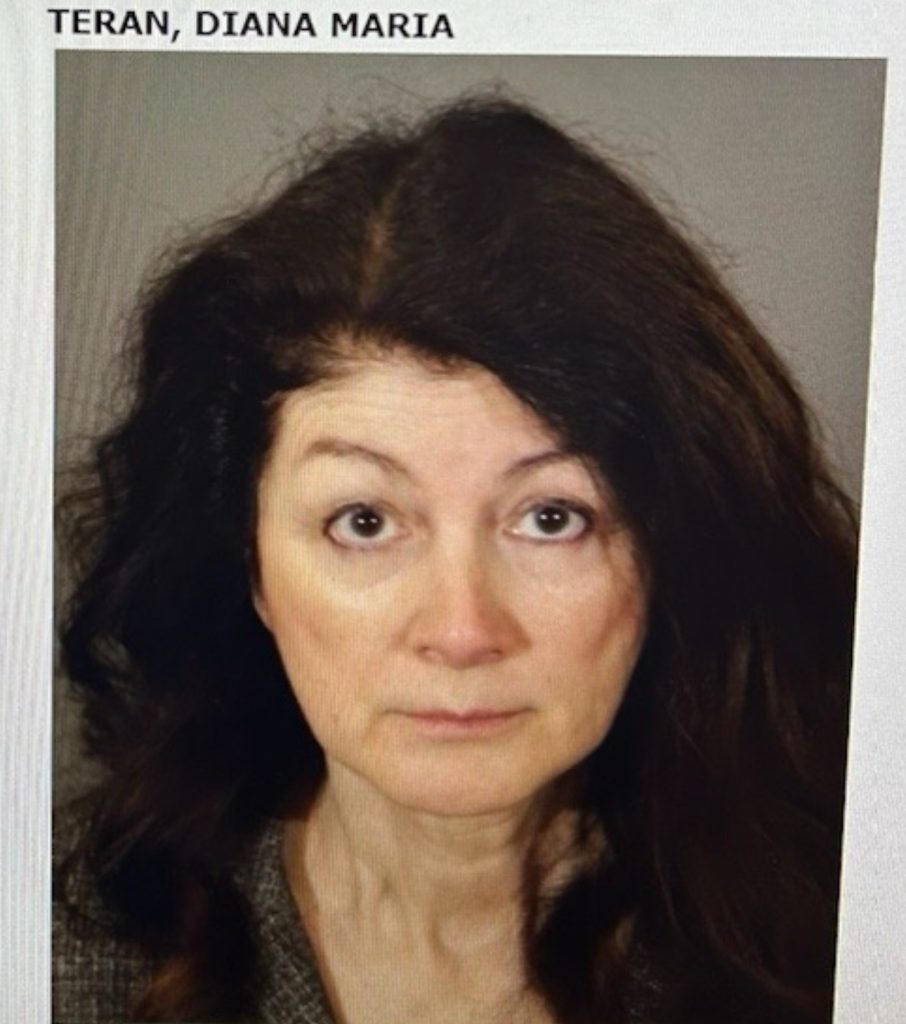
On April 27, 2024, Diana Teran turned herself in to the police. She was booked, took a mugshot, and was released after posting a $50,000 bond.

Credit: The Current Report

Last month, the Los Angeles Public Press brought a successful motion to unseal the arrest warrant affidavit in the case against Teran. Their motion was joined by Teran’s defense attorney, James Spertus. Judge Mary Lou Villar granted the motion and unsealed the affidavit on June 25th.

What’s in the Affidavit?

You can read the affidavit here:

The LA Public Press article, written by Emily Elena Dugdale, was overtly critical of Bonta and the AG’s office. The article quotes Susan E. Seager, a law professor, who said, “What this unsealing reveals is that Rob Bonta doesn’t understand public court documents.” She claimed that two of the 11 deputies placed their disciplinary records in the public domain prior to the crimes. She concluded, “What a joke.”

Seager did not explain whether she believed this would be a defense in the case against Teran, nor did Teran’s lawyer, James Spertus, who is quoted at length in the article. Professor Seager also did not address the charges relating to the other nine deputies.

What’s Next?

There may be more to come. The affiant, Special Agent Tony Baca, said “I have not included each and every fact known to me concerning this investigation.” He implied that there was evidence omitted from the affidavit. “Unless specifically indicated otherwise, all conversations and statements described in this affidavit are related in substance and in part only.”

Baca described the investigation as “ongoing.” He mentioned three witnesses who may be cooperating. And crucially, he mentioned that the grand jury is permitted to use materials from his investigation.

Rumors and speculation are flying around the LADA’s office. Prosecutors speculate that Teran raised suspicions when she suggested, out of the blue, that her employees investigate certain deputies that had not been on their radar. LADA had no reason to know anything about these deputies that might put them on the Brady list. It wouldn’t take long for prosecutors to realize that Teran may be using information she had obtained illegally during her former oversight role.

An investigatory grand jury has been convened on the case. That means that the Attorney General’s office is using the grand jury’s powers to continue its investigation. The involvement of the grand jury suggests that an indictment may be coming, either against Teran or against other potential defendants.

Teran is set to be arraigned on the complaint in July. Proceedings in front of the grand jury are secret. There is no way to know if a superceding indictment will come down against Teran, or against anyone else, much less when indictments may be unsealed.

Notes

Teran is also implicated in a whistleblower lawsuit that accuses her of delaying prosecutorial decisions against deputies in high-profile incidents, potentially to influence electoral outcomes.

DDA Ryan Erlich details the long history of scandal and dysfunction at George Gascon’s office.

Prosecutors Alliance, a group of progressive prosecutors, wrote an open letter asking Bonta to dismiss the case.

The LA Times, in a totally objective article, calls the charges “bunk” and only includes quotes from Gascon Allies.

More defense complaining in the LA Times.

USC Professor Jody Armour claims Bonta brought the case because he is afraid of police unions.

Bonta and Gascon in better times:

Whistleblower Blasts George Gascòn’s Cronyism and Gets a Response

John Lewin, cold case prosecutor and LADA critic, sent the following email to LADA management this morning. It is also posted on his public Facebook.

Your Latest Promotions

George:

As a career prosecutor with 30 years of experience who has tried an innumerable number of incredibly complex and high profile cases over my distinguished career, I wanted to make sure that you were aware of the response within the office to several of your recent promotions/transfers.

I send this knowing that you seem to rarely show up to do your actual job and appear to have a little or no interest in how your decisions impact your responsibilities in your position of what is supposed to be the chief law-enforcement officer of Los Angeles County.

As has been your modus operandi, you have made a mockery of the promotion process by promoting inexperienced sycophants over accomplished and well deserving actual prosecutors. Although this is your legal prerogative as District Attorney (for the few months that you remain in the position), the stench of incompetence, and even the appearance of outright corruption that it leaves in its wake, is beyond disturbing to contemplate.

First, you promoted several individuals who were young Grade 2s, when you came into office, whose sole qualifications for their Grade 4s appear to be that they are close friends/classmates of your equally incompetent current Chief Deputy, Joseph Iniguez (a promotion itself that has been met with justifiably relentless criticism and outright ridicule because it was so completely undeserving and so obviously politically motivated).

This promotion list and the latest administrative transfers/promotions, also demonstrate your commitment to promoting a number of ex-public defenders who have no experience and who have demonstrated a consistent level of incompetence in their new positions as “prosecutors” that has been almost breathtaking to behold.

You promoted John Perroni to Grade 4, a career public defender who his supervisor in JSID testified under oath could not competently handle his duties in JSID and needed to go to prelims or misdemeanors to learn the basics of the job.

Even worse, career public defender and recently hired DDA Greg Apt was just promoted to become the Assistant Head Deputy of JSID. This promotion occurred even though that same supervisor, the well-respected ex-Asst. Head Deputy of JSID (who you retaliatorily transferred out of the unit, who is married to a current public defender, and who along with her husband, is extremely personally close to Apt) reluctantly testified under oath that Apt too was unqualified to even be in JSID (much less lead it), and now you have made him second in command there. Is this really a defensible promotion?

Before you promoted Apt, did you consider the appearance of impropriety and favoritism from the fact that Apt just gave $1000 to your reelection campaign? I believe it’s your largest donation from any DDA in the office! When you couple that contribution with the $19,000 given to your original campaign for DA in 2020 by your inexperienced and highly under-qualified current Chief Deputy, Joseph Iniguez, it leads to the inescapable conclusion that if you give George Gascon 💰💰, you will get rewarded! Maybe that’s why ethical DAs like Jackie Lacey refused to accept campaign contributions from their employees!

This is pay to play at its finest!!

When you couple Apt’s promotion with the prior conduct and or disgusting and disparaging comments directed at police officers by ex-public defenders Blacknell and Teran (who you have also undeservedly promoted to two of the highest positions in the office), how can any law enforcement officer feel like they will have a fair evaluation of any allegation when these are two of the small number of people making the charging evaluations in these complicated cases?

Finally, I’ve been told that you don’t appreciate my emails (I guess that’s why you’ve never responded to any of them), but rest assured, I will continue to point out your disgraceful, incompetent and corrupt conduct whenever I see fit in whatever way I choose to do so! And, if you think that you can silence me by more acts of retaliation, if you haven’t figured it out by now, that is an approach that has never and will never work!!

-John Lewin

The Response

Lewin got a response from retired DDA Craig Rouvs:

It is unclear whether Lewin’s “nameless troops” will have to look very far to find something dumb that Rouvs said.

Notes

Photo Credit: Getty Images

Veteran Prosecutor Ruins George Gascon’s AMA

DDA John Lewin appeared on Instagram with eight pointed questions for Los Angeles County District Attorney George Gascon. Lewin raised some tough questions, especially considering that Gascon awarded Lewin prosecutor of the year and then, in a dramatic turn, banished him to an obscure corner of the office. So take a tour through some of Gascon’s biggest scandals, or sit back and enjoy watching LADA’s cold case expert take on his boss, lawyer who has never tried a case.

The Questions

Here, Lewin is referring to Gascon’s indictment of Torrance Police Department officers Anthony Chavez and Matthew Concannon for the fatal shooting of Christopher Mitchell. The officers shot Mitchell during a traffic stop after he refused to exit his vehicle and reached for a gun in his lap. The gun was an air rifle.

The gun in Christopher Mitchell’s lap. Credit LADA, City News Service

Although LADA had already reviewed the shooting and found it justified, Gascon indicted the two officers in March 2023.

Rumors have been swirling that the indictment was based on a law that was not in effect when the crime was committed. Both officers are charged with voluntary manslaughter. The indictment is based on the argument that the force used on Mitchell was not necessary since the gun was only an air rifle. This theory would work under the current state of the law. (Pen. Code, § 835a.) Today, peace officers may “use deadly force only when necessary in defense of human life.” (Id.) Section 835a also toughened several other standards around the use of force by police officers. For example, the standard is now objective; it no longer matters whether the officers subjectively though that deadly force was necessary. Today, the officers will have a harder time defending themselves by saying they thought the air rifle was a real gun. However, at the time of the crime, the law was less strict. Back then, the standard was subjective. “I thought the gun was real” was a defense when this shooting happened. And back then the force used by police only had to be “reasonable,” not “necessary.”

Why is this a problem for Gascon? He’s trying to use the new law to prosecute the old shooting. You can’t do that. The law that applies to the shooting is the law in place at the time of the shooting, not today’s laws. Trying to use today’s laws to punish yesterday’s crimes is called an “ex post facto” law. These type of laws were banned by the Constitution. This ban is taught as a basic fundamental feature of American criminal law. Observers, especially prosecutors, have been shocked that Gascon made such a basic error.

Questions about the Mitchell shooting continue. Lewin is referring to the rumor that Gascon special prosecutor Lawrence Middleton failed to present exculpatory evidence to the grand jury. This is required in state court but not in federal court. Many have speculated that Middleton was not aware of the rule requiring him to present exculpatory evidence because he only practiced in federal court where the rule does not apply. The rule requiring exculpatory evidence, called the Johnson rule, is universally known among Gascon’s deputies, making Middleton’s blunder especially embarrassing. (See People v. Johnson (1975) 15 Cal.3d 248.) It has been on the books for 48 years. Even worse, Middleton is being paid 1.5 million dollars a year and still making basic mistakes. Gascon’s office is full of prosecutors making $200,000 a year who have no problem obtaining indictments without violating state law. This bungled indictment is the only criminal charge Middleton has filed in the two years he has been on the payroll.

Lewin is referring to Gascon’s statements during an April 2023 news conference on the Mitchell shooting. “From my own personal review, I question whether the officers were able to see the gun before the shooting.” Gascon said. He continued “we know even the prior review indicated that there was no evidence that [Mitchell] was reaching for a gun.” The statements are significant to Lewin and many others because they seem to violate the State Bar’s Rules of Professional Conduct. Specifically, Rule 5-120 governs “Trial Publicity” and provides:

A member who is participating or has participated in the investigation or litigation of a matter shall not make an extrajudicial statement that a reasonable person would expect to be disseminated by means of public communication if the member knows or reasonably should know that it will have a substantial likelihood of materially prejudicing an adjudicative proceeding in the matter.

In other words, don’t talk about ongoing cases in the press, especially if it a potential juror may hear you. This rule explicitly applies to prosecutors. As with Middleton, it is likely that Gascon, who has never tried a case, much less a media case, simply did not know what his ethical obligations are.

Here, Lewin correctly points out that if the officers shot Mitchell without seeing the gun they would be guilty of first or second degree murder, not manslaughter. The theory of imperfect self-defense (“I thought he had a real gun but I was wrong”) would reduce murder to manslaughter. But only if a jury believes that the officers really thought he had a gun. If Gascon is right, and the officers shot him without seeing a gun, imperfect self-defense is not available and the right charge is murder. Although Lewin focuses his fire on Gascon, this is an equally valid question for Middleton, his special prosecutor.

Gascon demoted Lewin and other experienced prosecutors when he took office. Two of Gascon’s top deputies (both former public defenders) filed equity complaints against Lewin based on his social media posts. The office hired white-shoe law firm Sheppard Mullin to investigate Lewin for equity violations. Many, including Lewin, believe this was done in retaliation for their criticisms of Gascon’s policies. At least 10 high-ranking members of the district attorney’s staff have filed lawsuits alleging they were removed from their positions because they voiced disagreement with Gascon’s policies. Gascon has also weaponized the County’s Equity Policy to suspend prosecutors who have been critical of him. Lewin’s comments could be an indication that Gascon is using the same tactics against him.

Lewin is referring to Gascon’s practice of taking credit for his deputies’ convictions. For example, Eric Holder Jr. murdered rapper Nipsey Hussle. Holder was convicted by DDA John McKinney, a veteran prosecutor who has been critical of Gascon. The press release celebrating the conviction completely omitted McKinney, who did all the work.

Shawn Randolph, who is also mentioned by Lewin, won 1.5 million dollars after Gascon retailed against her. She proved that Gascon demoted her because she pointed out that some of his policies were illegal.

Joseph Iniguez, a four-trial prosecutor, jumped the line to Chief of Staff after endorsing Gascon during his campaign. Iniguez was arrested for being drunk in public at a fast food drive-thru. Although the police did not press charges, Iniguez sued the officer for impeding him as he attempted to videotape the encounter. Iniguez says he captured the entire incident on video. He also claims that the video proves the police officer made an illegal arrest and lied about it. Iniguez has never released the video even as the allegedly dirty officer has continued to do his job and make arrests. This is a problem.

If Iniguez is telling the truth, his failure to release the video has allowed a dirty, dishonest cop to remain on the beat. That’s a violation of his obligation as a prosecutor to provide defendants with evidence they may need. Specifically, if you were arrested by this officer, you could hold up Iniguez’s video and say, “this officer is a liar.” You could do that if you had the video, which you don’t, because Iniguez won’t produce it. If, on the other hand, Iniguez is lying about the officer, who really did nothing wrong, then Iniguez’s actions makes sense. He doesn’t want the world to know he’s lying.

When Gascon came into office, he gave a sweetheart offer to a criminal represented by a campaign donor. Moreover, the offer was negotiated for Gascon by Tiffany Blacknell, a public defender. That means that Blacknell was negotiating for Gascon while working against Gascon on behalf of the defendant in this case. This is an obvious conflict of interest. Although this was a particularly egregious example, prosecutors have noticed many others.

The largest apparent conflict was Gascon’s decision to allow his policies, like his ban on the use of any enhancements, to be written by public defenders. In other words, the criminal defense bar got to write policies that benefited their clients at the expense of the public, who wasn’t even at the table.

Do The Answers Matter?

George Gascon began his career as the District Attorney of San Francisco County. He could easily fire prosecutors he didn’t like in San Francisco. But the rules are different in Los Angeles. It is much harder, if not impossible, to fire John Lewin, which gives Lewin the freedom to ask these hard questions. You can tell that Lewin is angry by the tone of the questions. The most important question of all is whether Los Angeles is angry enough to oust Gascon in 2024.