Veteran Prosecutor Ruins George Gascon’s AMA

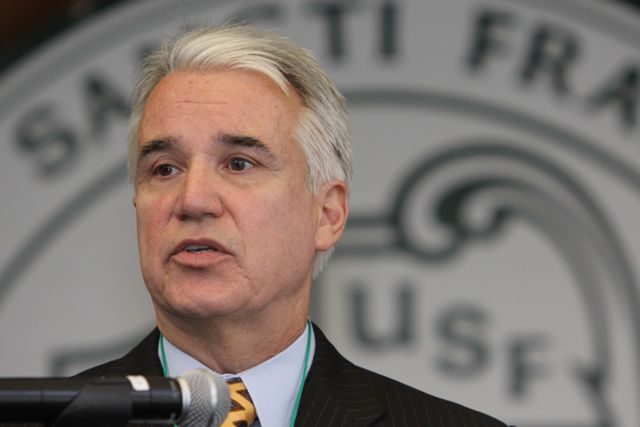
DDA John Lewin appeared on Instagram with eight pointed questions for Los Angeles County District Attorney George Gascon. Lewin raised some tough questions, especially considering that Gascon awarded Lewin prosecutor of the year and then, in a dramatic turn, banished him to an obscure corner of the office. So take a tour through some of Gascon’s biggest scandals, or sit back and enjoy watching LADA’s cold case expert take on his boss, lawyer who has never tried a case.

The Questions

Here, Lewin is referring to Gascon’s indictment of Torrance Police Department officers Anthony Chavez and Matthew Concannon for the fatal shooting of Christopher Mitchell. The officers shot Mitchell during a traffic stop after he refused to exit his vehicle and reached for a gun in his lap. The gun was an air rifle.

The gun in Christopher Mitchell’s lap. Credit LADA, City News Service

Although LADA had already reviewed the shooting and found it justified, Gascon indicted the two officers in March 2023.

Rumors have been swirling that the indictment was based on a law that was not in effect when the crime was committed. Both officers are charged with voluntary manslaughter. The indictment is based on the argument that the force used on Mitchell was not necessary since the gun was only an air rifle. This theory would work under the current state of the law. (Pen. Code, § 835a.) Today, peace officers may “use deadly force only when necessary in defense of human life.” (Id.) Section 835a also toughened several other standards around the use of force by police officers. For example, the standard is now objective; it no longer matters whether the officers subjectively though that deadly force was necessary. Today, the officers will have a harder time defending themselves by saying they thought the air rifle was a real gun. However, at the time of the crime, the law was less strict. Back then, the standard was subjective. “I thought the gun was real” was a defense when this shooting happened. And back then the force used by police only had to be “reasonable,” not “necessary.”

Why is this a problem for Gascon? He’s trying to use the new law to prosecute the old shooting. You can’t do that. The law that applies to the shooting is the law in place at the time of the shooting, not today’s laws. Trying to use today’s laws to punish yesterday’s crimes is called an “ex post facto” law. These type of laws were banned by the Constitution. This ban is taught as a basic fundamental feature of American criminal law. Observers, especially prosecutors, have been shocked that Gascon made such a basic error.
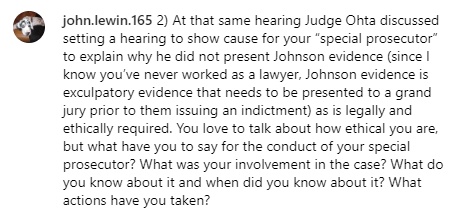
Questions about the Mitchell shooting continue. Lewin is referring to the rumor that Gascon special prosecutor Lawrence Middleton failed to present exculpatory evidence to the grand jury. This is required in state court but not in federal court. Many have speculated that Middleton was not aware of the rule requiring him to present exculpatory evidence because he only practiced in federal court where the rule does not apply. The rule requiring exculpatory evidence, called the Johnson rule, is universally known among Gascon’s deputies, making Middleton’s blunder especially embarrassing. (See People v. Johnson (1975) 15 Cal.3d 248.) It has been on the books for 48 years. Even worse, Middleton is being paid 1.5 million dollars a year and still making basic mistakes. Gascon’s office is full of prosecutors making $200,000 a year who have no problem obtaining indictments without violating state law. This bungled indictment is the only criminal charge Middleton has filed in the two years he has been on the payroll.
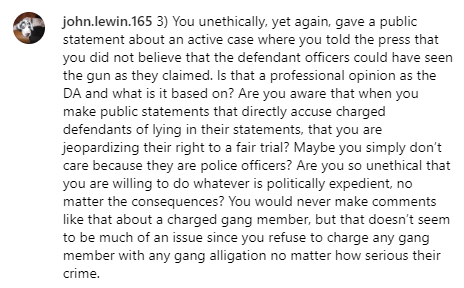
Lewin is referring to Gascon’s statements during an April 2023 news conference on the Mitchell shooting. “From my own personal review, I question whether the officers were able to see the gun before the shooting.” Gascon said. He continued “we know even the prior review indicated that there was no evidence that [Mitchell] was reaching for a gun.” The statements are significant to Lewin and many others because they seem to violate the State Bar’s Rules of Professional Conduct. Specifically, Rule 5-120 governs “Trial Publicity” and provides:

A member who is participating or has participated in the investigation or litigation of a matter shall not make an extrajudicial statement that a reasonable person would expect to be disseminated by means of public communication if the member knows or reasonably should know that it will have a substantial likelihood of materially prejudicing an adjudicative proceeding in the matter.

In other words, don’t talk about ongoing cases in the press, especially if it a potential juror may hear you. This rule explicitly applies to prosecutors. As with Middleton, it is likely that Gascon, who has never tried a case, much less a media case, simply did not know what his ethical obligations are.

Here, Lewin correctly points out that if the officers shot Mitchell without seeing the gun they would be guilty of first or second degree murder, not manslaughter. The theory of imperfect self-defense (“I thought he had a real gun but I was wrong”) would reduce murder to manslaughter. But only if a jury believes that the officers really thought he had a gun. If Gascon is right, and the officers shot him without seeing a gun, imperfect self-defense is not available and the right charge is murder. Although Lewin focuses his fire on Gascon, this is an equally valid question for Middleton, his special prosecutor.
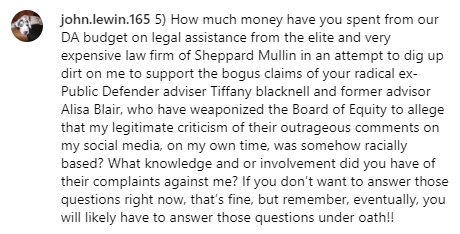
Gascon demoted Lewin and other experienced prosecutors when he took office. Two of Gascon’s top deputies (both former public defenders) filed equity complaints against Lewin based on his social media posts. The office hired white-shoe law firm Sheppard Mullin to investigate Lewin for equity violations. Many, including Lewin, believe this was done in retaliation for their criticisms of Gascon’s policies. At least 10 high-ranking members of the district attorney’s staff have filed lawsuits alleging they were removed from their positions because they voiced disagreement with Gascon’s policies. Gascon has also weaponized the County’s Equity Policy to suspend prosecutors who have been critical of him. Lewin’s comments could be an indication that Gascon is using the same tactics against him.

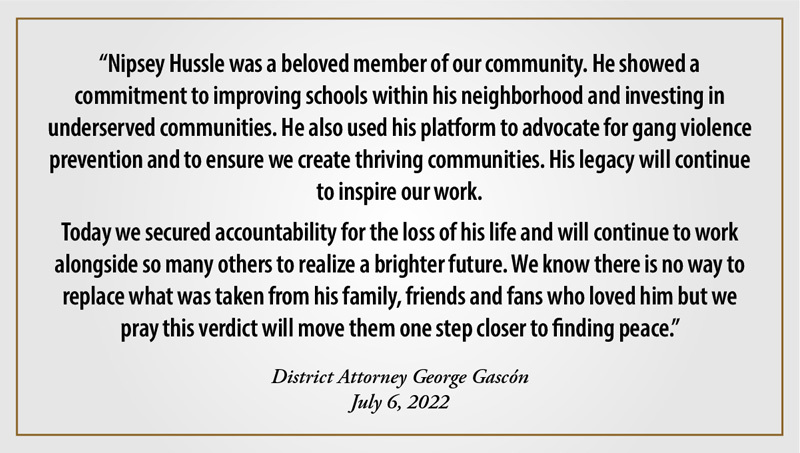
Lewin is referring to Gascon’s practice of taking credit for his deputies’ convictions. For example, Eric Holder Jr. murdered rapper Nipsey Hussle. Holder was convicted by DDA John McKinney, a veteran prosecutor who has been critical of Gascon. The press release celebrating the conviction completely omitted McKinney, who did all the work.
Shawn Randolph, who is also mentioned by Lewin, won 1.5 million dollars after Gascon retailed against her. She proved that Gascon demoted her because she pointed out that some of his policies were illegal.
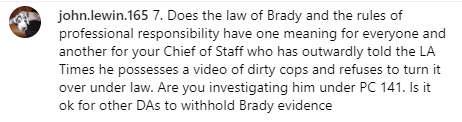
Joseph Iniguez, a four-trial prosecutor, jumped the line to Chief of Staff after endorsing Gascon during his campaign. Iniguez was arrested for being drunk in public at a fast food drive-thru. Although the police did not press charges, Iniguez sued the officer for impeding him as he attempted to videotape the encounter. Iniguez says he captured the entire incident on video. He also claims that the video proves the police officer made an illegal arrest and lied about it. Iniguez has never released the video even as the allegedly dirty officer has continued to do his job and make arrests. This is a problem.

If Iniguez is telling the truth, his failure to release the video has allowed a dirty, dishonest cop to remain on the beat. That’s a violation of his obligation as a prosecutor to provide defendants with evidence they may need. Specifically, if you were arrested by this officer, you could hold up Iniguez’s video and say, “this officer is a liar.” You could do that if you had the video, which you don’t, because Iniguez won’t produce it. If, on the other hand, Iniguez is lying about the officer, who really did nothing wrong, then Iniguez’s actions makes sense. He doesn’t want the world to know he’s lying.

When Gascon came into office, he gave a sweetheart offer to a criminal represented by a campaign donor. Moreover, the offer was negotiated for Gascon by Tiffany Blacknell, a public defender. That means that Blacknell was negotiating for Gascon while working against Gascon on behalf of the defendant in this case. This is an obvious conflict of interest. Although this was a particularly egregious example, prosecutors have noticed many others.

The largest apparent conflict was Gascon’s decision to allow his policies, like his ban on the use of any enhancements, to be written by public defenders. In other words, the criminal defense bar got to write policies that benefited their clients at the expense of the public, who wasn’t even at the table.

Do The Answers Matter?

George Gascon began his career as the District Attorney of San Francisco County. He could easily fire prosecutors he didn’t like in San Francisco. But the rules are different in Los Angeles. It is much harder, if not impossible, to fire John Lewin, which gives Lewin the freedom to ask these hard questions. You can tell that Lewin is angry by the tone of the questions. The most important question of all is whether Los Angeles is angry enough to oust Gascon in 2024.


The “Trial Tax” is a Lie

Here’s someone complaining that criminals get tougher sentences from judges after trial than they would in a plea bargain before trial. For some reason (maybe the post-court commute?) this really triggered me. I feel disgusted at the dishonest way this topic is presented by former criminal defense attorney Christina Swarns and angry that well-meaning people continue to be misled by her.

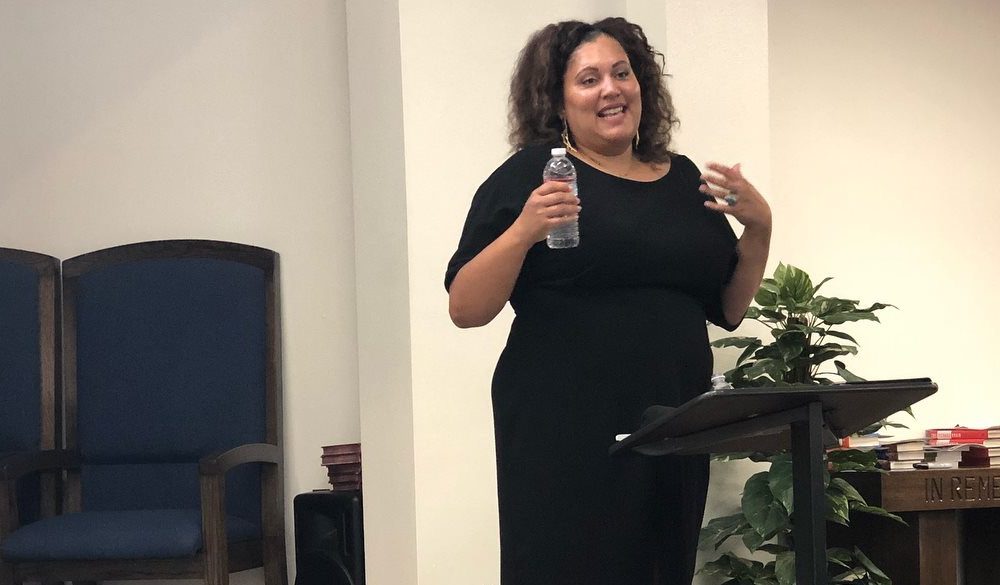
Christina Swarns. Credit: innocenceproject.org

First, she focuses her argument on innocent people. Even using the most generous estimates of those with a political and professional interest in exaggeration, the number of factually innocent people who go to trial is so tiny as to be not worth discussing. I know that will rankle some people who rightly see these cases as a tragedy. But looking at the system as a whole, there are so few actually innocent people as to be statistically insignificant. If we want to write a sob story full of anecdotal evidence, then innocent defendants are out there and exist, but if you want to talk seriously about public policy, then focusing on this group is unserious. Looking at the system as a whole, our procedure is almost laughably defendant-friendly, especially when compared to other countries. As a result, our conviction rates our much lower than our peer countries.

But there are still people that will try to get your clicks, or your time, or your charity dollars by telling stories of the wrongfully convicted. Swarns begins her article with a laughably weak story about a defendant who told her that he was innocent. She was a young, idealistic public defender, and of course she believed him. Left out of her account, as it is left out of most accounts, is the sheer number of people who disagreed with her. She doesn’t mention that a disinterested police officer believed that he was guilty and had evidence of it. A judge reviewed this evidence at the time of arrest and agreed that there was probable cause to believe her client committed the crime. The case was given to a prosecutor, who believed the defendant committed the crime, and that it could be proved beyond a reasonable doubt, and filed the case. Then, another judge heard a preliminary hearing, where the prosecutor and the defense attorney had a chance to put in actual evidence. And this second judge agreed with the first judge, and the officer, and the prosecutor, bringing the total number of disinterested people who have reviewed the evidence 4, and each of them agreed that the defendant was guilty. All of this happened in the case discussed by Swarns. But our young public defender believed her client! And when she tells her story, instead of admitting that the evidence showed his guilt, and that many other experienced people disagreed with her, she omits all this entirely. The only opinion that she thinks you need is hers.

Swarns continues. She put in a lot of work and prepared for trial, but on the day of trial, her client agreed to plead guilty in exchange for a one year sentence. I have been a part of many of these negotiations (maybe you have too?) and they are very realistic. Can the prosecutor prove the case? If he can, what would a judge decide is a just sentence? In Swarns’ case, her client decided that the DA could probably prove the case and that the judge would probably give him a tougher sentence than he was being offered. So he pled guilty. Instead of describing this common-sensical process, Swarns casually implies that the only way that the client would be convicted is racism.

The real world is very different from this description. In the real world, men like Swarns’ clients get away with most of the crimes they commit. Even violent crimes are only reported half of the time, and those reported crimes are only cleared with an arrest half of the time. In communities that are hostile to law enforcement, or that have a “no snitching” culture, these numbers are even lower.

If an arrest is made, and the case is filed by the DA, a violent criminal will come into an environment where there are many more cases than there are resources to prosecute. In other words, the DA’s office is hugely understaffed. The only way that American prosecutors can handle their massive caseloads is to give a discount to a defendant that accepts responsibility early. To be clear, what is happening here is that a defendant is getting less than he deserves simply because your local prosecutor doesn’t have time to take the case to trial.

On the other hand, a defendant has every incentive to go to trial. Virtually every defendant, including Swarns’, is getting a free lawyer. It doesn’t matter to the criminal defendant if they go to trial, they won’t have to pay a dime extra. The free lawyer will do all the work, along with the free defense investigator, and the free secretaries and paralegals needed to support them. There is also usually a free expert witness along the way. Understaffing and high caseloads are why, as Swarns correctly points out, less than 3% of criminal cases go to trial.

In order to settle 97% of cases prosecutors must go easy on guilty defendants. This is a tragedy for crime victims, who are forced to watch as overworked prosecutors sell their dead family members down the road because they don’t have the staff to do a murder trial. It’s a tragedy for anyone who thinks that a justice system should be different than a bazaar where everything is up for negotiation and the real value of something doesn’t matter. And it’s a real tragedy for those people who believe that once the legislature sets a consequence for a crime, that it should be imposed, not whittled away.

In this environment of discounts, bargains, and slaps on the wrist, the trial is the only avenue for actually imposing the consequence intended by the legislature. By the way, if you are a person like Swarns, you probably don’t care whether or not the legislature thinks a crime is worth five years versus four. You probably don’t think about the idea that when a democratically elected group of representatives decides a rule, it should be followed. When they decide a punishment, it should be imposed. Democracy matters, and if we value it, we should not work against it to frustrate the purposes of the legislature and flout their rules. Criminal defense attorneys generally don’t think this way, since their only ethical duty is to get the best possible resolution for the criminal. “Who cares if we voted and decided that spousal battery is illegal? She was cheating on him, so he should get diversion!” They, alone among lawyers, have no ethical duty to be honest. And so they are not honest. And they become so comfortable with dishonesty (or so true-believing in their politics) that they are write articles like this.

Anyway, criminal lawyers know what Swarns wont’ tell you: a sentencing judge is the only place in the courthouse where the defendant is likely to get the sentence he actually deserves. So defendants use their free lawyers and free staff to take a case to trial. Maybe they think they’ll beat it. Maybe they think that the witnesses won’t show up. Maybe they see what’s happening in the courthouse and think that after conviction they will still be able to get just a slap on the wrist. And sometimes they get lucky. But sometimes they get convicted and are surprised when there is an actual consequence for their crimes. So they cry “trial tax” and naive people believe them.

Notes

Swarns signs off her article “With gratitude, Christina Swarns Executive Director, Innocence Project.” The “with gratitude part” really annoys me, even though I know my annoyance is unjustified, because it just reeks of performative morality and attempted ingratiation, and also because I think this person has been lying to you for 1,200 words about her attempt to make you less safe. Or maybe she really is grateful.

Little to No Understanding of the Criminal Justice System

Caleb Williams, who describes himself as a student and criminal justice reform advocate, asked his Twitter followers to tweet things they’ve heard that show that the speaker has “little to no understanding of the justice system.” I had no idea who Caleb Williams is: the tweet was just dropped in front of me by the Twitter algorithm. Williams got dozens of responses that I was interested to read.

Unfortunately, the responses (and Williams’ own statements) had the opposite of the intended effect. Instead of having a laugh at criminal justice dilettantes, the tweets showed how little Caleb Williams and his followers understood about the system. This is a big problem, since well-meaning people need all the facts before they can ask for the right changes. In this area of public policy, the wrong changes have deadly consequences. And then I found out who Caleb Williams is and what he has done.

Here’s the tweet that started it off:

I read this and thought, “that’s true! His example of a false statement is actually true!” It takes guts, and a perverse kind of bravery, to break the law and commit a crime. When a burglar breaks into a home he’s taking a lot of big risks, including the risk that the owner will be there with a shotgun. That burglar can’t turn around and complain that he can’t go to prison because he’s frightened or too fragile or something.

But Twitter is fun exactly because you can talk directly to people who say ridiculous things. So I decided to contribute to the discussion. I found many ridiculous things in the comments.

Misconceptions About Criminal Justice

People are getting away with murder at an incredible rate. In California in 2021, 45% of murders did not even result in an arrest, much less a conviction. Over the past four decades, homicide clearance rates – the metric used to determine how many homicides police solve – have decreased from about 71% in 1980 to an all-time low of about 50% in 2020, according to separate analyses of FBI data by the non-profits the Marshall Project and Murder Accountability Project. “We’re on the verge of being the first developed nation where the majority of homicides go uncleared,” said Thomas Hargrove, founder of the Murder Accountability Project, which tracks unsolved homicides in the US.

Here’s another tweet:

This is inarguably true, not false, as the tweet implies. If anything, the comment doesn’t go far enough. Did you know that California prisoners are now being given tablets to use in custody? Prisoners get many more benefits than medical, food, recreation, and rehabilitation. Here’s an overview of California’s prison spending:

Importantly, prisoners get a free education, not just through a high school diploma, but also through a college degree. That means a prisoner is entitled to a free public education through college, while a law abiding citizen is not. Incredibly, the education benefits don’t end there. Prisoners can also get “career technical education” in things like auto body repair, carpentry, coding, plumbing and welding.

In addition to regular medical care, prisoners get mental health care, including medication, individual and group therapy, in-patient psychiatric care, 24-hour nursing supervision, and more, according to Stanford Law School. They get dental care, including in-custody dental clinics, dentists, and hygienists.

Some female prisoners who are pregnant or a mother to a child under six have the opportunity to be released from prison and housed in “a beautifully landscaped state of the art child-friendly campus in the City of Santa Fe Springs.” California pays to house, feed, and clothe the children while providing trauma-informed substance abuse prevention, as well as parenting classes and education.

The state’s generosity doesn’t end at the prison door. Parolees are entitled to “gate money,” a small gift that they may use to buy clothes, a bus ticket, or even a steak dinner. Parolees can get several types of loans from their parole agent, which the taxpayer is responsible for. The Prison Law Office identified 18 types of benefits for parolees in this 2011 letter. They include extensive reentry services, such as support for employment assistance and placement, relationship therapy, cognitive behavioral therapy, education, housing, and vocational training.

Here’s another commenter with little to no understanding of the criminal justice system:

Virtually all prisoners get out; only a tiny fraction are serving life without parole. But people are understandably worried that violent criminals will hurt people in the community when they are released. That’s because 46% of criminals released from prison are back in prison in 3 years. This statistic is worth unpacking. It’s not a statistic about the number of prisoners who commit new crimes. It’s not a statistic about the number of prisoners who commit new crimes and get caught. The 46% number is the number of prisoners who commit crimes, get caught, get either convicted or have their parole violated, and have to return to prison, all in just 3 years.

The picture gets worse the longer you watch a released prisoner. 70% of prisoners released in 2012 were arrested again within five years, according to data from the Bureau of Justice Statistics (BJS). The recidivism rate is over 80% for prisoners with juvenile records. The Bureau of Justice Statistics followed prisoners for nine years and found that 83% are arrested at least once. Many were arrested more than once: there was an average of five arrests per released prisoner.

The overwhelming majority of prisoners go back to crime when they are released. That’s why we should be very careful about who we release and when. There are many more bad replies to Caleb Williams, but here’s the last one I will highlight:

People who understand the criminal justice system know that “innocent until proven guilty” is the way the system actually works. The state has to prove that a person is guilty beyond a reasonable doubt. That’s the highest standard in the law. Any doubt that is reasonable means acquittal. Moreover, the state has to prove this to 12 people. Not just one, not three, but 12. That means none of the twelve jurors can have any reasonable doubts. Then the defendant can ask the judge to overturn the jury verdict if the judge has a problem with the evidence.

Just as a fun thought experiment, pick five family members and try to convince them, beyond a reasonable doubt, that aliens don’t exist. You will be surprised.

Who is Caleb Williams?

I though that Caleb Williams might just be another well-intentioned reform type who doesn’t have his facts straight. The truth is a lot darker.

Caleb Williams is a convicted sex offender. He was convicted of aggravated criminal sexual abuse. The conviction stemmed from sexual abuse of a minor between the ages of 13 and 17, over the course of three years between May 2015 and May 2018. According to news reports, he got the child pregnant. He was ordered not to participate in holiday events involving children and not to have access to a computer with internet access. He later requested partial custody of the child he conceived with the underage victim.

Caleb Williams’ picture from the National Sex Offender Registry

All of this information was easy to find because Williams is mildly famous for being on TV. Williams is “a longtime family friend” of sex offending reality star Josh Duggar “who at one point was romantically linked to Josh’s eldest sister, Jana.” Josh Duggar later accused Caleb Williams of framing him.

According a random person on Twitter, Williams was also present at the January 6th capitol insurrection. I’m not sure this is right, but you can look at the picture and judge for yourself.

Caleb Williams is a human being and his views on the system are backed up by more experience than most. He’s got a well-written blog with the slogan “you are worthy of a second chance,” which is certainly true. But I have to wonder if Williams has decided to blame the system for his disturbing crimes because he can’t blame himself.

Many people (sex offenders are people too) cannot psychologically cope with the awful things they have done, so they project onto others. Specifically, they can project the self-hatred that they may feel onto the system that held them accountable. Or at least that’s what years of work in this field suggests to me. And I’m not alone. Dr. Stanton Samenow, in his book Inside the Criminal Mind, writes that criminals often have “errors in thinking,” such as “claiming to be a victim and blaming others when held accountable.”

In this case, Williams seems to be blaming the system for his actions, rather than blaming himself. That’s sad, because many people on Twitter, including me, do not know about Williams’ background when they read his tweets. They may think he really is a “student” and “reform advocate” like he describes himself. They may not realize that they may be listening to someone with their own agenda and issues to work through.

Notes

Williams also has a problem with law enforcement, thinks cops are racist, thinks that prisons exist to make money for states, that sex registration is harassment, and that Elon Musk’s “Pope Coat” was “fire.” You can find those hot takes and many more on his Twitter account.

Featured image credit: Instagram.

Revolt at LADA Training

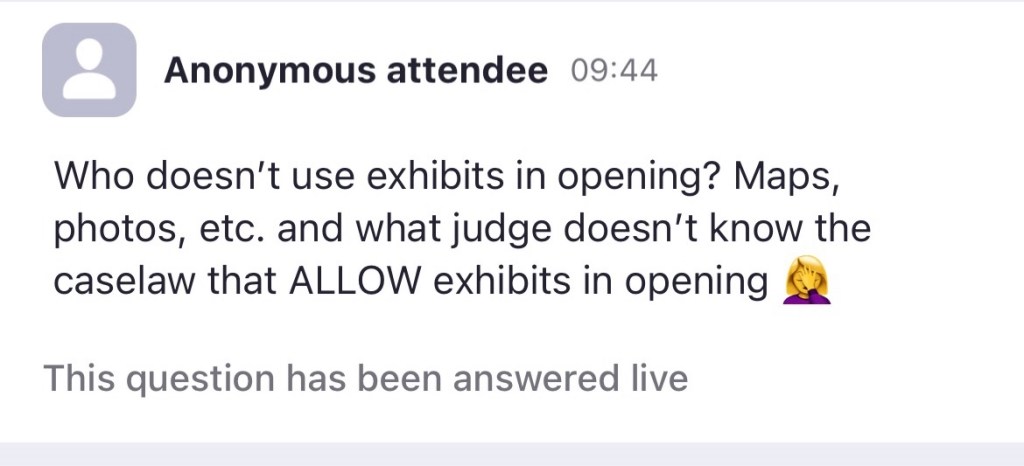
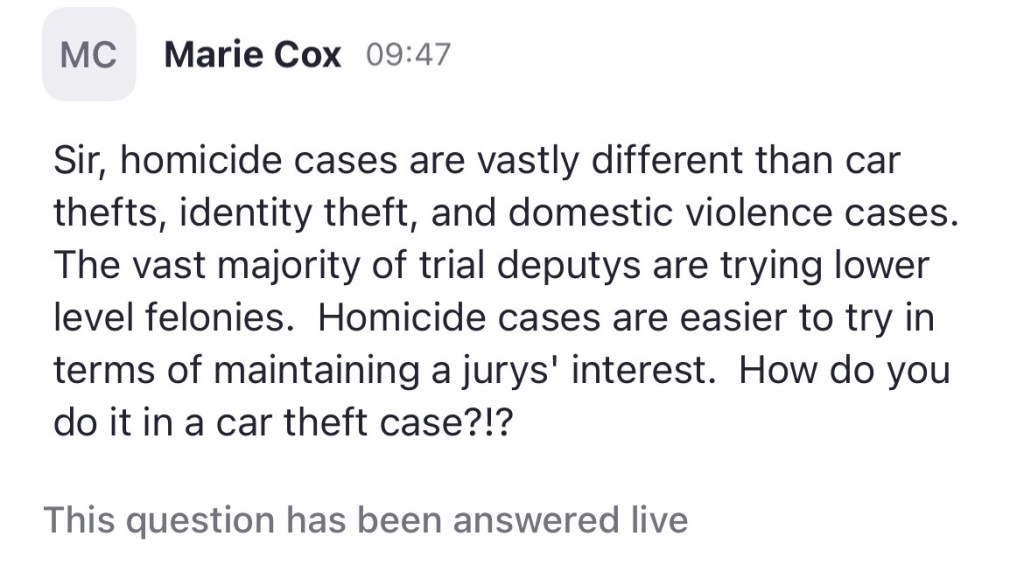
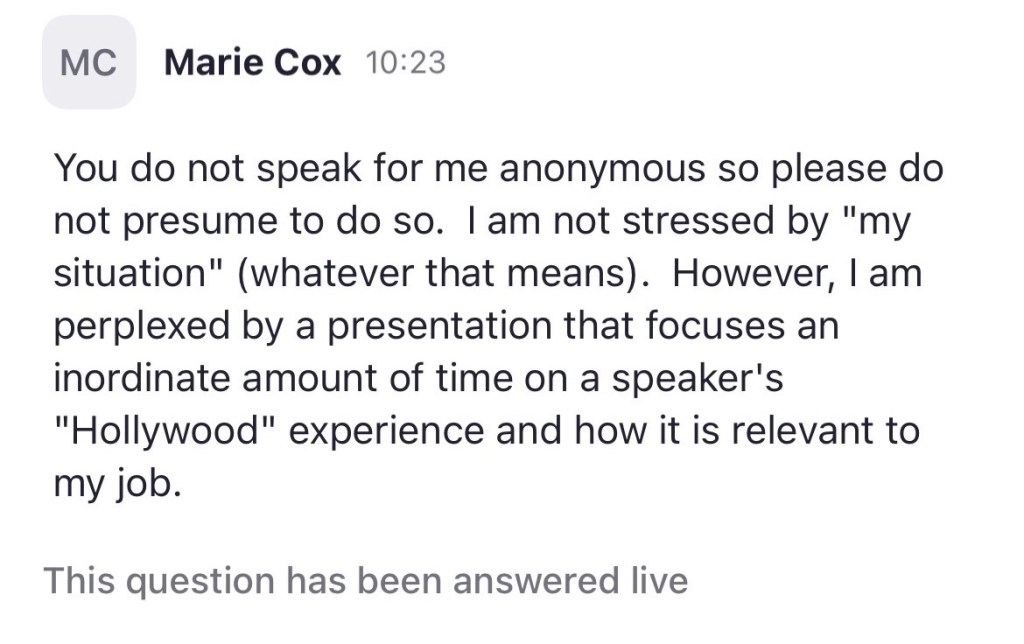
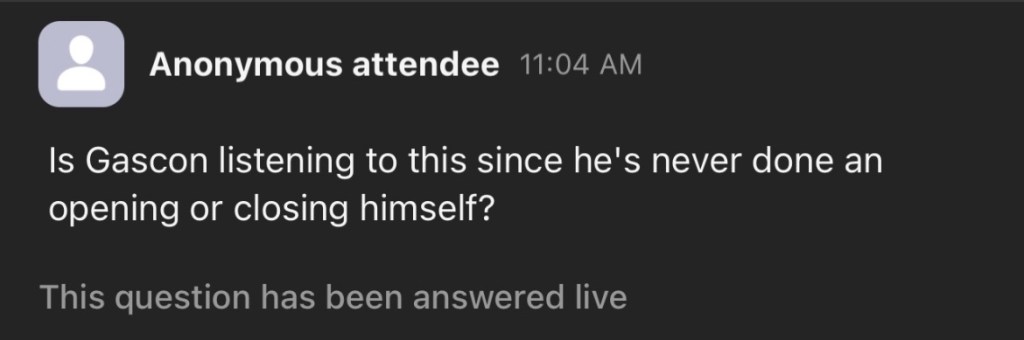
The Los Angeles County District Attorney’s Office will occasionally do a training on Saturday for its prosecutors. Since the election of George Gascón, topics have been on cultural rather than legal issues, such as Racial Justice and Transgender Awareness. This Saturday, even though LADA has 800 of the countries best prosecutors, Gascón brought in an outside person to train on opening statements and closing arguments. This was a particularly fraught time for the office, since the last Saturday seminar involved a lengthy and pointed question about the district attorney’s political policies which was censored out of a subsequent broadcast. That censored comment was by celebrated cold-case prosecutor John Lewin. This Saturday, Lewin’s skepticism broke out into an all out revolt.

The revolt took place in an online comment box. It started out gently at first, as prosecutors began to realize that they had more expertise than the trainer hired by the office.

The question was not answered live.

Bafflement over the rudimentary nature of the training and the speaker’s lack of experience continued.

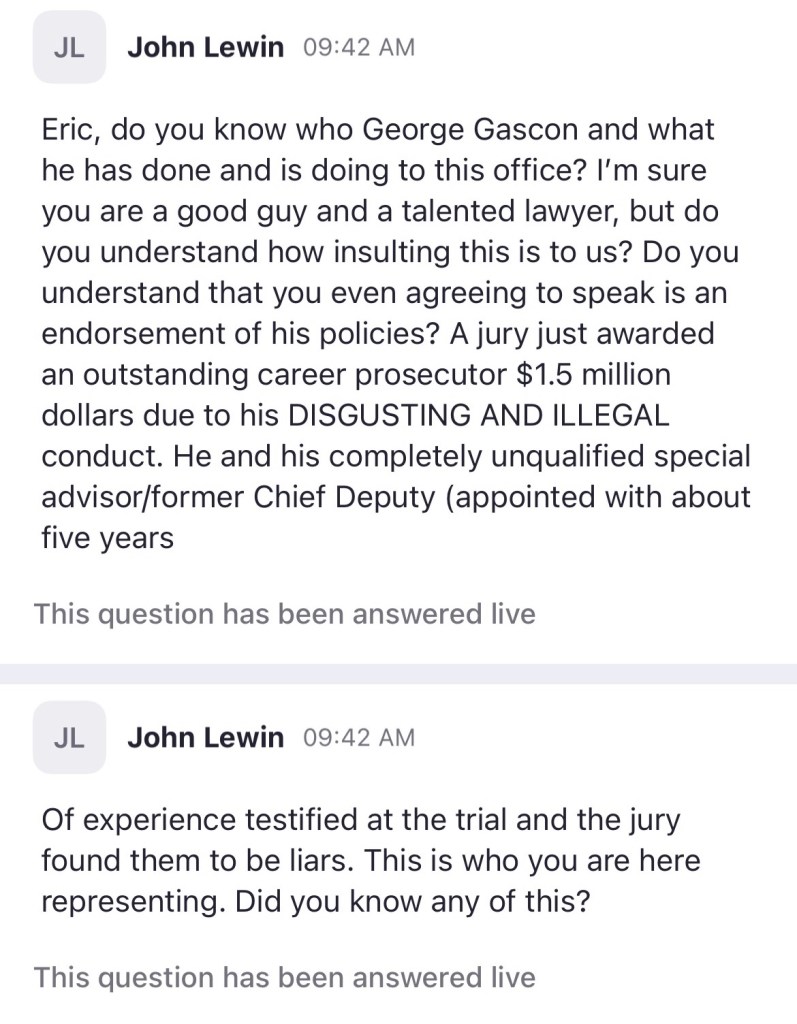
This question was not answered live. Then John Lewin weighed in. He is a famous name in legal circles for convicting real estate tycoon Robert Durst of murder, after other agencies tried and failed for many years. He was the longest serving member of the office’s Major Crimes division. He’s media savvy, occasionally appearing on AM talk radio, and was the subject of an LA magazine cover story. When Gascon came to office, he busted Lewin out of Majors and sent him to Inglewood to file low level felonies. This was widely viewed as retaliation for Lewin’s outspoken criticism of the DA’s weakness towards violent criminals.

Lewin is referring to a recently 1.5 million dollar jury verdict awarded to Shawn Randolph, the former head of LADA’s Juvenile Division. The jury found that Gascón illegally retaliated against Randolph after she warned him that his policies were illegal and required prosecutors to lie in court. These are not private opinions or political statements, these are findings of fact by an impartial jury.

The presenter bumbled on, ignoring Lewin and giving advice about how to argue gang cases, apparently unaware that Gascón banned the filing of gang cases.

This question was not answered live.

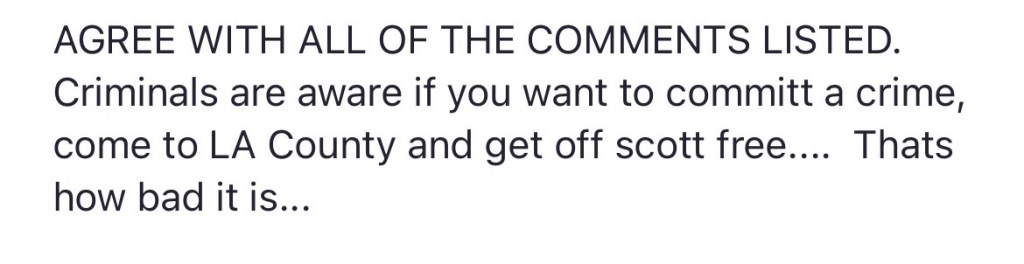
This is true. Gascón’s special directives instruct his prosecutors to use the term “justice-involved individual.” The audience had apparently had enough. Political comments continued.

Members of the administration, or maybe one of the 2.5% of prosecutors that support Gascón, weighed in with this:

It is hard to tell if this is a tongue-in-cheek reference to the fact that the “several years” the presenter had been working were much fewer than the years of experience in the audience. Prosecutors passed over that point and responded:

Lewin also weighed in.

By the end of the training, Gascón (who has never tried a case) hadn’t won himself any friends.

This question was not answered live.

Briefing Complete in Union Lawsuits Against Gascon

The First Lawsuit

The Association of Deputy District Attorneys for Los Angeles County (ADDA) filed a lawsuit on December 30, 2020 to stop several illegal policies put out by newly-elected district attorney George Gascon. The Superior Court agreed with the ADDA and filed a temporary injunction on February 8, 2021. Gascon appealed on March 19, 2021. He filed his opening brief on August 17, 2021. The ADDA responded on November 16, 2021. Briefing was completed when Gascon filed a reply on December 6, 2021.

There were two amicus curiae briefs. The first was from the American Civil Liberties Union of Southern California. The second was written by Erwin Chemerinsky, law professor at the University of California at Berkeley, writing on behalf of 67 other progressive prosecutors. The ADDA responded on January 3, 2022.

As of today, the parties are awaiting a decision by the Second District Court of Appeal.

Alisa Blair. Credit Voyagela.com.

The Second Lawsuit

On October 14, 2021, the ADDA sought an injunction in Superior Court to prevent District Attorney George Gascon from appointing ineligible political supporters to civil service protected positions in the District Attorney’s Office. Specifically, Gascon appointed former public defenders:

  1. Alisa Blair;
  2. Tiffiny Blacknell; and
  3. Shelan Joseph.

He did this outside of the merit system created by the County Charter to root out political bias in hiring and promotion. None of these public defenders had taken or passed the test required for promotion, nor did they have the required experience as a prosecutor. There were 53 candidates who had followed the rules and had been certified as eligible under the County Charter. All 53 were passed over.  The ADDA also appealed before the Civil Service Commission.

On November 8, 2021, a judge denied the ADDA’s request for a preliminary injunction. He held that the appeal before the Civil Service Commission should be completed before an injunction issued. A day before the court denied the request, Gascon promoted 53 internal candidates. Lawyers said this appeared to be an attempt to moot the lawsuit and the Civil Service proceedings. The parties held a trial setting conference on December 3, 2021, which was continued. Then, Gascon filed a Motion for Stay of Proceedings on December 21, which the ADDA opposed on January 3, 2022. Briefing was completed with Gascon ‘s reply on January 7th. The Court heard the motion on January 14, 2022 and denied it. That same day, the court continued a trial setting conference for a second time.

The next hearing is another trial setting conference on April 20, 2022.

Murder at the Beach

Dockweiler Beach is a beautiful state park in the Santa Monica Bay. Known for bonfires and barbecues, Dockweiler has plenty of parking and is a short drive from the gang-infested neighborhoods of South Central Los Angeles. On March 17, 1995, two couples got into a car and drove there together. They would not all return alive.

That same day, several members of the Limehood Piru Street Bloods were at the beach. Kenji Howard and Edward Powell, and several others had driven down in a car and spent the day causing trouble. According to witnesses, Powell brought a gun he had obtained by trading away cocaine. He shot at several airplanes landing or departing from nearby Los Angeles International Airport.

At 10:00 p.m., when the beach closes, police officers arrived and ordered everyone to leave. While walking back to the cars, someone heard a voice out of Powell’s car say, “give me the strap,” meaning “give me the gun.”

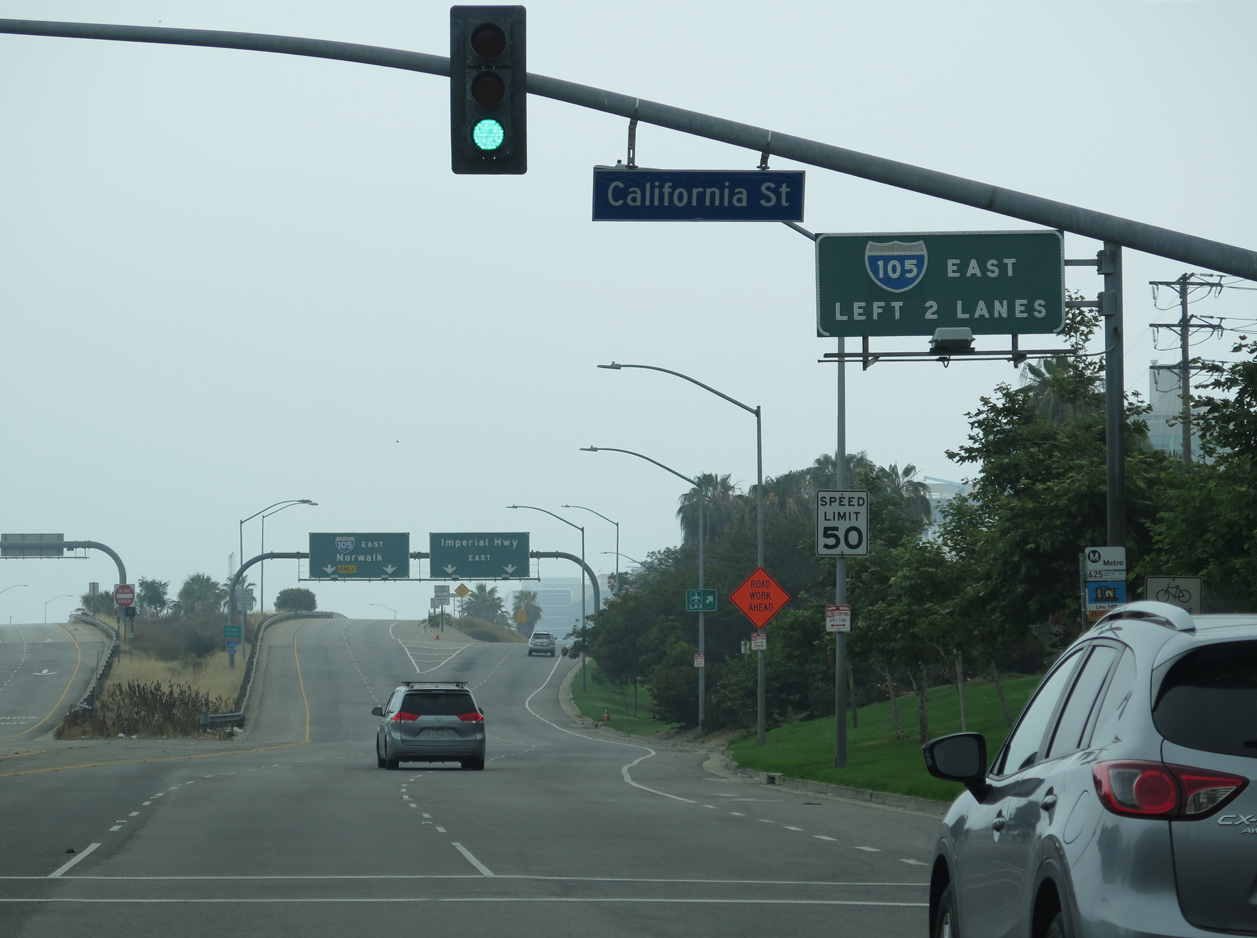
The entrance to the 105 freeway where murders occurred. Credit: Insterstate-guide.com.

Edward Powell drove his car after the car containing the two couples. As the two cars entered the freeway, Powell pulled the car containing the Bloods up next to the car containing the two couples.

The Bloods in Powell’s car flashed gang signs. None of the two couples were gang members. Then someone in the Blood car started shooting at the two couples. Approximately 10 shots were fired. Witnesses described seeing shots from the back passenger seat. That is where Kenji Howard was sitting. Later, Howard admitted to shooting his gun out of the window.

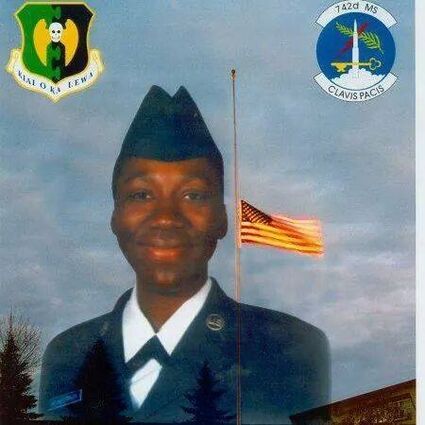
One of the four friends was killed immediately. That was Arkett Mejia, a young woman on leave from the Air Force to attend her parents’ 25th anniversary. Another one of the four friends, Travon Johnson, was also shot. He did not die immediately. He was paralyzed from the neck down and lived for 18 years, until 2013, in a coma. Then he succumbed to his injuries.

One of the two victims: Arkett Mejia. Credit Santa Monica Observer/Facebook

Powell drove Howard back to the gang’s territory. Howard was arrested the next day in possession of the gun. The gun was confiscated, tested, and determined to be the murder weapon. Officers also impounded Powell’s vehicle and noted that the rear windows did not roll down.

Who Shot?

After Howard was arrested with the gun, he was released, probably because he was a minor. Howard was interviewed nine days after he was caught with the gun. He waived his Miranda rights and said that he saw Powell, “firing seven or eight shots.” In other words, he told the police that someone else was the murderer. “Numerous witnesses” said they saw Powell firing the shots.

Police are understandably suspicious of statements like that. Howard’s other statements did not give the detectives much confidence. He said he was sleeping when the shooting occurred, even though it was only 2 minutes by car from the beach parking lot. He falsely claimed that he had bought the gun from Powell the day after the shooting. He was released after the interview on his promise to return the next day. He broke this promise and fled to Seattle. He remained on the run for six weeks until he was captured.

After he was captured in Seattle, Howard interviewed again. Again, he denied being the shooter. He failed a polygraph. He was interrogated for three hours. Then he changed his story. He said that two other men made him shoot the gun. He said he “had not meant to hurt anyone.” He was not paying attention to where he was “capping” the rounds and had just shot out the window. He did not find out until a couple of days later that he had actually killed someone. He gave details about how he shot. He said he wrested his wrist on top of the open window in the door, pointed the gun downward, and fired several shots.

Howard confessed a second time to different investigators. He explained that Powell handed him the gun and threatened to hurt him if he did not shoot at the other car.

Kenji Howard was charged with murder. At trial, Howard retracted his confession and went back to his original story. He said that he was asleep when he was awakened by gunshots. He saw Powell reach over another man and shoot through the open front passenger window. The jury convicted him of firearm possession and hung on the remaining counts. The district attorney chose to retry the case. The second convicted Howard of murder and a grab-bag of other crimes. He was sentenced to life with the possibility of parole in 35 years, plus seven additional years. Howard appealed, but the Court of Appeal affirmed the judgment and sentence.

Kenji Howard on a poster from Change.org

The Forensic Evidence

Investigators found gunshot residue on the front passenger door opposite Powell, who was driving. Howard was in the back passenger seat. GSR was found along the mid-section of the right passenger door along the top of it from from to back. Generally, the GSR was towards the center of the door. There was no GSR on the frame of the right passenger door, outside the car.

The GSR expert discussed Howard’s confession. He said that it was inconsistent with the forensic evidence. If the confession was true, and Howard was holding the gun outside and pointed down, it would not leave gunshot residue inside of the door at all. He did not consider whether the confession might be partially true, whether Howard might have changed the details to minimize his guilt, or any other scenario. He simply said that the portion of Howard’s confession where he described the position of his hands was not true.

Moreover, the shots into the victims’ car were “back to front,” meaning that the shooter’s gun must have been in front of the target car. But this which would seem to rule out Howard firing forward from the back seat through the front passenger window.

The People brought their own firearms expert. This expert disputed the conclusions of the first expert. Instead, he said he could not rule out the rear passenger as the shooter. He also said, however, that the evidence was also consistent with the driver being the shooter.

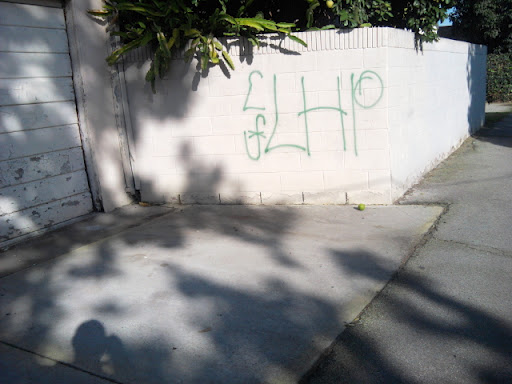
Lime Hood Piru graffiti. Credit: Unitedgangs.com

How Howard Got His Conviction Overturned

Because he was 16 years old at the time of the crime, Howard was given a “fitness hearing,” to determine if he was fit to be tried in adult court. A judge in juvenile court determined that it was appropriate to try Howard in adult court and transferred him there. He insisted on his trial, which eventually resulted in his conviction.

Powell, an adult, was also convicted of murder as an aider and abetter. Both convictions were either not appealed or upheld on appeal.

Both men went to prison. With no appeals left, both men were out of moves. The only thing they could do was finish their time. But men with access to a law library and time on their hands should not be counted out.

Whether or not this statement is true, it cost Powell nothing. He was already convicted of the crime. The punishment for a shooter and an aider/abetter is the same. In other words, Powell is man with nothing to lose by saying these things. As the court noted, he has not been given anything for his confession. But it has not cost him anything either. And his gang has a lot to gain. Howard could get out.

After Powell confessed, the Court of Appeal granted Howard’s writ of Habeas Corpus and sent it back to the trial court for a retrial. The office that would retry the case was the Los Angeles County District Attorney’s Office led by DA George Gascon.

LADA George Gascon

What Gascon Did

Since Kenji Howard was 16 at the time of the incident, he was returned to juvenile court for another hearing about whether to transfer him back to adult court. When he got there, the assigned prosecutor had been given a script to read into the record. The script was from Chief Deputy Sharon Woo. It said that Howard “was a minor  at the time of this offense. It is the policy of District Attorney George Gascón not to pursue transfer hearings to adult court. Accordingly, this matter will remain in juvenile court.”

Juvenile court supervision ends at 25, but Howard is older, and cannot be supervised there. In other words, he will get out immediately. Sharon Woo allowed him to be released immediately, without considering the merits of the case. But she went farther, and dismissed the case.

“In weighing the evidentiary challenges of proceeding to an adjudication [juvenile court trial] and the reality that no additional penalties can be imposed, the District Attorney’s Office has concluded that its current resource constraints and overarching policy considerations and broad discretion favor dismissal of this matter.

The District Attorney determines how best to represent society’s interest in prosecuting criminal offenses. Here the interest of justice and society’s interest as represented by District Attorney Gascón are best served by allocating the limited resources of the District Attorney’s Office to more critical needs.”

To summarize, the LADA received the case and dismissed it without even consider whether the defendant was guilty.

How LADA Will Make Kenji Howard a Millionaire

Now that charges are dismissed, Howard is asking for a finding of factual innocence. (Pen. Code, 851.8.) Remember, the appellate court only found that the defendant should be retried. It did not exonerate him. After all, he confessed. The LADA would have to oppose this motion. Given their position on the juvenile adjudication, it is clear that they will not use the same resources required for trial to oppose this motion.

LADA will allow the finding of factual innocence. Once this happens, the defendant is entitled to receive $140 a day from the California Victim Compensation Board. (Gov’t. Code, 4904.) This would result in an award of $1.2 million dollars to Howard that would otherwise go to other victims, like the families of Arkett and Travon.

This finding would also allow Howard to sue the state. This would result in legal fees paid by taxpayers. And of course, any recovery will be paid by taxpayers. Ironically, the victims’ families can’t get any of this money from Howard because the statute of limitations has run on their suits.

What Should Have Happened

Kenji Howard should be retried as an adult. First, it is appropriate to try him as an adult because the crime he confessed to, murder, is not ethically complex. Five-year-olds know that murder is wrong. Certainly, Kenji Howard knew that going to the beach with a bunch of gang members, shooting at airplanes, getting into a fight, and shooting into an occupied vehicle were wrong. It would be farce to claim that his “developing brain” prevented him from seeing this, or that it rendered him unable to resist the urge to murder people. The first judge was correct: this case belongs in adult court.

Second, Howard should be retried. This case is not black and white. The concerns raised by the appellate court, particularly those about the GSR evidence, are real. A jury should hear them and make a decision. Powell’s confession should be tested on cross-examination, which it hasn’t. The GSR experts should each testify to the jury, and the jury should decide which is more credible. All the other witnesses should testify as well. 1.2 million dollars is enough to pay the annual salary of 15 teachers. That’s an entire school. You and your neighbors should not give this money to a confessed killer unless there is a jury determination that he is not guilty.

Notes

I heard about this by reading an excellent article by Kathleen Cady for the Los Angeles Association of Deputy District Attorneys. It was also published in the Antelope Valley Times.

The Superior Court Criminal Memorandum of Decision on Howard’s Petition for Habeas Corpus.

Full version of the poster shown above, created by Mary Sutton.

An interview with a 17-year-old Lime Stree gang member.

Irony and the Death of Jeff Adachi

Jeff Adachi, the elected public defender of San Francisco, advocated ending the war on drugs. Now he’s dead from a drug overdose.

Adachi should be lauded for his career in public service. His death also raises important questions about drug crime. Adachi was in possession of cocaine and under its influence on the day of his death. Someone sold or furnished the drug to him. These are all against the law.  Unfortunately, people have decided that drug laws are not worth enforcing in the same way that they used to.  Police used to spend a lot of time and effort trying to detect and prevent these types of crimes. Adachi describes this time as “the bad old days.”

Things are different now. Drugs crimes have been reduced to misdemeanors, or in some cases infractions. As a result, police no longer prioritize these crimes, and allocate their resources elsewhere. Adachi himself points out:

[San Francisco]’s felony drug arrests are plummeting at unprecedented speed — 92 percent since the peak in 1988-89, and despite our population growing by 150,000. 

Jeff Adachi was in favor of these changes. He said, “The war on drugs ruined countless lives.” He described it as biased, devastating and misery-inducing. He continued, “We applaud anything resembling a ceasefire in this calamitous war.”

The irony is that Adachi helped to end the exact kind of police work that could have saved his life. He described police work aimed at drug users as “the war on crumbs.” He said that in February, when he was probably a drug user himself. If law enforcement had managed to stop that cocaine from entering the United States, or California, or even just San Francisco, then Adachi would be alive today. Once the cocaine got into the city, if a policeman had managed to find it, Adachi would be alive today. To be even more specific, if a policemen had stopped Adachi, frisked him, and discovered his drugs on the night of his death, he would be alive today. It’s an uncomfortable reminder to opponents of stop and frisk that drug enforcement can save lives.

You might say that law enforcement failed to do its job. Law enforcement should have stopped the transportation of the cocaine, should have been out there stopping and frisking people, should have assigned officers to drug interdiction. But Adachi himself worked to prevent that. He described efforts that could have saved his life in the most derogatory way possible. And he went to court, and the court of public opinion, again and again to obstruct drug enforcement. In retrospect, he should not have done that.

His death, then, is a reminder of the consequences of drug crime. In Adachi’s case, the consequences were fatal. He died on a gurney in a corner of a hospital ER. And although he was only one man, his death is dramatic evidence that his ideas on drugs were wrong. His death was a private tragedy for his family. But he was a public figure. And the public can learn an important lesson from Jeff Adachi’s ironic (and unnecessary) death.

Miscellany

Local news outlet Mission Local blames Adachi’s death on failure to treat his heart problems. Incredibly, they call this “the painful lesson” to be learned from his death.

Adachi wanted his misdemeanor attorneys to conduct 10 trials a year.

Information about Adachi’s death came to light when a reporter obtained the police report. Many were angered and embarrassed by this. The publication of the details of Adachi’s death has become a saga of its own.

Strike Peremptory Challenges

The Washington Post’s coverage of Foster v. Chatman and racial bias in jury selection brings up two issues that are not often discussed.

First, most of the coverage of peremptory challenges in general, and Foster in particular, have focused on alleged prosecutorial misconduct.  Specifically, commentators allege that prosecutors use peremptory challenges in a racially biased way.  I have read several articles who cite to a 2012 study of racial bias in jury selection in North Carolina.  In that study, prosecutors used 60% of their peremptory challenges to strike black jurors, even though they made up only 32% of the jury pool.  The implication, made explicit by many, is that prosecutors in North Carolina are racially biased against black jurors.  The Post article, crucially, points out the flip side of the coin.  “Defense attorneys used 87% of their strikes against white jurors, who made up 68% of the jury pool.”  Each side of a criminal prosecution, then, uses peremptory challenges in a way that may show racial bias*.  Could this be because there are differences between the races when it comes to their attitudes towards the criminal justice system, as the Post polling shows?  Could it be because recent shootings “have widened the gulf between how whites and blacks view law enforcement” as the Post asks?

The Post’s coverage of a second issue is also thoughtful and encouraging.  That issue is the way that Batson challenges (accusations that one side is using peremptory challenges in a racist way) actually occur in court.  The Foster case is not only the subject of the article but a great example.  Foster murdered Queen Madge White, a 79-year-old widow and former elementary school teacher.  He broke into her home, broke her jaw, sexually molested her with a bottle, and strangled her to death.  Foster confessed to the crime.  The case went to trial anyway, and the defense attorney announced that they would make a Batson challenge if any of the black jurors in the pool were stricken.  The prosecutor took notes of the characteristics of each juror, including their race.  He then used four peremptory challenges on the black jurors in the pool.  The Defense made a Batson challenge, which was heard by the judge, and rejected, because the prosecution provided valid, non-racial reasons for striking the jurors.

Racism is wrong, of course.  Striking black jurors to disenfranchise them is wrong.  Striking black jurors because of racial animus is wrong and stupid.  Prosecutors should be allowed to account for the different attitudes of blacks and whites without being accused of racism.  The lesson that I’ve learned from Chatman is that you can never strike a black juror (or even take a note indicating that someone is black) without someone making that accusation.  I don’t want to have to defend myself in that way.

That’s why my preference, along with Thurgood Marshal and Stephen Breyer, is to eliminate peremptory challenges entirely.  The burden of this change would fall most heavily on the community, rather the defendant, since prosecutors need everyone to agree, and biased juror can cost the community a conviction.  Defendants, by contrast, can afford a jury of 11 jurors with pro-prosecution biases, as long as they have one that is defense biased, or even neutral.  Eliminating peremptory challenges would remove the a the risk of professional sanctions on prosecutors who are constantly at risk of being misunderstood by an appellate court 20 years after jury selection.  Exposing the reputation and livelyhood of prosecutors to such capricious and inconsistent risk is not just.  A false accusation of racism, when made by the California Supreme Court, can end a career.  Therefore, we should end peremptory challenges altogether.

*It might not be racial bias.  Race correlates heavily with poverty, for example,  and it could be that prosecutors prefer rich jurors to poor ones and defense attorneys vice-versa.  I have heard anecdotal evidence to this effect.  One part of the discussion of these statistics that needs to be highlighted is that jury selection is extremely complicated, just like race relations, and reducing our analysis of the North Carolina study to the naked numbers of blacks and whites stricken is massively misleading and unhelpful.  In the same way that counting the number of firemen at fires and then accusing them of arson would be misleading and unhelpful.  This is not a case in which an innocent man was incarcerated because the prosecution gerrymandered a racist jury.  This was a case in which the defense elected to go to trial even though the defendant had confessed, raised allegations of racism at every turn, and each time these allegations were rejected by a judge.  Foster’s conviction should not have been overturned merely because the prosecution prepared for the defense’s threatened Batson challenges.

Annotations

The Supreme Court reversed Foster v. Chatman on the grounds that the prosecutor improperly used peremptory challenges.  I’m not sure that was the right thing to do.

The California Supreme Court, in People v. Gutierrez, et al., handed down a rare reversal on the same grounds.  You can read the unanimous decision here.  This is the first time since 2001 that the California Supreme Court found that racial bias tainted jury selection.

Two Criminal Defense Lawyers Elected As LA Commissioners

According to the Metropolitan News-Enterprise, Christopher Smith and Maria Puente-Porras have been elected as commissioners of the Los Angeles Superior Court.  Both are practicing criminal defense lawyers.

Superior Court commissioners are subordinate judicial officers who are appointed by, and serve at the pleasure of, Superior Court judges.  They exercise all the powers and perform all the duties authorized by law to be performed by commissioners.  These duties mirror those performed by judges, although some require assignment by the Court to act as a temporary judge as well as a stipulation by all parties.

Both commissioners were elected by Superior Court judges off of a list of candidates nominated by a judicial panel.  The panel ranks the candidates on the list, and the top candidates are generally elected.  Due to budget constraints and the conversion of commissioner positions to judgeships, no commissioner elections were held between 2012 and early 2014.  Ballots were mailed to all Los Angeles Superior Court judges that year.  A handful of candidates have been elected as commissioners.

The highest ranked remaining candidate on the list is Los Angeles County Deputy District Attorney LaTonya Hadnot, hopefully she will be the next to be elected.