John Lewin, cold case prosecutor and LADA critic, sent the following email to LADA management this morning. It is also posted on his public Facebook.
Your Latest Promotions
George:
As a career prosecutor with 30 years of experience who has tried an innumerable number of incredibly complex and high profile cases over my distinguished career, I wanted to make sure that you were aware of the response within the office to several of your recent promotions/transfers.
I send this knowing that you seem to rarely show up to do your actual job and appear to have a little or no interest in how your decisions impact your responsibilities in your position of what is supposed to be the chief law-enforcement officer of Los Angeles County.
As has been your modus operandi, you have made a mockery of the promotion process by promoting inexperienced sycophants over accomplished and well deserving actual prosecutors. Although this is your legal prerogative as District Attorney (for the few months that you remain in the position), the stench of incompetence, and even the appearance of outright corruption that it leaves in its wake, is beyond disturbing to contemplate.
First, you promoted several individuals who were young Grade 2s, when you came into office, whose sole qualifications for their Grade 4s appear to be that they are close friends/classmates of your equally incompetent current Chief Deputy, Joseph Iniguez (a promotion itself that has been met with justifiably relentless criticism and outright ridicule because it was so completely undeserving and so obviously politically motivated).
This promotion list and the latest administrative transfers/promotions, also demonstrate your commitment to promoting a number of ex-public defenders who have no experience and who have demonstrated a consistent level of incompetence in their new positions as “prosecutors” that has been almost breathtaking to behold.
You promoted John Perroni to Grade 4, a career public defender who his supervisor in JSID testified under oath could not competently handle his duties in JSID and needed to go to prelims or misdemeanors to learn the basics of the job.
Even worse, career public defender and recently hired DDA Greg Apt was just promoted to become the Assistant Head Deputy of JSID. This promotion occurred even though that same supervisor, the well-respected ex-Asst. Head Deputy of JSID (who you retaliatorily transferred out of the unit, who is married to a current public defender, and who along with her husband, is extremely personally close to Apt) reluctantly testified under oath that Apt too was unqualified to even be in JSID (much less lead it), and now you have made him second in command there. Is this really a defensible promotion?
Before you promoted Apt, did you consider the appearance of impropriety and favoritism from the fact that Apt just gave $1000 to your reelection campaign? I believe it’s your largest donation from any DDA in the office! When you couple that contribution with the $19,000 given to your original campaign for DA in 2020 by your inexperienced and highly under-qualified current Chief Deputy, Joseph Iniguez, it leads to the inescapable conclusion that if you give George Gascon 💰💰, you will get rewarded! Maybe that’s why ethical DAs like Jackie Lacey refused to accept campaign contributions from their employees!
This is pay to play at its finest!!
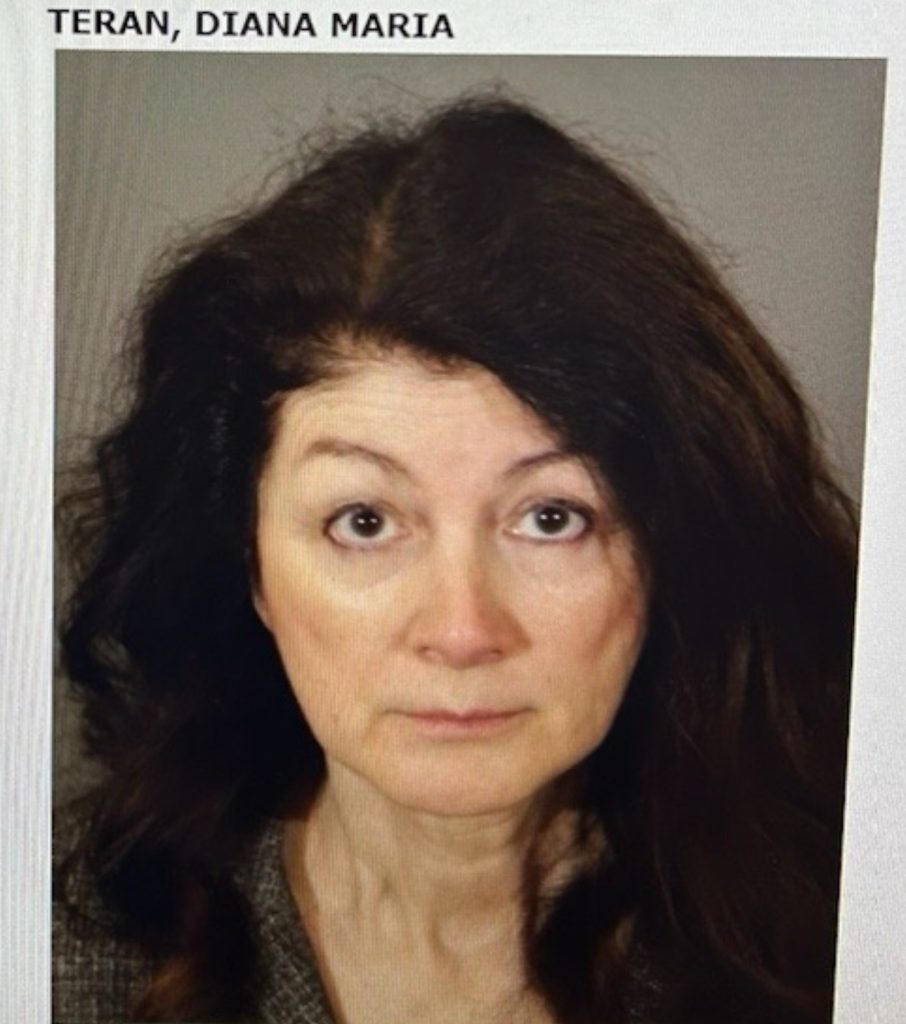
When you couple Apt’s promotion with the prior conduct and or disgusting and disparaging comments directed at police officers by ex-public defenders Blacknell and Teran (who you have also undeservedly promoted to two of the highest positions in the office), how can any law enforcement officer feel like they will have a fair evaluation of any allegation when these are two of the small number of people making the charging evaluations in these complicated cases?
Finally, I’ve been told that you don’t appreciate my emails (I guess that’s why you’ve never responded to any of them), but rest assured, I will continue to point out your disgraceful, incompetent and corrupt conduct whenever I see fit in whatever way I choose to do so! And, if you think that you can silence me by more acts of retaliation, if you haven’t figured it out by now, that is an approach that has never and will never work!!
-John Lewin
The Response
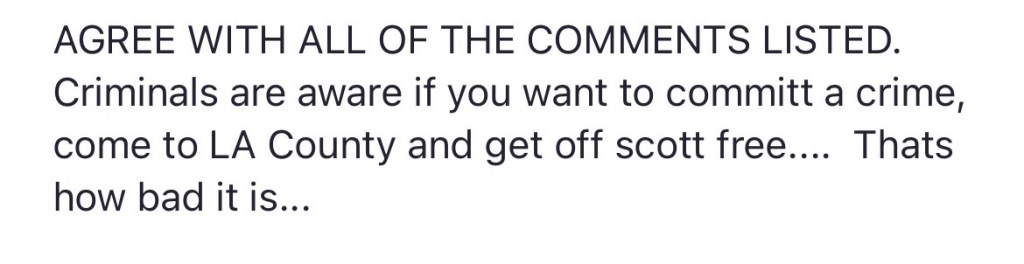
Lewin got a response from retired DDA Craig Rouvs:
It is unclear whether Lewin’s “nameless troops” will have to look very far to find something dumb that Rouvs said.
“Vagrant” is not a word that is used much today. Merriam-Webster defines it as, “one who has no established residence and wanders idly from place to place without lawful or visible means of support.” Wikipedia notes that vagrants “usually live in poverty and support themselves by begging, scavenging, petty theft, temporary work, or social security.” Historically, vagrancy was illegal. It was punished with forced labor, military service, or imprisonment. This long-standing approach was ended in the 1960s, not by police chiefs or mayors, and not by congressmen or senators, but by unelected judges. We don’t use the word “vagrant” anymore, but the definition fits “unhoused person” almost perfectly.
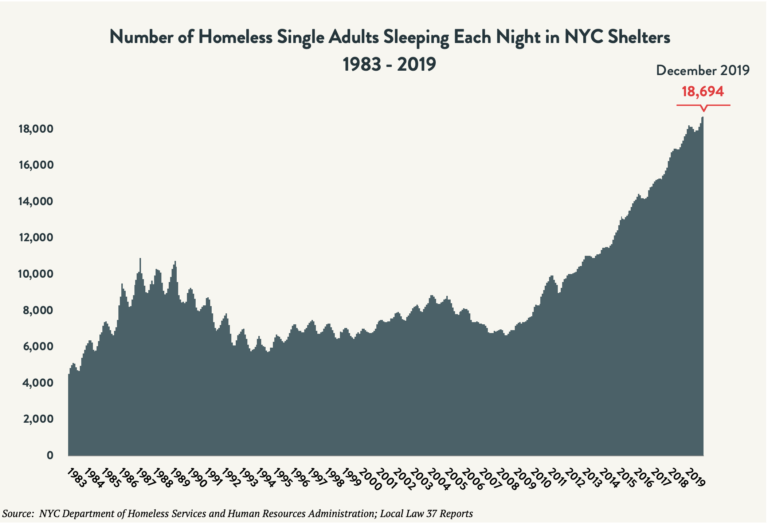
The judicial branch’s decision to take over homeless policy happened quietly but had a lasting negative effect. Between 1960 and 1980 justices and judges struck down laws aimed at criminalizing vagrancy. In the years since, as everyone knows, the problem exploded. New York is an obvious example:
Local governments have an interest in regulating or even prohibiting homelessness, especially the adverse health and safety effects that it caused on others. They can choose to use “carrots,” such as free housing, to get people off the streets. Or they can use “sticks,” such as vagrancy laws, to discourage the problem. Or at least they used to be able to, until the judicial branch decided to limit local choice.
Once the judicial branch had waded into this area, it showed no inclination to wade out. The Ninth Circuit’s recent decision in Johnson, et al., v City of Grants Pass (9th Cir. 2023) __ F.4th __, 2023 WL 4350948 is a perfect example. Grant’s Pass is a small town in Oregon. In response to it’s homeless problem it passed city ordinances banning camping in public parks and sleeping in public. Repeat violators could be prosecuted for trespass. (Id. at p. 4.) Homeless advocates sued and the Ninth Circuit decided that the Eighth Amended prohibited “the imposition of criminal penalties for sitting, sleeping, or lying outside on public property for homeless individuals who cannot obtain shelter.” (Martin v. City of Boise (9th Cir. 2018) 902 F.3d 1031, 1048.) Did the founders, who were enthusiastically criminalizing vagrancy, intend for this result? I think the answer is so obvious that it doesn’t even need to be discussed.
Several justices, however, discussed the point in dissent.
[W]ith no mooring in the text of the Constitution, our history and traditions, or the precedent of the Supreme Court, the court has taken our national founding document and used it to enact judge-made rules governing who can sit and sleep where, rules whose ill effects are felt not merely by the States, and not merely by our cities, but block by block, building by building, doorway by doorway. Local leaders—and the people who elect them— must be allowed the latitude to address on the ground the distinctly local features of the present crisis of homelessness and lack of affordable housing. Not every challenge we face is constitutional in character. Not every problem in our country has a legal answer that judges can provide. This is one of those situations.
To understand why this matters we have to understand the current homeless crisis. The only solution our local leaders have left is to build housing and try to move people into it. Building housing is incredibly expensive. Some would say it is prohibitively expensive. There are 75,518 homeless people in Los Angeles County. It costs roughly $600,000 to build housing for one homeless person in Los Angeles. A little back-of-the-envelope math gives us the total cost to build housing for every homeless person in Los Angeles. It’s $45,310,800,000. That’s 45 billion dollars. The entire Los Angeles City budget is 11 billion dollars. If LA spent that entire budget on homelessness, and spent nothing on police, fire, parks, etc., it would take four years to save the money to build those units. But Mayor Karen Bass is only proposing to spend 1.3 billion. At that rate, it would take 34 years to save the money to build those units. Only by then, the problem would presumably only be worse. The point is: there is no way for political leaders to build their way out of the homelessness problem.
Without the ability to build enough units to house all the homeless, local leaders used to be able to discourage people from choosing to live on the street without working. These anti-vagrancy laws are off the table now, thanks to the judicial branch. Why they chose to insert themselves into these political decisions (hubris? well-intentioned overreach?) is irrelevant. The choice is no longer with us, but with judges, and that isn’t a good thing for people who want to decide these questions for themselves. If you are an idealistic young person that wants to end homelessness, voting is not enough, nor is going into politics. The only real way to work on this problem now is to become a federal judge, because these judges are really running the homelessness problem now.
Notes
Here’s the Twitter post that started me down this road:
are you new here? LA and many other cities have been sued repeatedly for civil rights violations, finding those laws unconstitutional.
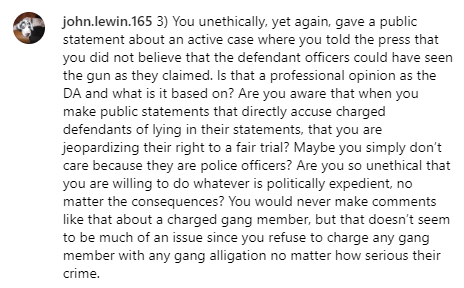
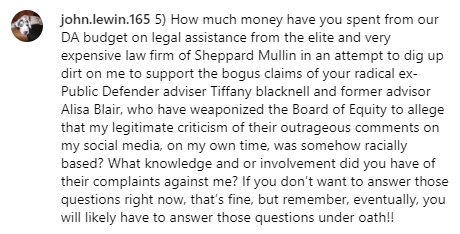
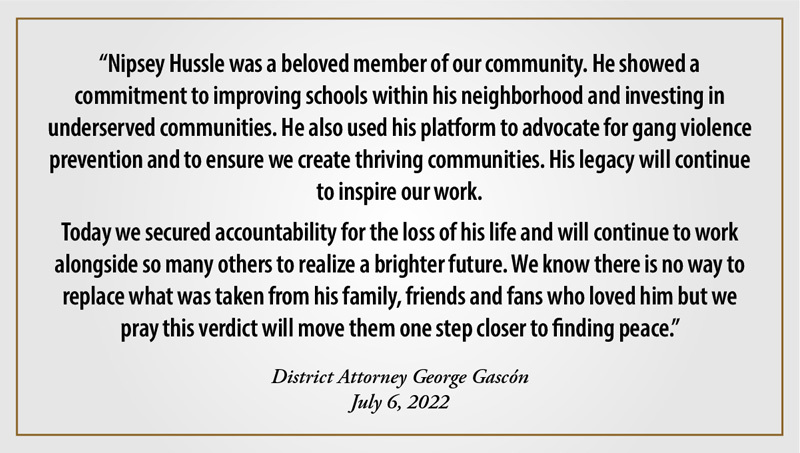
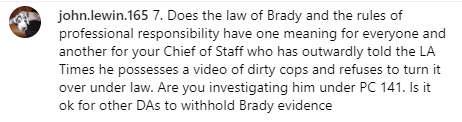
DDA John Lewin appeared on Instagram with eight pointed questions for Los Angeles County District Attorney George Gascon. Lewin raised some tough questions, especially considering that Gascon awarded Lewin prosecutor of the year and then, in a dramatic turn, banished him to an obscure corner of the office. So take a tour through some of Gascon’s biggest scandals, or sit back and enjoy watching LADA’s cold case expert take on his boss, lawyer who has never tried a case.
Rumors have been swirling that the indictment was based on a law that was not in effect when the crime was committed. Both officers are charged with voluntary manslaughter. The indictment is based on the argument that the force used on Mitchell was not necessary since the gun was only an air rifle. This theory would work under the current state of the law. (Pen. Code, § 835a.) Today, peace officers may “use deadly force only when necessary in defense of human life.” (Id.) Section 835a also toughened several other standards around the use of force by police officers. For example, the standard is now objective; it no longer matters whether the officers subjectively though that deadly force was necessary. Today, the officers will have a harder time defending themselves by saying they thought the air rifle was a real gun. However, at the time of the crime, the law was less strict. Back then, the standard was subjective. “I thought the gun was real” was a defense when this shooting happened. And back then the force used by police only had to be “reasonable,” not “necessary.”
Why is this a problem for Gascon? He’s trying to use the new law to prosecute the old shooting. You can’t do that. The law that applies to the shooting is the law in place at the time of the shooting, not today’s laws. Trying to use today’s laws to punish yesterday’s crimes is called an “ex post facto” law. These type of laws were banned by the Constitution. This ban is taught as a basic fundamental feature of American criminal law. Observers, especially prosecutors, have been shocked that Gascon made such a basic error.
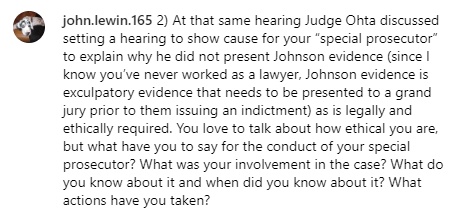
Questions about the Mitchell shooting continue. Lewin is referring to the rumor that Gascon special prosecutor Lawrence Middleton failed to present exculpatory evidence to the grand jury. This is required in state court but not in federal court. Many have speculated that Middleton was not aware of the rule requiring him to present exculpatory evidence because he only practiced in federal court where the rule does not apply. The rule requiring exculpatory evidence, called the Johnson rule, is universally known among Gascon’s deputies, making Middleton’s blunder especially embarrassing. (See People v. Johnson (1975) 15 Cal.3d 248.) It has been on the books for 48 years. Even worse, Middleton is being paid 1.5 million dollars a year and still making basic mistakes. Gascon’s office is full of prosecutors making $200,000 a year who have no problem obtaining indictments without violating state law. This bungled indictment is the only criminal charge Middleton has filed in the two years he has been on the payroll.
Lewin is referring to Gascon’s statements during an April 2023 news conference on the Mitchell shooting. “From my own personal review, I question whether the officers were able to see the gun before the shooting.” Gascon said. He continued “we know even the prior review indicated that there was no evidence that [Mitchell] was reaching for a gun.” The statements are significant to Lewin and many others because they seem to violate the State Bar’s Rules of Professional Conduct. Specifically, Rule 5-120 governs “Trial Publicity” and provides:
A member who is participating or has participated in the investigation or litigation of a matter shall not make an extrajudicial statement that a reasonable person would expect to be disseminated by means of public communication if the member knows or reasonably should know that it will have a substantial likelihood of materially prejudicing an adjudicative proceeding in the matter.
In other words, don’t talk about ongoing cases in the press, especially if it a potential juror may hear you. This rule explicitly applies to prosecutors. As with Middleton, it is likely that Gascon, who has never tried a case, much less a media case, simply did not know what his ethical obligations are.
Here, Lewin correctly points out that if the officers shot Mitchell without seeing the gun they would be guilty of first or second degree murder, not manslaughter. The theory of imperfect self-defense (“I thought he had a real gun but I was wrong”) would reduce murder to manslaughter. But only if a jury believes that the officers really thought he had a gun. If Gascon is right, and the officers shot him without seeing a gun, imperfect self-defense is not available and the right charge is murder. Although Lewin focuses his fire on Gascon, this is an equally valid question for Middleton, his special prosecutor.
Gascon demoted Lewin and other experienced prosecutors when he took office. Two of Gascon’s top deputies (both former public defenders) filed equity complaints against Lewin based on his social media posts. The office hired white-shoe law firm Sheppard Mullin to investigate Lewin for equity violations. Many, including Lewin, believe this was done in retaliation for their criticisms of Gascon’s policies. At least 10 high-ranking members of the district attorney’s staff have filed lawsuits alleging they were removed from their positions because they voiced disagreement with Gascon’s policies. Gascon has also weaponized the County’s Equity Policy to suspend prosecutors who have been critical of him. Lewin’s comments could be an indication that Gascon is using the same tactics against him.
Joseph Iniguez, a four-trial prosecutor, jumped the line to Chief of Staff after endorsing Gascon during his campaign. Iniguez was arrested for being drunk in public at a fast food drive-thru. Although the police did not press charges, Iniguez sued the officer for impeding him as he attempted to videotape the encounter. Iniguez says he captured the entire incident on video. He also claims that the video proves the police officer made an illegal arrest and lied about it. Iniguez has never released the video even as the allegedly dirty officer has continued to do his job and make arrests. This is a problem.
If Iniguez is telling the truth, his failure to release the video has allowed a dirty, dishonest cop to remain on the beat. That’s a violation of his obligation as a prosecutor to provide defendants with evidence they may need. Specifically, if you were arrested by this officer, you could hold up Iniguez’s video and say, “this officer is a liar.” You could do that if you had the video, which you don’t, because Iniguez won’t produce it. If, on the other hand, Iniguez is lying about the officer, who really did nothing wrong, then Iniguez’s actions makes sense. He doesn’t want the world to know he’s lying.
When Gascon came into office, he gave a sweetheart offer to a criminal represented by a campaign donor. Moreover, the offer was negotiated for Gascon by Tiffany Blacknell, a public defender. That means that Blacknell was negotiating for Gascon while working against Gascon on behalf of the defendant in this case. This is an obvious conflict of interest. Although this was a particularly egregious example, prosecutors have noticed many others.
The largest apparent conflict was Gascon’s decision to allow his policies, like his ban on the use of any enhancements, to be written by public defenders. In other words, the criminal defense bar got to write policies that benefited their clients at the expense of the public, who wasn’t even at the table.
Do The Answers Matter?
George Gascon began his career as the District Attorney of San Francisco County. He could easily fire prosecutors he didn’t like in San Francisco. But the rules are different in Los Angeles. It is much harder, if not impossible, to fire John Lewin, which gives Lewin the freedom to ask these hard questions. You can tell that Lewin is angry by the tone of the questions. The most important question of all is whether Los Angeles is angry enough to oust Gascon in 2024.
Many innocent people plead guilty because of the trial penalty—the threat of a longer sentence if a person loses at trial vs. that offered in a plea deal.
Here’s someone complaining that criminals get tougher sentences from judges after trial than they would in a plea bargain before trial. For some reason (maybe the post-court commute?) this really triggered me. I feel disgusted at the dishonest way this topic is presented by former criminal defense attorney Christina Swarns and angry that well-meaning people continue to be misled by her.
Christina Swarns. Credit: innocenceproject.org
First, she focuses her argument on innocent people. Even using the most generous estimates of those with a political and professional interest in exaggeration, the number of factually innocent people who go to trial is so tiny as to be not worth discussing. I know that will rankle some people who rightly see these cases as a tragedy. But looking at the system as a whole, there are so few actually innocent people as to be statistically insignificant. If we want to write a sob story full of anecdotal evidence, then innocent defendants are out there and exist, but if you want to talk seriously about public policy, then focusing on this group is unserious. Looking at the system as a whole, our procedure is almost laughably defendant-friendly, especially when compared to other countries. As a result, our conviction rates our much lower than our peer countries.
But there are still people that will try to get your clicks, or your time, or your charity dollars by telling stories of the wrongfully convicted. Swarns begins her article with a laughably weak story about a defendant who told her that he was innocent. She was a young, idealistic public defender, and of course she believed him. Left out of her account, as it is left out of most accounts, is the sheer number of people who disagreed with her. She doesn’t mention that a disinterested police officer believed that he was guilty and had evidence of it. A judge reviewed this evidence at the time of arrest and agreed that there was probable cause to believe her client committed the crime. The case was given to a prosecutor, who believed the defendant committed the crime, and that it could be proved beyond a reasonable doubt, and filed the case. Then, another judge heard a preliminary hearing, where the prosecutor and the defense attorney had a chance to put in actual evidence. And this second judge agreed with the first judge, and the officer, and the prosecutor, bringing the total number of disinterested people who have reviewed the evidence 4, and each of them agreed that the defendant was guilty. All of this happened in the case discussed by Swarns. But our young public defender believed her client! And when she tells her story, instead of admitting that the evidence showed his guilt, and that many other experienced people disagreed with her, she omits all this entirely. The only opinion that she thinks you need is hers.
Swarns continues. She put in a lot of work and prepared for trial, but on the day of trial, her client agreed to plead guilty in exchange for a one year sentence. I have been a part of many of these negotiations (maybe you have too?) and they are very realistic. Can the prosecutor prove the case? If he can, what would a judge decide is a just sentence? In Swarns’ case, her client decided that the DA could probably prove the case and that the judge would probably give him a tougher sentence than he was being offered. So he pled guilty. Instead of describing this common-sensical process, Swarns casually implies that the only way that the client would be convicted is racism.
The real world is very different from this description. In the real world, men like Swarns’ clients get away with most of the crimes they commit. Even violent crimes are only reported half of the time, and those reported crimes are only cleared with an arrest half of the time. In communities that are hostile to law enforcement, or that have a “no snitching” culture, these numbers are even lower.
If an arrest is made, and the case is filed by the DA, a violent criminal will come into an environment where there are many more cases than there are resources to prosecute. In other words, the DA’s office is hugely understaffed. The only way that American prosecutors can handle their massive caseloads is to give a discount to a defendant that accepts responsibility early. To be clear, what is happening here is that a defendant is getting less than he deserves simply because your local prosecutor doesn’t have time to take the case to trial.
On the other hand, a defendant has every incentive to go to trial. Virtually every defendant, including Swarns’, is getting a free lawyer. It doesn’t matter to the criminal defendant if they go to trial, they won’t have to pay a dime extra. The free lawyer will do all the work, along with the free defense investigator, and the free secretaries and paralegals needed to support them. There is also usually a free expert witness along the way. Understaffing and high caseloads are why, as Swarns correctly points out, less than 3% of criminal cases go to trial.
In order to settle 97% of cases prosecutors must go easy on guilty defendants. This is a tragedy for crime victims, who are forced to watch as overworked prosecutors sell their dead family members down the road because they don’t have the staff to do a murder trial. It’s a tragedy for anyone who thinks that a justice system should be different than a bazaar where everything is up for negotiation and the real value of something doesn’t matter. And it’s a real tragedy for those people who believe that once the legislature sets a consequence for a crime, that it should be imposed, not whittled away.
In this environment of discounts, bargains, and slaps on the wrist, the trial is the only avenue for actually imposing the consequence intended by the legislature. By the way, if you are a person like Swarns, you probably don’t care whether or not the legislature thinks a crime is worth five years versus four. You probably don’t think about the idea that when a democratically elected group of representatives decides a rule, it should be followed. When they decide a punishment, it should be imposed. Democracy matters, and if we value it, we should not work against it to frustrate the purposes of the legislature and flout their rules. Criminal defense attorneys generally don’t think this way, since their only ethical duty is to get the best possible resolution for the criminal. “Who cares if we voted and decided that spousal battery is illegal? She was cheating on him, so he should get diversion!” They, alone among lawyers, have no ethical duty to be honest. And so they are not honest. And they become so comfortable with dishonesty (or so true-believing in their politics) that they are write articles like this.
Anyway, criminal lawyers know what Swarns wont’ tell you: a sentencing judge is the only place in the courthouse where the defendant is likely to get the sentence he actually deserves. So defendants use their free lawyers and free staff to take a case to trial. Maybe they think they’ll beat it. Maybe they think that the witnesses won’t show up. Maybe they see what’s happening in the courthouse and think that after conviction they will still be able to get just a slap on the wrist. And sometimes they get lucky. But sometimes they get convicted and are surprised when there is an actual consequence for their crimes. So they cry “trial tax” and naive people believe them.
Notes
Swarns signs off her article “With gratitude, Christina Swarns Executive Director, Innocence Project.” The “with gratitude part” really annoys me, even though I know my annoyance is unjustified, because it just reeks of performative morality and attempted ingratiation, and also because I think this person has been lying to you for 1,200 words about her attempt to make you less safe. Or maybe she really is grateful.
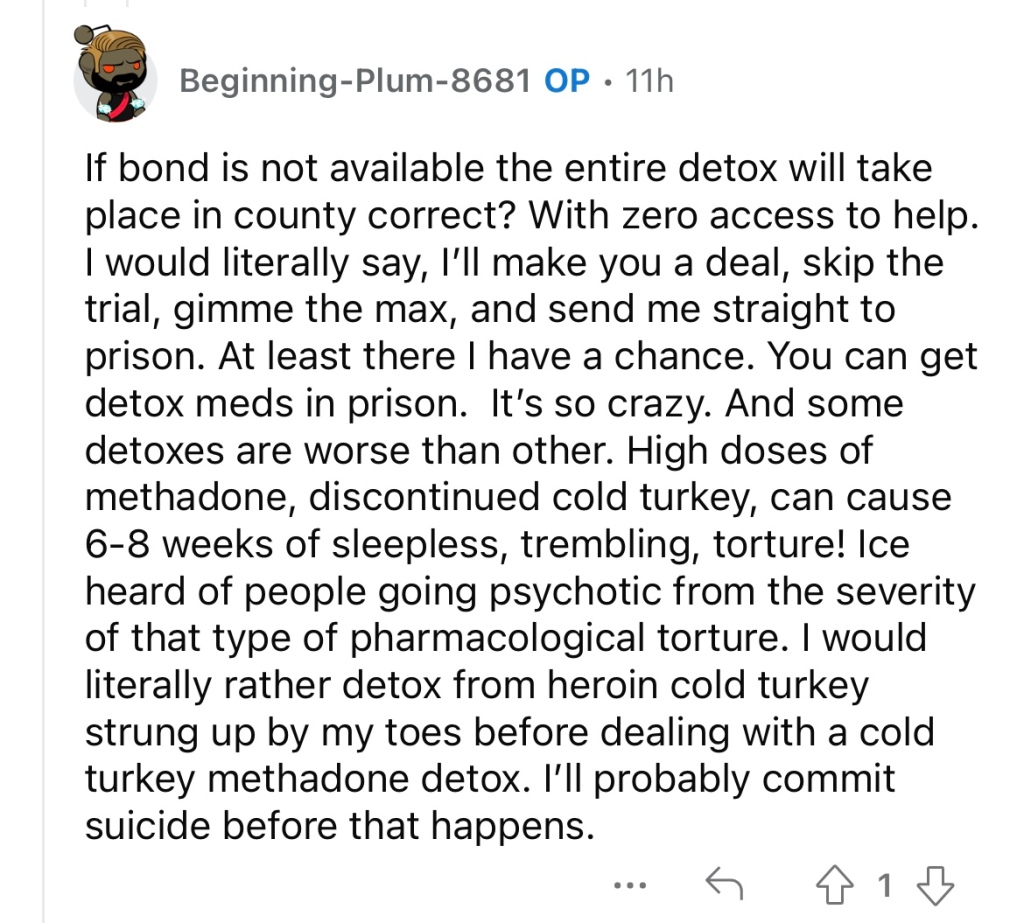
I was poking around on Reddit, because I’m a glutton for punishment, when I found this on r/prison:
I’m immediately annoyed that a drug addict thinks a working person owes him a free detox. Why do I have to solve your problems? In school, we called this a “natural consequence.” Get addicted and arrested? Detox cold turkey. That way you learn.
Then, he calls medical detox a basic human right (according to who?) and I’m feeling even more annoyed because now it sounds like he wants this service given to him for free. You know, because all you have to do to get a free medical service is call it a basic human right. Finally, he finished off by saying anyone who doesn’t want to pay for his rehab isn’t even human and should be ashamed.
Before I even have a chance to make these points I discover that the writer has anticipated them. He even doubles down:
Let people pay for their own rehab if they want to? That seems reasonable, until you remember that people absolutely can pay for their own rehab, and do it all the time. He’s saying something different. He wants to be let out for rehab, that’s what he means by “freedom.” My annoyance levels rapidly rising, I scroll down to comment.
But before I get there, I find more from the original poster.
Now his descriptions are getting vivid and he’s starting to bring himself into the discussion. The situation is shifting from annoying person demanding free stuff to something a little more sad.
Now I get it. This guy is a heroin addict. He’s going to jail and he’s worried about getting dopesick. No, he’s terrified of getting dopesick.
He’s not blaming himself for trying the drug, getting addicted, and committing a crime. He’s not even reflecting on his own role. He’s not writing in r/ifuckedup. I read everything he wrote. He’s scared of withdrawals and wants a bailout.
Viewed that way, we can feel compassion for the addict and understand where he’s coming from. His desire for free rehab isn’t coming from his ideas about fairness or the criminal justice system. He’s just really scared of heroin withdrawals and is looking for a place to channel that.
The sad thing is that some people who read his stuff aren’t going to pick up on the nuance. Readers may be taken in because they think he’s arguing altruistically when really he’s frightened and wants something for nothing.
I think compassion requires something more than just free rehab for this addicted criminal. They say that you can’t quit heroin until you hit rock bottom. I hope he can hit rock bottom because it’s a step on the way to sobriety. I hope he has a rough withdrawal period and decides to quit. Throwing money at him won’t give him a chance to deal with the consequences of addiction. It may even rob him of the motivation he needs to go sober.
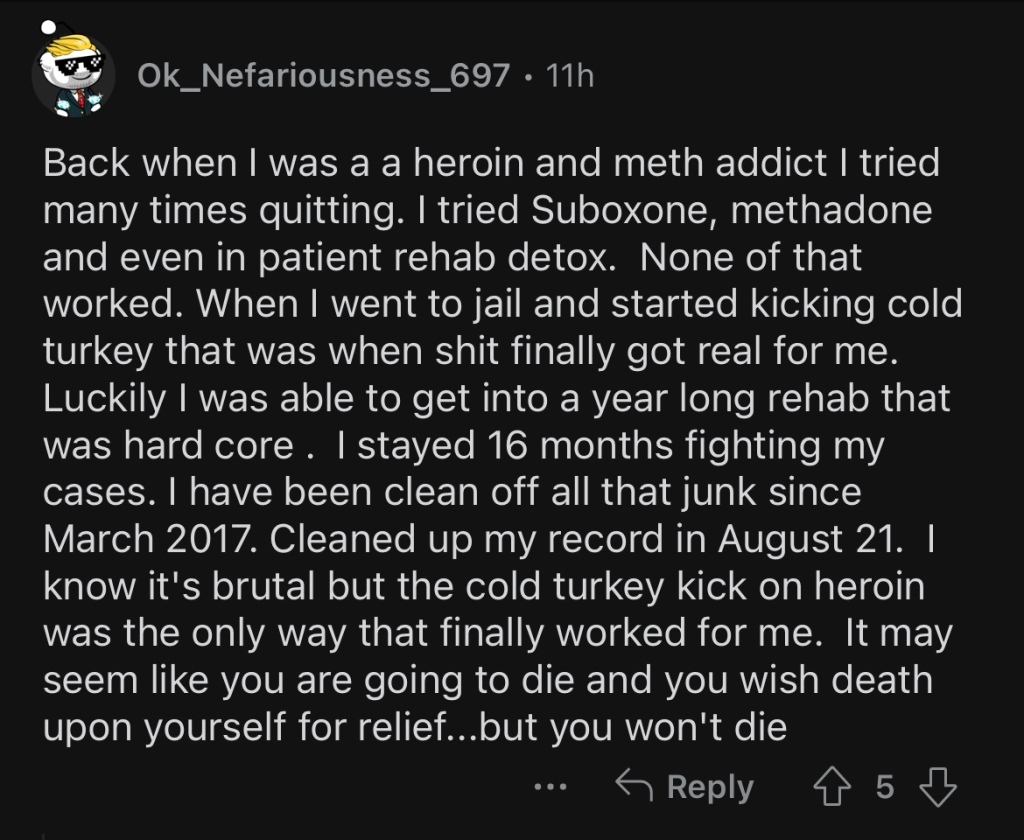
Maybe another Redditor put it best:
Bonus Stupidity
Here’s some other uninformed things I found along the way.
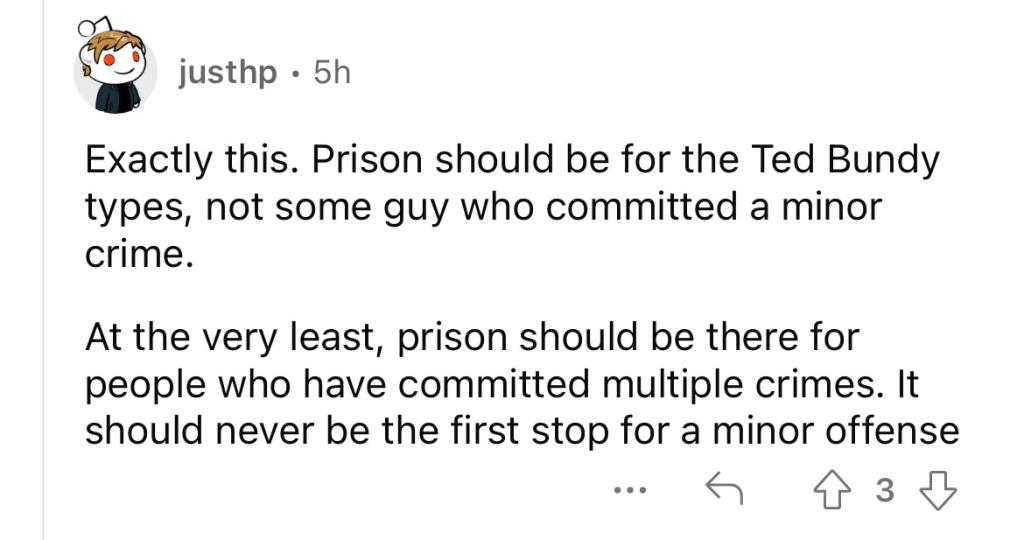
Read a RAP sheet for any prisoner you want. I challenge you to find one who went there as a first stop for a minor offense. There are diversion laws that explicitly forbid this. And the system is built to give you multiple chances to go straight before you go to prison.
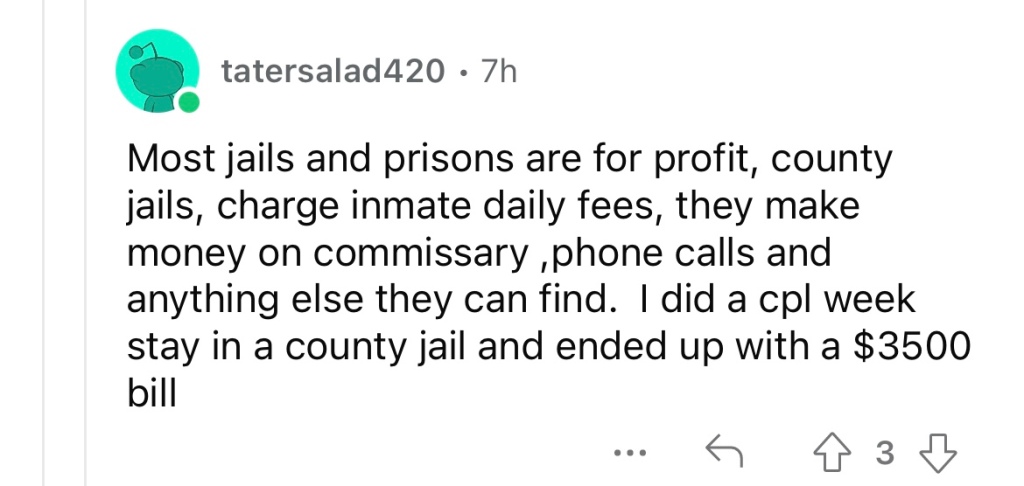
They idea that prison is profitable is so astoundingly inaccurate that I can only laugh.
This person probably had to pay just a small part of the cost of his own jail stint and look how mad he is. Are you just as mad? Because you paid for him too.
Caleb Williams, who describes himself as a student and criminal justice reform advocate, asked his Twitter followers to tweet things they’ve heard that show that the speaker has “little to no understanding of the justice system.” I had no idea who Caleb Williams is: the tweet was just dropped in front of me by the Twitter algorithm. Williams got dozens of responses that I was interested to read.
Unfortunately, the responses (and Williams’ own statements) had the opposite of the intended effect. Instead of having a laugh at criminal justice dilettantes, the tweets showed how little Caleb Williams and his followers understood about the system. This is a big problem, since well-meaning people need all the facts before they can ask for the right changes. In this area of public policy, the wrong changes have deadly consequences. And then I found out who Caleb Williams is and what he has done.
I read this and thought, “that’s true! His example of a false statement is actually true!” It takes guts, and a perverse kind of bravery, to break the law and commit a crime. When a burglar breaks into a home he’s taking a lot of big risks, including the risk that the owner will be there with a shotgun. That burglar can’t turn around and complain that he can’t go to prison because he’s frightened or too fragile or something.
But Twitter is fun exactly because you can talk directly to people who say ridiculous things. So I decided to contribute to the discussion. I found many ridiculous things in the comments.
People are getting away with murder at an incredible rate. In California in 2021, 45% of murders did not even result in an arrest, much less a conviction. Over the past four decades,homicideclearance rates – the metric used to determine how many homicides police solve – have decreased from about 71% in 1980 to an all-time low of about 50% in 2020, according to separate analyses of FBI data by the non-profits the Marshall Project and Murder Accountability Project. “We’re on the verge of being the first developed nation where the majority of homicides go uncleared,” said Thomas Hargrove, founder of the Murder Accountability Project, which tracks unsolved homicides in the US.
Here’s another tweet:
They get free medical, they eat three good hot meals a day, oh and they have recreation and rehabilitation programs
Importantly, prisoners get a free education, not just through a high school diploma, but also through a college degree. That means a prisoner is entitled to a free public education through college, while a law abiding citizen is not. Incredibly, the education benefits don’t end there. Prisoners can also get “career technical education” in things like auto body repair, carpentry, coding, plumbing and welding.
Some female prisoners who are pregnant or a mother to a child under six have the opportunity to be released from prison and housed in “a beautifully landscaped state of the art child-friendly campus in the City of Santa Fe Springs.” California pays to house, feed, and clothe the children while providing trauma-informed substance abuse prevention, as well as parenting classes and education.
The state’s generosity doesn’t end at the prison door. Parolees are entitled to “gate money,” a small gift that they may use to buy clothes, a bus ticket, or even a steak dinner. Parolees can get several types of loans from their parole agent, which the taxpayer is responsible for. The Prison Law Office identified 18 types of benefits for parolees in this 2011 letter. They include extensive reentry services, such as support for employment assistance and placement, relationship therapy, cognitive behavioral therapy, education, housing, and vocational training.
Here’s another commenter with little to no understanding of the criminal justice system:
You can't just let them out! They have committed an act of violence
Virtually all prisoners get out; only a tiny fraction are serving life without parole. But people are understandably worried that violent criminals will hurt people in the community when they are released. That’s because 46% of criminals released from prison are back in prison in 3 years. This statistic is worth unpacking. It’s not a statistic about the number of prisoners who commit new crimes. It’s not a statistic about the number of prisoners who commit new crimes and get caught. The 46% number is the number of prisoners who commit crimes, get caught, get either convicted or have their parole violated, and have to return to prison, all in just 3 years.
The picture gets worse the longer you watch a released prisoner. 70% of prisoners released in 2012 were arrested again within five years, according to data from the Bureau of Justice Statistics (BJS). The recidivism rate is over 80% for prisoners with juvenile records. The Bureau of Justice Statistics followed prisoners for nine years and found that 83% are arrested at least once. Many were arrested more than once: there was an average of five arrests per released prisoner.
The overwhelming majority of prisoners go back to crime when they are released. That’s why we should be very careful about who we release and when. There are many more bad replies to Caleb Williams, but here’s the last one I will highlight:
People who understand the criminal justice system know that “innocent until proven guilty” is the way the system actually works. The state has to prove that a person is guilty beyond a reasonable doubt. That’s the highest standard in the law. Any doubt that is reasonable means acquittal. Moreover, the state has to prove this to 12 people. Not just one, not three, but 12. That means none of the twelve jurors can have any reasonable doubts. Then the defendant can ask the judge to overturn the jury verdict if the judge has a problem with the evidence.
Just as a fun thought experiment, pick five family members and try to convince them, beyond a reasonable doubt, that aliens don’t exist. You will be surprised.
Who is Caleb Williams?
I though that Caleb Williams might just be another well-intentioned reform type who doesn’t have his facts straight. The truth is a lot darker.
Caleb Williams is a convicted sex offender. He was convicted of aggravated criminal sexual abuse. The conviction stemmed from sexual abuse of a minor between the ages of 13 and 17, over the course of three years between May 2015 and May 2018. According to news reports, he got the child pregnant. He was ordered not to participate in holiday events involving children and not to have access to a computer with internet access. He later requested partial custody of the child he conceived with the underage victim.
Caleb Williams’ picture from the National Sex Offender Registry
According a random person on Twitter, Williams was also present at the January 6th capitol insurrection. I’m not sure this is right, but you can look at the picture and judge for yourself.
The guy in the middle is Caleb Williams. He’s a registered sex offender and still on probation. If anyone knows how to get this to his PO that would be cool. https://t.co/s6TWvqDQ6v
Caleb Williams is a human being and his views on the system are backed up by more experience than most. He’s got a well-written blog with the slogan “you are worthy of a second chance,” which is certainly true. But I have to wonder if Williams has decided to blame the system for his disturbing crimes because he can’t blame himself.
Many people (sex offenders are people too) cannot psychologically cope with the awful things they have done, so they project onto others. Specifically, they can project the self-hatred that they may feel onto the system that held them accountable. Or at least that’s what years of work in this field suggests to me. And I’m not alone. Dr. Stanton Samenow, in his book Inside the Criminal Mind, writes that criminals often have “errors in thinking,” such as “claiming to be a victim and blaming others when held accountable.”
In this case, Williams seems to be blaming the system for his actions, rather than blaming himself. That’s sad, because many people on Twitter, including me, do not know about Williams’ background when they read his tweets. They may think he really is a “student” and “reform advocate” like he describes himself. They may not realize that they may be listening to someone with their own agenda and issues to work through.
Notes
Williams also has a problem with law enforcement, thinks cops are racist, thinks that prisons exist to make money for states, that sex registration is harassment, and that Elon Musk’s “Pope Coat” was “fire.” You can find those hot takes and many more on his Twitter account.
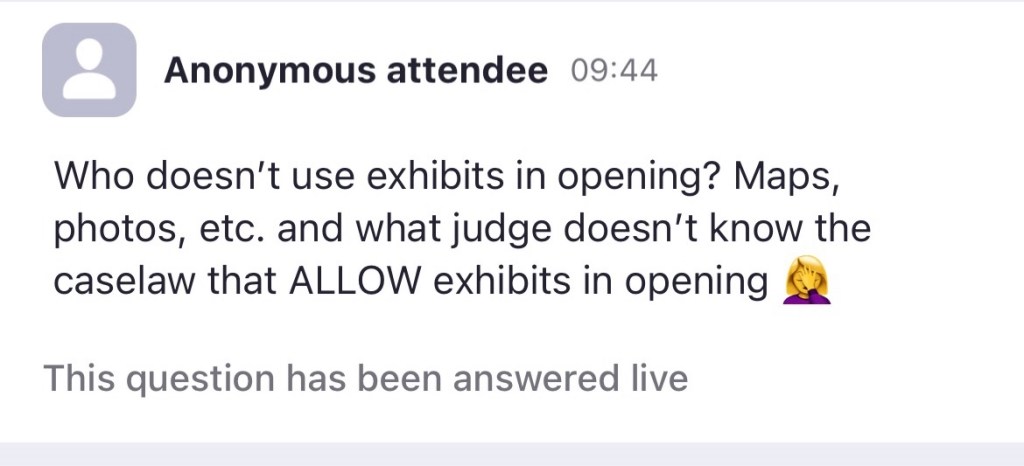
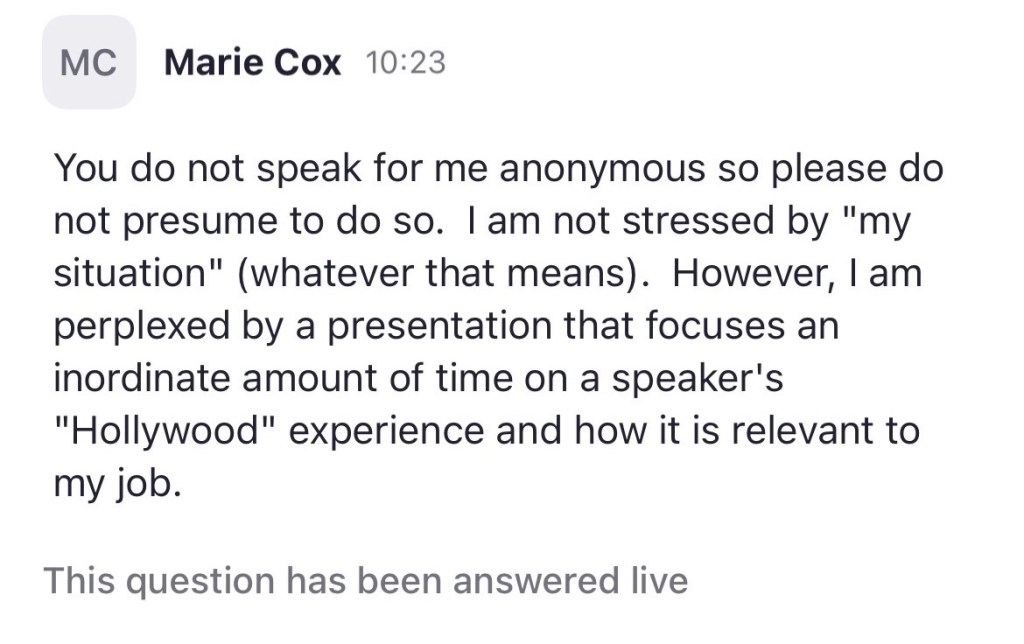
The Los Angeles County District Attorney’s Office will occasionally do a training on Saturday for its prosecutors. Since the election of George Gascón, topics have been on cultural rather than legal issues, such as Racial Justice and Transgender Awareness. This Saturday, even though LADA has 800 of the countries best prosecutors, Gascón brought in an outside person to train on opening statements and closing arguments. This was a particularly fraught time for the office, since the last Saturday seminar involved a lengthy and pointed question about the district attorney’s political policies which was censored out of a subsequent broadcast. That censored comment was by celebrated cold-case prosecutor John Lewin. This Saturday, Lewin’s skepticism broke out into an all out revolt.
The revolt took place in an online comment box. It started out gently at first, as prosecutors began to realize that they had more expertise than the trainer hired by the office.
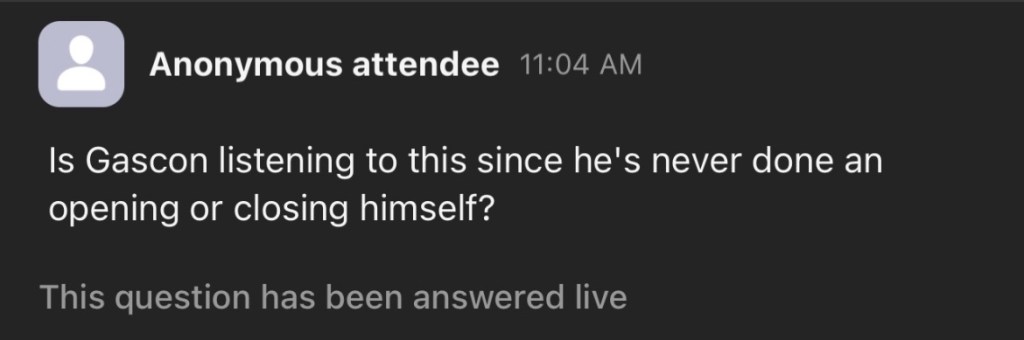
The question was not answered live.
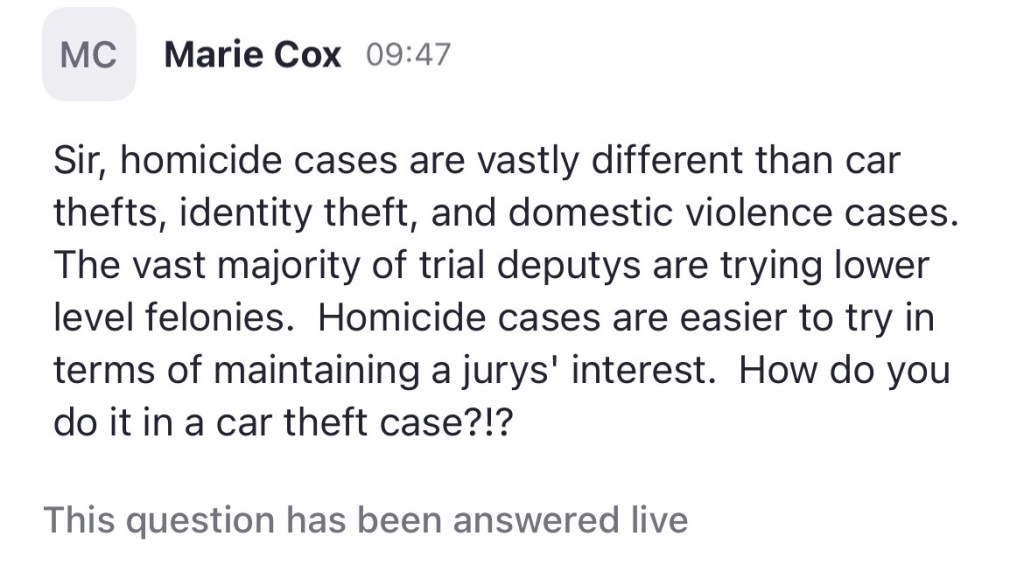
Bafflement over the rudimentary nature of the training and the speaker’s lack of experience continued.
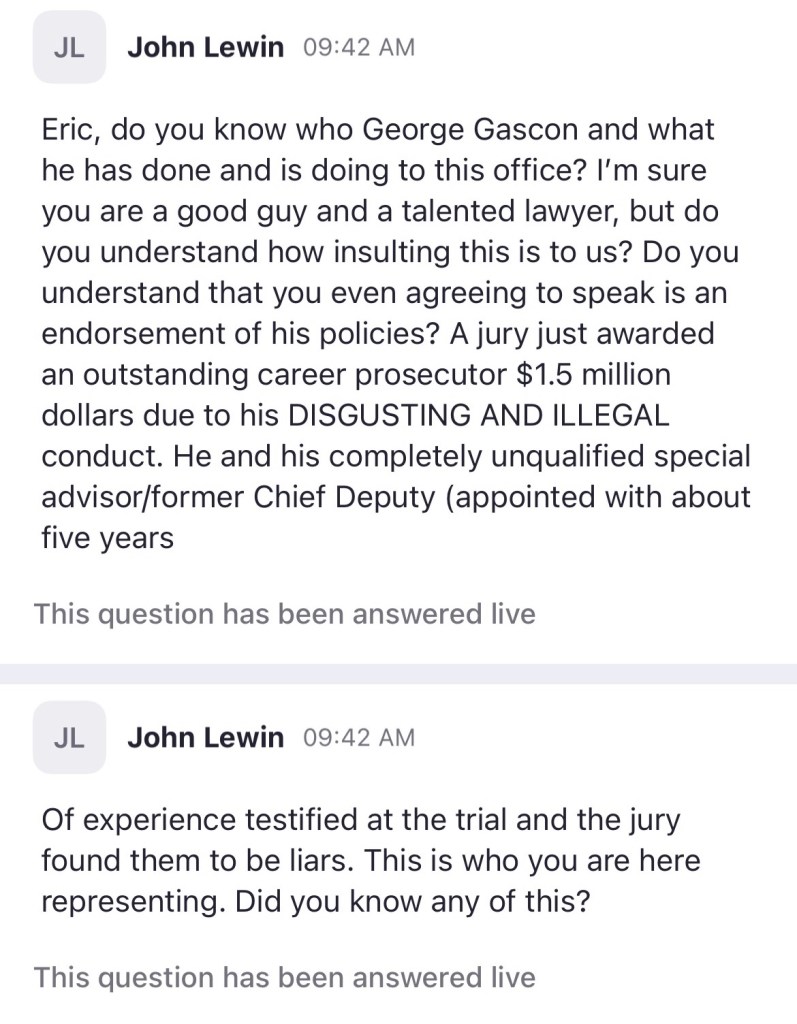
This question was not answered live. Then John Lewin weighed in. He is a famous name in legal circles for convicting real estate tycoon Robert Durst of murder, after other agencies tried and failed for many years. He was the longest serving member of the office’s Major Crimes division. He’s media savvy, occasionally appearing on AM talk radio, and was the subject of an LA magazine cover story. When Gascon came to office, he busted Lewin out of Majors and sent him to Inglewood to file low level felonies. This was widely viewed as retaliation for Lewin’s outspoken criticism of the DA’s weakness towards violent criminals.
Lewin is referring to a recently 1.5 million dollar jury verdict awarded to Shawn Randolph, the former head of LADA’s Juvenile Division. The jury found that Gascón illegally retaliated against Randolph after she warned him that his policies were illegal and required prosecutors to lie in court. These are not private opinions or political statements, these are findings of fact by an impartial jury.
The presenter bumbled on, ignoring Lewin and giving advice about how to argue gang cases, apparently unaware that Gascón banned the filing of gang cases.
This question was not answered live.
This is true. Gascón’s special directives instruct his prosecutors to use the term “justice-involved individual.” The audience had apparently had enough. Political comments continued.
Members of the administration, or maybe one of the 2.5% of prosecutors that support Gascón, weighed in with this:
It is hard to tell if this is a tongue-in-cheek reference to the fact that the “several years” the presenter had been working were much fewer than the years of experience in the audience. Prosecutors passed over that point and responded:
Lewin also weighed in.
By the end of the training, Gascón (who has never tried a case) hadn’t won himself any friends.
Black Lives Matter cofounder Patrisse Cullors said that police officers killed her cousin, Keenan Anderson, in January 2023. She said he was “tased to death” and “publicly humiliated.” Is this an outrageous example of police violence or a dishonest attack on blameless officers?
Why the Police Had to Deal with Keenan Anderson
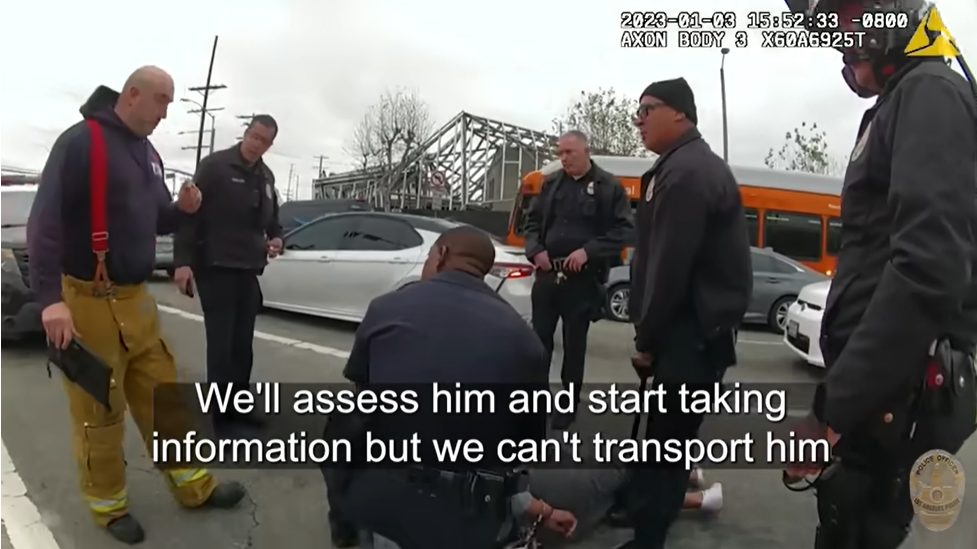
Keenan Anderson was high on cocaine and weed on January 3, 2023, at about 3:35 in the afternoon. He was driving his BMW at the intersection of Venice Boulevard and Lincoln Boulevard in Los Angeles. Driving under the influence of drugs or alcohol is dangerous and illegal even if the driver doesn’t crash, but Keenan Anderson did crash his BMW into other cars. Instead of remaining at the scene, as the law requires, Anderson ran from his crash.
Next, Anderson apparently tried to carjack an Uber driver, but failed to get into the car and continued running. The driver said, “I am Uber driver and he was trying to steal my car while he hit other cars right here.” The driver did not use the word carjack, but civilians rarely use technical crime labels. If the driver was in the car when Anderson tried to “steal it,” then Anderson committed an attempted carjacking. The driver may have been standing near the car while Anderson attempted to steal it. This seems less likely because Anderson would need a key to start the car. It also seems unlikely that an Uber driver would have his car parked and be standing near it, rather than driving it to a fare, or driving it to an area where he could expect a fare. Even if Anderson were only trying to steal an empty car, that’s still grand theft of an automobile, which is a felony, although less serious than carjacking.
Bystanders saw the crash and watched Anderson run. They flagged down an LAPD officer who saw Anderson running into the street. The officer radios in the call, describes it as a possible DUI, and asks for backup.
The Stop
The officer approached Anderson, who was running in the middle of the street. It’s important to understand that it is illegal to run from the scene of a traffic collision, and it’s illegal to run in the middle of the street. Although Anderson was not protecting himself from being hit by a car, the officer protected Anderson and everyone else by ordering Anderson out of the street. Anderson said, “somebody is trying to kill me” but wouldn’t say who, and eventually got out of the street.
The officer told Anderson to sit on the sidewalk. Anderson wouldn’t sit down at first, and said things that didn’t make sense. Instead of telling the officer that he was high and had crashed his car, he told the officer that his car broke down and that he was asking for repairs. The officer stayed with Anderson and spoke to him for about 7 minutes.
Then Anderson got up and tried to leave. He asked the officer for water; the officer agreed. He asked to sit in a place where he could be seen; the officer agreed. But he wouldn’t sit down. The officer said, “I don’t want you in the road” but Anderson ran away from the officer back into the intersection.
The officer caught back up with Anderson in the middle of the road. He yelled at Anderson to get on the ground. Anderson complied. He told Anderson to get on his stomach. Anderson did not get on his stomach. Other officers came to help put handcuffs on Anderson, who was becoming more and more irate. He was shouting things that didn’t make sense. The officer said, “Keenan, relax!” But Anderson did not relax and shouted, “they are trying to kill me!” The video doesn’t not show the officers trying to kill Anderson or hurt him in any way.
As Anderson continued to try to avoid handcuffing, the officers warned him 13 times that if he did not stop, they would tase him. He did not stop. Anderson shouted, “these are actors!” One black officer had an elbow near Anderson’s neck as the officer attempted to grab Anderson’s wrist. A third officer warned the black officer “watch your elbow,” and the black officer moved his elbow.
Officers were able to put handcuffs and leg restraints on Anderson, as Anderson said, “This is an act… they’re not police.” After he was handcuffed, Anderson said, “They think I killed C Lo… They’re trying to sedate me… I know too much… they sedated me.”
Anderson was Given Immediate Medical Care and Taken to the Hospital
After Anderson was restrained, Anderson was conscious and speaking. He continued to make claims that were not connected with reality, like “I know too much” and “they’re trying to sedate me.”
Officer rolled Anderson on his side to make sure that he could breathe while he was restrained.
Officers let paramedics from the Los Angeles Fire Department examine Anderson to make sure that he was not hurt by the taser.
LAFD could not take him to a hospital in the fire truck, so they waited for an ambulance. Anderson was placed in a wheelchair.
The ambulance arrived five minutes later and took Anderson to the hospital. Four and a half hours after he was arrested he died from a heart attack.
The Toxicology Unit of the Forensic Science Division tested Anderson’s blood. They found cocaine metabolite and THC.
The situation was summarized by the Uber driver, who can be heard on a cell phone recording. He says, “That guy right there, he caused that accident, he was trying to steal my car. Yeah, the police is doing the right job right now. Don’t think that the police is trying to abuse him.”
The Arrest Video
There are a lot of videos about the death of Keenan Anderson. Most of them are short, sensationalized news segments that don’t show the complete arrest. LAPD put out a longer version that appears to contain all the relevant body camera video, along with commentary from the Department. It is age-restricted and can be seen here.
This incident is a test for the body worn camera and the anti-police movement. Body worn camera should also protect police in situations like this, where the officers acted appropriately and the suspect did not. That’s one of the reasons why police agencies agreed to the cameras.
But if media refuses to show the actual video, or edits in a deceptive way, or gatekeeps the video in a way that makes it difficult for people to see what actually happened, then the police agencies don’t get the benefit of the video.
Did Tasers kill Keenan Anderson?
"Los Angeles Police just killed another Black man – Keenan Anderson – after he flagged police down for help with a traffic collision. Anderson was tased by police 6 times in 42 seconds in the middle of the street, and died a few hours later."
— Roger van Egmond Ⓥ 𓃟 Pigoneer #GTTO (@VanGzip65) January 20, 2023
Keenan Anderson’s decision to drive while high caused his car crash. His decision to get high probably contributed to his decision to try to carjack the Uber driver. His decision to get high probably contributed to his decision to run from the cops. In other words, if Keenan Anderson had not done drugs, this would not have happened. The first cause of Keenan Anderson’s death is Keenan Anderson.
Did the officers contribute to his death with their tasers? We will have a credible answer after an autopsy. In the meantime, there is “no consensus” that tasers are dangerous to the heart. Even among those who believe that tasers are dangerous to the heart, the danger presents at the time of the taser use, not four hours later in a hospital. It’s important to remember that Anderson’s heart was beating after the incident, in the ambulance, all the way to the hospital, for four and half hours before his death. But the electrical effect of the taser was long over when he died.
Nika Soon-Shiong’s father bought the LA Times. Then she got appointed as a public safety commissioner in West Hollywood, despite having no background at all in criminal justice. While there, she reduced the number of deputies on the street before quitting early to return to graduate school.
Who is Nika Soon-Shiong?
Nika Soon-Shiong grew up wealthy. She is the daughter of Patrick Soon-Shiong the publisher of the Los Angeles Times. Her father became rich after inventing a drug called Abraxane.
Soon-Shiong is extremely well educated. She graduated from Stanford in 2011 with a bachelor of arts in international relations. Soon-Shiong’s resume is silent as to what she did between 2011 and 2014. She began 2014 as an intern at the Estafani Center in Cape Town. She also spent the summer of 2014 in Cape Town, doing a research project for Stanford around individuals affected by HIV, presumably as part of a master program. She spent the summer of 2015 at the New York State Summer Writers Institute, a fiction workshop. She received her masters in African studies, in 2016. As I read her resume, I became increasingly curious about when her interest in criminal justice began.
After getting her masters, she was the “Princeton in Africa Fellow” for a year. This job entailed producing a podcast, photography exhibition, and photo-essay showcasing public school conditions. After a year in this role, she continued doing research on South African public schools until the end of 2017. There is no indication of any work related to criminal justice.
Sooh-Shiong enrolled in a doctoral program at Oxford in 2018. While there she worked as a “consultant” for the president of the World Bank. One of her duties was writing “speeches and media posts” for him. According to her resume, Oxford gave her a doctorate in philosophy in 2019, in international development. Interestingly, she said in a 2022 interview that she had not completed her doctorate. Local media report that she was working on her thesis and returned when the pandemic struck.
When she arrived back in Los Angeles she took an active role in her father’s newsroom. For example, she banned the use of the word “looting” to describe theft by protesters of the murder of George Floyd. She is 29 years old.
Nika Soon-Shiong Has No Qualifications for a Job in Criminal Justice
It might seem provocative so say that a public safety commissioner has literally no background in criminal justice, but if it cannot be said about Nika Soon-Shiong, it cannot be said about anyone. She grew up extremely, superlatively rich, with all the benefits it implies. She has never lived in a crime-ridden neighborhood, and therefore has less lived experience than literally hundreds of thousands of people in the County of Los Angeles.
Her education is completely unrelated to criminal justice, criminology, penology, or any related field. Nor does she have a law degree, much less experience handling a criminal case.
During her education, she found time to host a podcast and attend a fiction workshop, but did not work anywhere near the criminal justice system. She has no background in law enforcement. Although nothing was preventing her from completing the LASD Explorer Program, volunteering as a reserve deputy, or even working as a peace officer, she has not done any of those things. Certainly, she has no experience in any of the many public sector jobs that might prepare a person for the public safety commission.
The one thing that might qualify someone to be in a position of public trust is the ability to run a successful business. That’s a general skill that can be applied to almost any job. Making money is the simplest, most obvious proof that you have general business administration skills. But again, Soon-Shiong did not make her money. It was simply given to her by her father.
The public safety commission job was also just given to her. She was appointed by City Councilmember Lindsay Horvath, despite her having no background, training, or experience in criminal justice.
Nika Soon-Shiong Defunded the Police
In 2022, Soon-Shiong led West Hollywood to decrease the amount of their policing budget. The net result is five fewer deputies on the streets. She did this despite reliable and recent data showing that hiring more police reduces crime. According to this data, reducing a police force by five officers leads to one additional murder every two years. It also reduces other more common crimes like robbery, rape, and aggravated assault. Moreover, additional police result in Black lives saved at about twice the rate of white lives saved.
Meanwhile, West Hollywood’s crime rate shot up 38% in the past year.
Then, in August, she resigned as public safety commissioner, despite the fact that her term was not over until February of 2023.
It’s No Surprise That A Well-Meaning Heiress Misunderstands Criminal Law
Well-meaning people have weakened our criminal justice system in the last decade. Kind people go wrong because they are focusing on the wrong problems or because they have been misled about the solutions. All of us, inherently, want to believe that rehabilitation is all that is needed to prevent crime and change criminals back in to normal neighbors. We want to believe this despite knowing, since 1974, that “Nothing Works” to rehabilitate an unwilling prisoner. And virtually all prison inmates do not want to rehabilitate. The only tools we are left with are deterrence and incapacitation. If rehabilitation is the carrot then these are the sticks. It is difficult for kind, well-meaning people to accept this and act on it.
At the same time, none of us relish the idea of locking up another human being for a long period of time. It’s easy to direct our natural human sympathy at the criminal defendant: after all, he is there in court, there in jail, easy to see. While the victim usually isn’t there, can’t be seen, and sometimes there is no one victim at all. California state prisoners stole $400 million in COVID relief, for example. Since there was no single victim, it’s easy to think that there was no victim at all. Even though those prisoners sold all of the tax paid by 165,906 households, how do you know if it’s your taxes they stole? It’s as if the entire City of Pasadena‘s taxes floated away without so much as a sharpened pencil to show for it. The absent victim, or the institutional victim, present a trap for compassionate people, who direct their sympathy at the only person in front of them: the criminal defendant.
It takes education, training, and experience to understand these things. But that is exactly what Nika Soon-Shiong and others do not have. They see news coverage that leads to them to believe that there is an epidemic of police brutality. They read books telling them that prison is a new racial caste system. They believe that the United States participates in a racialized “mass incarceration” because of our prison populations. None of these things are true. But people are easy to mislead when they have no inkling of the way the system actually works. You would expect a public safety commissioner to be the kind of person to have an inkling. But in the case of Nika Soon-Shiong, and so many others in similar positions, you’d be wrong.
Soon Shiong has been compared to Ivanka Trump: both are rich heiresses in positions of public trust without any qualifications to serve. They have different political views, but they are two sides of the same coin. Many of us felt that Ivanka Trump had no business in the White House. She didn’t know what she was doing and hadn’t earned it. Applying this same rule to Nika Soon-Shiong yields the same result. She doesn’t know what she is doing and doesn’t belong there. West Hollywood, like everyone else, deserves high quality public servants, not dilettantes or the spoiled rich.
At the end of the day, Nika Soon-Shiong is gone, and so are those West Hollywood deputies.
Notes
Predictably, Soon-Shiong’s allies accused her opponents of racism. This led to a lot of distracting outrage all around and didn’t keep anyone safe.
If Nika Soon-Shiong is 29, as reported by LA Magazine, and graduated from Stanford in 2011, as she wrote on her resume, then she would have graduated at age 18. If she studied 4 years, she would have enrolled at 14. That seems possible, but odd.
You may have heard by now that American basketball player Brittney Griner was convicted of drug crimes in Russia and sentenced to nine years in prison. Her supporters have called this a wrongful detention and may be traded back to the United States in a prisoner swap. But no one is talking about just how egregious it is that a WNBA player’s crime should set a Russian arms dealer free.
The Crime
Brittney Griner, who is 31, has played basketball in Russia since 2014, the same year that Russia annexed Crimea away from Ukraine. She continued to play for Russian teams between 2014 and the 2021-2022 season. She is obviously familiar with Russia, having traveled to and from the country many times. On February 17, 2022, she flew to Russia to play her eighth season of Russian Premier League basketball. She earns roughly $1 million per season playing there.
Despite her familiarity with Russia, Griner flew into Moscow’s Sheremetyevo Airport with vape cartridges containing cannabis oil in her luggage. These are illegal in Russia. It is also illegal to fly with marijuana in the United States. The cannabis was discovered by a drug sniffing dog. The Russian Federal Customs Service then put the luggage through an X-ray and saw the cartridges. Griner was arrested at the airport. Just a week later, Russia invaded Ukraine on February 24, 2022.
Even though Griner admitted that she was guilty was given a legal sentence, President Biden said that “Russia is wrongfully detaining Brittney.”
The U.S. offered to trade convicted Russian arms dealer Viktor Bout in exchange for Griner and another American. Bout, who is called “The Merchant of Death,” was the inspiration for the 2005 film Lord of War starring Nicholas Cage. The former Soviet officer illegally sold 700 surface-to-air missiles, thousands of guns, high-tech helicopters and planes fitted wit grenade launchers. He worked with the Taliban, Muammar Gaddafi, and Liberian dictator Charles Taylor. He was arrested in Thailand after a sting operation in 2011.
We Aren’t Talking About Brittany Griner’s Mistakes
Brittany Griner is not a child. She is a multi-millionaire in her 30s. She had flown back and forth to Russia multiple times every year since 2014. She also flew regularly with her WNBA team. Despite this, she broke US laws by flying with marijuana in her carry-on luggage. As you read this, you might be thinking that this is a minor crime, and it is. But it is a crime. And despite her extensive experience with Russia, she broke Russian law by bringing drugs there too. Given her history, she cannot credibly say that she didn’t know she was committing a crime. Given her age, she can’t write it off to inexperience.
She pleaded guilty and apologized. She was given a legal sentence. We may think the sentence was too harsh, but Russians are in charge of Russian laws, not Americans. Our opinion does not matter.
Since Griner is famous, rich, and connected, she was able to get the federal government to attempt to get her back. In that way, she is already more privileged than virtually any other American arrested abroad. Moreover, the US set free an extremely dangerous man in exchange for Griner’s release.
This is what we aren’t talking about. Griner’s mistakes led directly to the release of a cartoonishly dangerous Russian arms dealer. The media seems to be talking around that by focusing on the length of the sentence. Nine years for marijuana possession is shocking for a generation of Americans used to authorities ignoring marijuana possession or winking at it, even in those states where it remains illegal. Griner, and her relatives, should pause for a moment to consider whether it is in the national interest to trade a rich athlete with a history of violence against women for a man so notorious that a movie was made about his criminal exploits.
If Griner had followed the rules, like the rest of us, that arms dealer would be staying right where he belongs, in federal prison. Griner’s crime is robbing the arm’s dealer’s victims of justice in a very literal way. Yes, it’s just marijuana that she tried to sneak in. That’s a minor crime. But her minor crime became much worse because of the consequences. Griner should not be treated as a returning hero, or even a returning hostage. She should be treated as the woman whose admittedly illegal conduct let “The Lord of War” out of prison. And that is not a minor thing at all.
Notes
Griner said that she unintentionally packed the cannabis canisters in her suitcase because she was in a hurry. Although this detail should be included out of fairness to Griner, the reader should know that every drug criminal has an excuse or explanation when they are caught. The fact that she still pled guilty shows that this is not a legal excuse for her crime. Indeed, her own legal team said that her guilty plea was intended to “take full responsibility for her actions.”
One of the more interests parts of Griner’s biography is the contrast between her protests against the American government and her years of working in Russia apparently without protest. She refused to play basketball after the death of Breonna Taylor and has protested the playing of the national anthem. Her Russian team, UMMC Ekaterinburg, is owned by the second largest copper producer in Russia. The owner of this copper producer, Iskander Makhmudov, is a billionaire oligarch with ties to Vladimir Putin. Even team executives have problematic ties to the political order. For example her team’s president was added to an EU sanctions list for supporting the war in Ukraine.